




The most reactive towards $S{N_1}$ is :
( A ) $PhC{H_2}Cl$
( B ) $PhCl$
( C )$PhCHCl(C{H_3})$
( D )$P - N{O_2}{C_6}{H_4}C{H_2}Cl$
Answer
 Verified
573.9k+ views
Hint: Order of reactivity towards $S{N_1}$ reaction depends on the formation of intermediate carbocation and another factor is degree of carbocation formed.
Complete step-by-step answer:$S{N_1}$reaction is the nucleophilic substitution reaction . They are the unimolecular reaction because the rate of $S{N_1}$ reaction depends only on the concentration of one reactant.
Order of reactivity of $S{N_1}$ nucleophilic substitution reaction depends on the degree of carbocation i.e; $3^\circ > 2^\circ > 1^\circ $.
Let's check the above given options :
( A ) $PhC{H_2}Cl$ $ \to $
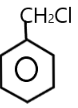
The carbocation of this structure is $1^\circ $ . As we know that $1^\circ $ carbocation is less reactive towards $S{N_1}$ nucleophilic reaction .
( B ) $PhCl$$ \to $
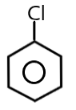
The carbocation of this structure is $2^\circ $. So as we know that $2^\circ $ carbocation is more reactive towards $S{N_1}$ nucleophilic reaction than the $1^\circ $ carbocation .
( C ) $PhCHCl(C{H_3})$ $ \to $
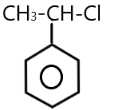
The carbocation of this structure is $2^\circ $ . So $2^\circ $ carbocation is more reactive towards $S{N_1}$ nucleophilic reaction than the $1^\circ $ carbocation . The presence of methyl $ - C{H_3}$ group also increases the positive charge present on the central carbon atom .
( D ) $p - N{O_2}{C_6}{H_4}C{H_2}Cl$ $ \to $
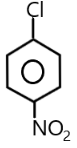
The carbocation of this structure is $1^\circ $. As we know that $1^\circ $ carbocation is least reactive towards $S{N_1}$ nucleophilic substitution reaction . The presence of an electron withdrawing group at the para position of the phenyl group also decreases the positive charge on carbocation .
So, from the above explanations we can conclude that the CORRECT answer of the above question is OPTION ( C ) .
Note: We have to remember that the order of reactivity of $S{N_1}$ nucleophilic substitution reaction depends on the degree of carbocation . Also presence of electron withdrawing group and electron donating group contributes in the reactivity towards $S{N_1}$ nucleophilic substitution reaction .
Complete step-by-step answer:$S{N_1}$reaction is the nucleophilic substitution reaction . They are the unimolecular reaction because the rate of $S{N_1}$ reaction depends only on the concentration of one reactant.
Order of reactivity of $S{N_1}$ nucleophilic substitution reaction depends on the degree of carbocation i.e; $3^\circ > 2^\circ > 1^\circ $.
Let's check the above given options :
( A ) $PhC{H_2}Cl$ $ \to $
The carbocation of this structure is $1^\circ $ . As we know that $1^\circ $ carbocation is less reactive towards $S{N_1}$ nucleophilic reaction .
( B ) $PhCl$$ \to $
The carbocation of this structure is $2^\circ $. So as we know that $2^\circ $ carbocation is more reactive towards $S{N_1}$ nucleophilic reaction than the $1^\circ $ carbocation .
( C ) $PhCHCl(C{H_3})$ $ \to $
The carbocation of this structure is $2^\circ $ . So $2^\circ $ carbocation is more reactive towards $S{N_1}$ nucleophilic reaction than the $1^\circ $ carbocation . The presence of methyl $ - C{H_3}$ group also increases the positive charge present on the central carbon atom .
( D ) $p - N{O_2}{C_6}{H_4}C{H_2}Cl$ $ \to $
The carbocation of this structure is $1^\circ $. As we know that $1^\circ $ carbocation is least reactive towards $S{N_1}$ nucleophilic substitution reaction . The presence of an electron withdrawing group at the para position of the phenyl group also decreases the positive charge on carbocation .
So, from the above explanations we can conclude that the CORRECT answer of the above question is OPTION ( C ) .
Note: We have to remember that the order of reactivity of $S{N_1}$ nucleophilic substitution reaction depends on the degree of carbocation . Also presence of electron withdrawing group and electron donating group contributes in the reactivity towards $S{N_1}$ nucleophilic substitution reaction .
Recently Updated Pages
Master Class 12 Business Studies: Engaging Questions & Answers for Success

Master Class 12 Biology: Engaging Questions & Answers for Success
Master Class 12 Chemistry: Engaging Questions & Answers for Success
Class 12 Question and Answer - Your Ultimate Solutions Guide
Master Class 11 Social Science: Engaging Questions & Answers for Success
Master Class 11 English: Engaging Questions & Answers for Success
Trending doubts
Which are the Top 10 Largest Countries of the World?
Draw a labelled sketch of the human eye class 12 physics CBSE
Name the crygenes that control cotton bollworm and class 12 biology CBSE
Differentiate between homogeneous and heterogeneous class 12 chemistry CBSE
Ribosomal RNA is actively synthesised in A Nucleoplasm class 12 biology CBSE
How many molecules of ATP and NADPH are required information class 12 biology CBSE