




The middle piece of the sperm contains
(a)Proteins
(b)Centriole
(c)Nucleus
(d)Mitochondria
Answer
 Verified
604.5k+ views
Hint: The sperm's middle portion includes an organelle that is generally referred to as the powerhouse of the cell. This organelle, according to a hypothesis, was originally a prokaryotic cell able to introduce oxidative mechanisms.
Complete answer:
There is a head, a centerpiece, and a tail in the sperm cell. The head comprises a tightly coiled chromatin fiber nucleus, surrounded anteriorly by an acrosome, containing enzymes that are used to enter the female egg. The middle piece has a central filamentous core with several spiraled mitochondria around it, used for the journey through the female cervix, uterus, and uterine tubes for ATP development. The lashing movements which propel the spermatocyte are executed by the tail or flagellum.
Between the head and the tail, the middle piece is the central part of the sperm cell. The midpiece makes up approximately 10 percent of the total sperm duration, like the head. The midpiece comprises tightly packed mitochondria that provide the energy needed for swimming, unlike the sperm head that carries genetic material.
Additional Information: The centriole is part of the sperm cell that is situated between the middle and the head. One normal centriole and one atypical centriole, such as the proximal centriole, are found in the neck or connecting portion. The centriole is involved in sperm aster and zygote aster formation in a complex known as the centriole-centrosome complex.
In addition to supplying the energy needed for swimming, it is also proposed that mitochondria play a role in apoptosis, known as regulated cell death.
So, the correct answer is, ‘Mitochondria’.
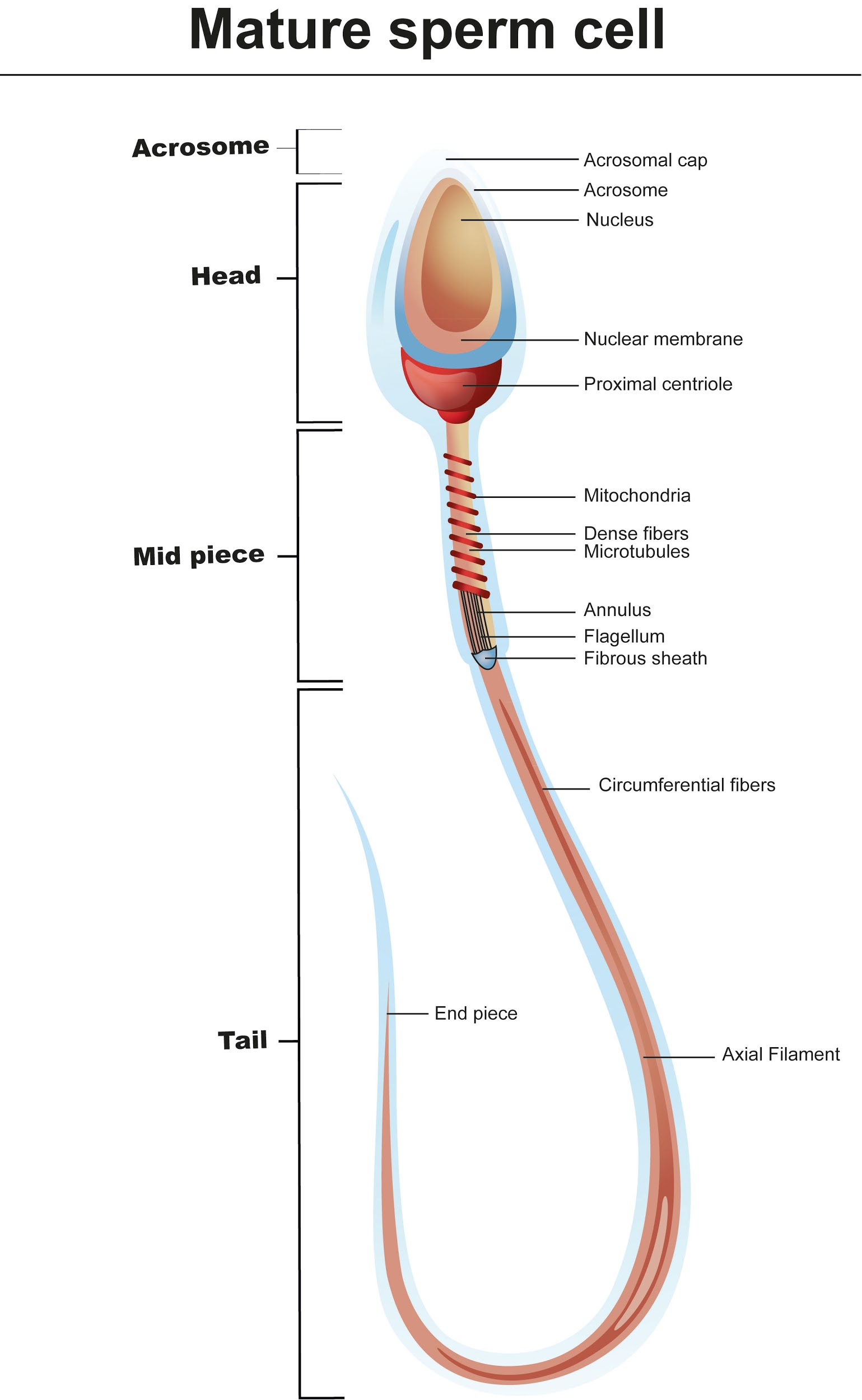
Note: The male reproductive cell, or gamete, is sperm. The main function of sperm is to enter the ovum and fuse with it to provide two subcellular structures, such as the male pronucleus containing the genetic material and the centrioles that are structures that help organize the cytoskeleton of the microtubule.
Complete answer:
There is a head, a centerpiece, and a tail in the sperm cell. The head comprises a tightly coiled chromatin fiber nucleus, surrounded anteriorly by an acrosome, containing enzymes that are used to enter the female egg. The middle piece has a central filamentous core with several spiraled mitochondria around it, used for the journey through the female cervix, uterus, and uterine tubes for ATP development. The lashing movements which propel the spermatocyte are executed by the tail or flagellum.
Between the head and the tail, the middle piece is the central part of the sperm cell. The midpiece makes up approximately 10 percent of the total sperm duration, like the head. The midpiece comprises tightly packed mitochondria that provide the energy needed for swimming, unlike the sperm head that carries genetic material.
Additional Information: The centriole is part of the sperm cell that is situated between the middle and the head. One normal centriole and one atypical centriole, such as the proximal centriole, are found in the neck or connecting portion. The centriole is involved in sperm aster and zygote aster formation in a complex known as the centriole-centrosome complex.
In addition to supplying the energy needed for swimming, it is also proposed that mitochondria play a role in apoptosis, known as regulated cell death.
So, the correct answer is, ‘Mitochondria’.
Note: The male reproductive cell, or gamete, is sperm. The main function of sperm is to enter the ovum and fuse with it to provide two subcellular structures, such as the male pronucleus containing the genetic material and the centrioles that are structures that help organize the cytoskeleton of the microtubule.
Recently Updated Pages
Master Class 12 Business Studies: Engaging Questions & Answers for Success

Master Class 12 Biology: Engaging Questions & Answers for Success
Master Class 12 Chemistry: Engaging Questions & Answers for Success
Class 12 Question and Answer - Your Ultimate Solutions Guide
Master Class 11 Social Science: Engaging Questions & Answers for Success
Master Class 11 English: Engaging Questions & Answers for Success
Trending doubts
Which is more stable and why class 12 chemistry CBSE
What are the major means of transport Explain each class 12 social science CBSE
Name the part of the flower which the tassels of the class 12 biology CBSE
The value of constant k in coulombs law is beginalign class 12 physics CBSE
Suicide bags of cells are aEndoplasmic reticulum bLysosome class 12 biology CBSE
Quantisation of charge implies a Charge does not exist class 12 physics CBSE