




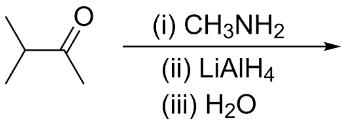
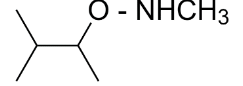
The major organic product formed from the following reaction is:
A.
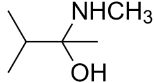
B.
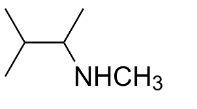
C.
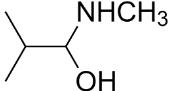
D.
Answer
 Verified
561.9k+ views
Hint:To determine the major organic product formed from the reaction, we need to know what type of reactions are taking place. We can see that the reactant ketone is first reacted with a primary amine and the product formed is further reacted with reducing agent lithium aluminum hydride.
Complete step-by-step answer:In the given reaction, the reactant is 3-methylbutan-2-one. It is a ketone and is also known as methyl isopropyl ketone. It is an uncommon solvent.
When a ketone is reacted with a primary amine, it first undergoes nucleophilic addition to give carbinolamine and then further undergoes elimination and dehydrates to form a substituted imine.
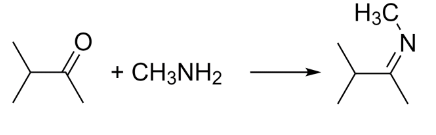
So, 3-dimethylbutan-2-imine is formed when 3-methylbutan-2-one is reacted with methylamine. This imine formed can be further reduced to an amine.
Now when a nitrile or a substituted imine is reacted with lithium aluminum hydride in the presence of water, the electrophilic carbon is attacked by the nucleophilic hydride to form an anion which is converted into a secondary amine upon addition of water.
Lithium aluminum hydride $LiAl{{H}_{4}}$ or LAH is an inorganic compound that is often used as a reducing agent, especially to reduce amides, carboxylic acids, and esters.
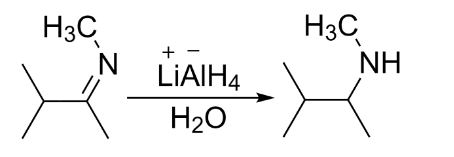
So, 3-dimethylbutan-2-amine is formed. It is a secondary amine.
The major organic product formed from the following reaction is option (B) 3-dimethylbutan-2-amine.
Note:It should be noted that the reaction between the ketone and the primary amine is carried out in an acidic buffer. This is done so that the carboxyl C=O group can be activated and the dehydration can be facilitated without the nucleophile being inhibited.
Complete step-by-step answer:In the given reaction, the reactant is 3-methylbutan-2-one. It is a ketone and is also known as methyl isopropyl ketone. It is an uncommon solvent.
When a ketone is reacted with a primary amine, it first undergoes nucleophilic addition to give carbinolamine and then further undergoes elimination and dehydrates to form a substituted imine.
So, 3-dimethylbutan-2-imine is formed when 3-methylbutan-2-one is reacted with methylamine. This imine formed can be further reduced to an amine.
Now when a nitrile or a substituted imine is reacted with lithium aluminum hydride in the presence of water, the electrophilic carbon is attacked by the nucleophilic hydride to form an anion which is converted into a secondary amine upon addition of water.
Lithium aluminum hydride $LiAl{{H}_{4}}$ or LAH is an inorganic compound that is often used as a reducing agent, especially to reduce amides, carboxylic acids, and esters.
So, 3-dimethylbutan-2-amine is formed. It is a secondary amine.
The major organic product formed from the following reaction is option (B) 3-dimethylbutan-2-amine.
Note:It should be noted that the reaction between the ketone and the primary amine is carried out in an acidic buffer. This is done so that the carboxyl C=O group can be activated and the dehydration can be facilitated without the nucleophile being inhibited.
Recently Updated Pages
Master Class 12 Business Studies: Engaging Questions & Answers for Success

Master Class 12 Chemistry: Engaging Questions & Answers for Success
Master Class 12 Biology: Engaging Questions & Answers for Success
Class 12 Question and Answer - Your Ultimate Solutions Guide
Master Class 11 Social Science: Engaging Questions & Answers for Success
Master Class 11 Chemistry: Engaging Questions & Answers for Success
Trending doubts
Which are the Top 10 Largest Countries of the World?
Draw a labelled sketch of the human eye class 12 physics CBSE
Name the crygenes that control cotton bollworm and class 12 biology CBSE
Differentiate between homogeneous and heterogeneous class 12 chemistry CBSE
How many molecules of ATP and NADPH are required information class 12 biology CBSE
In a transcription unit the promoter is said to be class 12 biology CBSE