




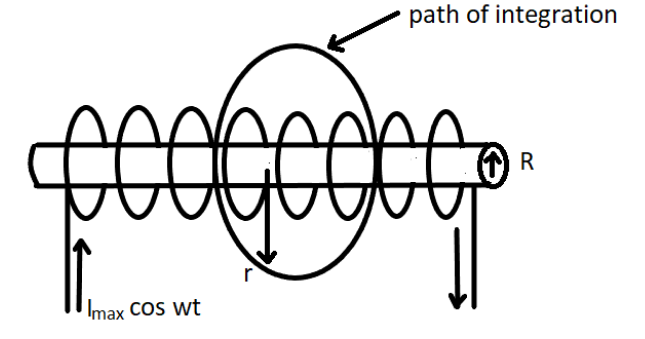
The magnitude of the induced electric field inside the solenoid, at a distance $r < R$ from its long central axis is:
A. $\dfrac{{3{\mu _0}n{I_{\max }}\omega }}{2}r\,\sin \omega t$
B. $\dfrac{{{\mu _0}n{I_{\max }}\omega }}{2}r\,\cos \omega t$
C. ${\mu _0}n{I_{\max }}\omega r\,\sin \omega t$
D. $\dfrac{{{\mu _0}n{I_{\max }}\omega }}{2}r\,\sin \omega t$
Answer
 Verified
637.2k+ views
Hint: A cylindrical coil of many tightly wound turns of insulated wire with a general diameter of the coil smaller than its length is called a solenoid. Each turn in a solenoid is regarded as a circular loop. Here, we will use the formula of faraday’s law to calculate the electric field.
Complete step by step answer:
Consider a very long solenoid having $n$ turns per unit length of the solenoid. Let the current $I$ be flowing through the solenoid.
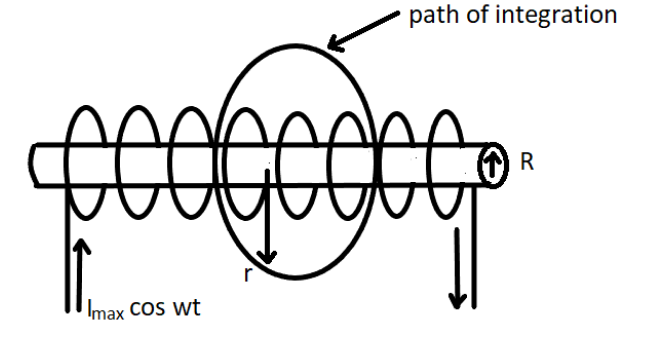
The figure above shows the magnetic field inside the solenoid is almost uniform, strong, and directed along the axis of the solenoid. Now, if the solenoid has $n$ turns than the magnetic field inside the solenoid is given by
$B = {\mu _0}nI$
Now, according to faraday’s law, the induced EMF in the solenoid is given by
$\oint {\vec E.d\vec l = \dfrac{{ - d{\phi _m}}}{{dt}}} $
Taking magnitude on both sides, we get
$\left| {\oint {\vec E.d\vec l} } \right| = \left| {\dfrac{{d{\phi _m}}}{{dt}}} \right|$
Now, flux inside the solenoid of the radius $r$ is given by
$\phi = \int {B.ds} $
Putting the value of $B$ we get
$\phi = \int {{\mu _0}nI.ds} $
$ \Rightarrow \,\phi = \,{\mu _0}nI\int {ds} $
$ \Rightarrow \,\phi = {\mu _0}nI(\pi {r^2})$
Now, putting this value of flux in the above equation, we get
$\left| {\oint {\vec E.d\vec l} } \right| = \left| {\dfrac{{d({\mu _0}nI\pi {r^2})}}{{dt}}} \right|$
$ \Rightarrow \,\vec E\oint {d\vec l\, = \left| {{\mu _0}n\pi {r^2}\dfrac{{dI}}{{dt}}} \right|} $
$ \Rightarrow \vec E(2\pi r) = \left| {{\mu _0}n{r^2}\dfrac{{d\left( {{I_{\max }}\cos \omega t} \right)}}{{dt}}} \right|$
$ \Rightarrow \vec E(2\pi r) = \left| {{\mu _0}n{r^2}{I_{\max }}\omega \,\sin \omega t} \right|$
$ \therefore \,\vec E = \dfrac{{{\mu _0}nr}}{2}{I_{\max }}\omega \sin \omega t$
Therefore, The magnitude of the induced electric field inside the solenoid, at a distance $r < R$ from its long central axis is $\dfrac{{{\mu _0}n{I_{\max }}\omega }}{2}r\sin \omega t$ .
Hence, option D is the correct option.
Note:A solenoid has an enameled wire wound which is in the form of a helix.
Therefore, we can say that a solenoid is a hollow pipe on which winding or wires is done.For an ideal solenoid in which the turns are tightly packed and their number is very large, the magnetic field at a point outside the solenoid is zero whereas the electric field is induced both inside and outside the solenoid. The induced electric field outside the solenoid will be conservative in nature which means that $curl(E) = 0$ .
Complete step by step answer:
Consider a very long solenoid having $n$ turns per unit length of the solenoid. Let the current $I$ be flowing through the solenoid.
The figure above shows the magnetic field inside the solenoid is almost uniform, strong, and directed along the axis of the solenoid. Now, if the solenoid has $n$ turns than the magnetic field inside the solenoid is given by
$B = {\mu _0}nI$
Now, according to faraday’s law, the induced EMF in the solenoid is given by
$\oint {\vec E.d\vec l = \dfrac{{ - d{\phi _m}}}{{dt}}} $
Taking magnitude on both sides, we get
$\left| {\oint {\vec E.d\vec l} } \right| = \left| {\dfrac{{d{\phi _m}}}{{dt}}} \right|$
Now, flux inside the solenoid of the radius $r$ is given by
$\phi = \int {B.ds} $
Putting the value of $B$ we get
$\phi = \int {{\mu _0}nI.ds} $
$ \Rightarrow \,\phi = \,{\mu _0}nI\int {ds} $
$ \Rightarrow \,\phi = {\mu _0}nI(\pi {r^2})$
Now, putting this value of flux in the above equation, we get
$\left| {\oint {\vec E.d\vec l} } \right| = \left| {\dfrac{{d({\mu _0}nI\pi {r^2})}}{{dt}}} \right|$
$ \Rightarrow \,\vec E\oint {d\vec l\, = \left| {{\mu _0}n\pi {r^2}\dfrac{{dI}}{{dt}}} \right|} $
$ \Rightarrow \vec E(2\pi r) = \left| {{\mu _0}n{r^2}\dfrac{{d\left( {{I_{\max }}\cos \omega t} \right)}}{{dt}}} \right|$
$ \Rightarrow \vec E(2\pi r) = \left| {{\mu _0}n{r^2}{I_{\max }}\omega \,\sin \omega t} \right|$
$ \therefore \,\vec E = \dfrac{{{\mu _0}nr}}{2}{I_{\max }}\omega \sin \omega t$
Therefore, The magnitude of the induced electric field inside the solenoid, at a distance $r < R$ from its long central axis is $\dfrac{{{\mu _0}n{I_{\max }}\omega }}{2}r\sin \omega t$ .
Hence, option D is the correct option.
Note:A solenoid has an enameled wire wound which is in the form of a helix.
Therefore, we can say that a solenoid is a hollow pipe on which winding or wires is done.For an ideal solenoid in which the turns are tightly packed and their number is very large, the magnetic field at a point outside the solenoid is zero whereas the electric field is induced both inside and outside the solenoid. The induced electric field outside the solenoid will be conservative in nature which means that $curl(E) = 0$ .
Recently Updated Pages
Which of the following graphs shows the variation of class 12 physics CBSE

Draw a labelled diagram of the human male reproductive class 12 biology CBSE
Describe the experiment to compare the emf of two cells class 12 physics CBSE
What is standard hydrogen electrode
What is conventional current and electric current class 12 physics CBSE
2Bromopentane is treated with an alcoholic KOH solution class 12 chemistry CBSE
Trending doubts
A member of Simon commission later became Prime Minister class 12 social science CBSE
What is the Full Form of PVC, PET, HDPE, LDPE, PP and PS ?
Differentiate between internal fertilization and external class 12 biology CBSE
Differentiate between lanthanoids and actinoids class 12 chemistry CBSE
Sketch and label the Malpighian body class 12 biology CBSE
State the principle of an ac generator and explain class 12 physics CBSE