




The length x of a rectangle is decreasing at a rate of 3 cm/ min and width y is increasing at a rate of 2 cm/ min. When x=10cm and y=6cm, find the rates of change of (i) the perimeter, (ii) the area of the rectangle.
Answer
 Verified
572.7k+ views
Hint: Length is x cm and breadth is y cm. Length is decreasing at a rate of 3 cm/ min which means $ \dfrac{{dx}}{{dt}} = - 3 $ , breadth is increasing at a rate of 2 cm/ min which means $ \dfrac{{dy}}{{dt}} = 2 $ . In the same way find the perimeter as a derivative and area as a derivative to find the rates of change in them.
Formulas used:
1. Perimeter of a rectangle with length l and breadth b is $ 2\left( {l + b} \right) $
2. Area of a rectangle with length l and breadth b is $ l \times b $
3. $ \dfrac{d}{{dt}}\left( {x + y} \right) = \dfrac{{dx}}{{dt}} + \dfrac{{dy}}{{dt}} $
4. $ \dfrac{d}{{dt}}\left( {xy} \right) = x\dfrac{{dy}}{{dt}} + y\dfrac{{dx}}{{dt}} $
Complete step by step solution:
We are given that the length x of a rectangle is decreasing at a rate of 3cm/ min and width y is increasing at a rate of 2cm/ min.
Length with respect to time is $ \dfrac{{dx}}{{dt}} = - 3\;cm/min $
Breadth with respect to time is $ \dfrac{{dy}}{{dt}} = 2\;cm/min $
We have to find the rates of change in perimeter and area of the rectangle.
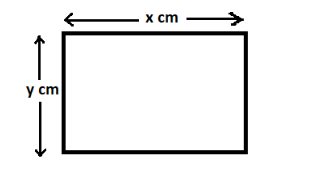
Perimeter of the rectangle is $ 2\left( {l + b} \right) $ which is
$ P = 2\left( {x + y} \right) $
Differentiating the perimeter with respect to time, we get
$ \Rightarrow \dfrac{{dP}}{{dt}} = \dfrac{d}{{dt}}2\left( {x + y} \right) $
$ \Rightarrow \dfrac{{dP}}{{dt}} = 2\left( {\dfrac{{dx}}{{dt}} + \dfrac{{dy}}{{dt}}} \right) $
$ \Rightarrow \dfrac{{dP}}{{dt}} = 2\left( { - 3 + 2} \right)\;cm/min $
$ \therefore \dfrac{{dP}}{{dt}} = - 2\;cm/min $
Therefore, the perimeter is decreasing at a rate of 2cm/ min.
Area of the rectangle is $ l \times b $ which is
$ A = x \times y $
Differentiating the area with respect to time, we get
$ \Rightarrow \dfrac{{dA}}{{dt}} = \dfrac{d}{{dt}}\left( {x \times y} \right) $
$ \Rightarrow \dfrac{{dA}}{{dt}} = x\dfrac{{dy}}{{dt}} + y\dfrac{{dx}}{{dt}} $
$ \Rightarrow \dfrac{{dA}}{{dt}} = x\left( 2 \right) + y\left( { - 3} \right) = 2x - 3y $
Given x is equal to 10cm and y is equal to 6 cm
$ \Rightarrow \dfrac{{dA}}{{dt}} = 2\left( {10} \right) - 3\left( 6 \right) = 20 - 18 = 2\;c{m^2}/min $
Therefore, the area is increasing at a rate of $ 2\;c{m^2}/min $ .
So, the correct answer is “ $ 2\;c{m^2}/min $ ”.
Note: Length and breadth of a rectangle are not equal, only opposite sides are equal. When length and breadth (all the sides) are equal, then the rectangle is considered as a square. All squares are rectangles, but all rectangles are not squares. Perimeter is the distance around the shape or the measure of its borders whereas area is the space inside the shape.
Formulas used:
1. Perimeter of a rectangle with length l and breadth b is $ 2\left( {l + b} \right) $
2. Area of a rectangle with length l and breadth b is $ l \times b $
3. $ \dfrac{d}{{dt}}\left( {x + y} \right) = \dfrac{{dx}}{{dt}} + \dfrac{{dy}}{{dt}} $
4. $ \dfrac{d}{{dt}}\left( {xy} \right) = x\dfrac{{dy}}{{dt}} + y\dfrac{{dx}}{{dt}} $
Complete step by step solution:
We are given that the length x of a rectangle is decreasing at a rate of 3cm/ min and width y is increasing at a rate of 2cm/ min.
Length with respect to time is $ \dfrac{{dx}}{{dt}} = - 3\;cm/min $
Breadth with respect to time is $ \dfrac{{dy}}{{dt}} = 2\;cm/min $
We have to find the rates of change in perimeter and area of the rectangle.
Perimeter of the rectangle is $ 2\left( {l + b} \right) $ which is
$ P = 2\left( {x + y} \right) $
Differentiating the perimeter with respect to time, we get
$ \Rightarrow \dfrac{{dP}}{{dt}} = \dfrac{d}{{dt}}2\left( {x + y} \right) $
$ \Rightarrow \dfrac{{dP}}{{dt}} = 2\left( {\dfrac{{dx}}{{dt}} + \dfrac{{dy}}{{dt}}} \right) $
$ \Rightarrow \dfrac{{dP}}{{dt}} = 2\left( { - 3 + 2} \right)\;cm/min $
$ \therefore \dfrac{{dP}}{{dt}} = - 2\;cm/min $
Therefore, the perimeter is decreasing at a rate of 2cm/ min.
Area of the rectangle is $ l \times b $ which is
$ A = x \times y $
Differentiating the area with respect to time, we get
$ \Rightarrow \dfrac{{dA}}{{dt}} = \dfrac{d}{{dt}}\left( {x \times y} \right) $
$ \Rightarrow \dfrac{{dA}}{{dt}} = x\dfrac{{dy}}{{dt}} + y\dfrac{{dx}}{{dt}} $
$ \Rightarrow \dfrac{{dA}}{{dt}} = x\left( 2 \right) + y\left( { - 3} \right) = 2x - 3y $
Given x is equal to 10cm and y is equal to 6 cm
$ \Rightarrow \dfrac{{dA}}{{dt}} = 2\left( {10} \right) - 3\left( 6 \right) = 20 - 18 = 2\;c{m^2}/min $
Therefore, the area is increasing at a rate of $ 2\;c{m^2}/min $ .
So, the correct answer is “ $ 2\;c{m^2}/min $ ”.
Note: Length and breadth of a rectangle are not equal, only opposite sides are equal. When length and breadth (all the sides) are equal, then the rectangle is considered as a square. All squares are rectangles, but all rectangles are not squares. Perimeter is the distance around the shape or the measure of its borders whereas area is the space inside the shape.
Recently Updated Pages
Master Class 12 Economics: Engaging Questions & Answers for Success

Master Class 12 Physics: Engaging Questions & Answers for Success
Master Class 12 English: Engaging Questions & Answers for Success
Master Class 12 Social Science: Engaging Questions & Answers for Success
Master Class 12 Maths: Engaging Questions & Answers for Success
Master Class 12 Business Studies: Engaging Questions & Answers for Success
Trending doubts
Which are the Top 10 Largest Countries of the World?
What are the major means of transport Explain each class 12 social science CBSE
Draw a labelled sketch of the human eye class 12 physics CBSE
What is a transformer Explain the principle construction class 12 physics CBSE
Why cannot DNA pass through cell membranes class 12 biology CBSE
Differentiate between insitu conservation and exsitu class 12 biology CBSE