




The lateral surface area of a cylinder is equal to:-
A. \[2\pi {{r}^{2}}\]
B. \[2\pi r{{h}^{2}}\]
C. \[2\pi rh\]
D. None
Answer
 Verified
628.5k+ views
Hint: Lateral surface area is also known as curved surface area. It is generally asked to find out the curved surface area or the lateral surface area for a solid which has a curved surface such as cylinder, cone, sphere, hemisphere, etc.
Complete step-by-step answer:
As mentioned in the hint that lateral surface area is also known as curved surface area and we are asked in general, to find out the curved surface area or the lateral surface area for a solid which has a curved surface such as cylinder, cone, sphere, hemisphere, etc.
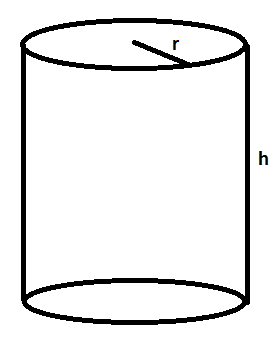
Now, we know that on rolling a rectangular sheet of paper we get a solid figure. This figure is nothing but a cylinder which is open from the top and bottom.
Now, as we are concerned just with the lateral or the curved surface of the solid so we can avoid the top and bottom surfaces for now.
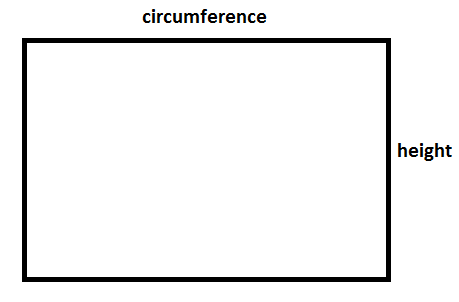
Now, as we know that the open cylinder is formed from the rectangular sheet of paper, we also know that the height of the cylinder is equal to the breadth of the rectangular sheet and the circumference of the cross section of the cylinder is formed of the entire length of the same rectangle.
If we now see closely, we will notice that if we know the area of that rectangular sheet, then we also know the lateral surface area of the cylinder.
Let the breadth of the sheet be ‘h’ and the length of it be \[2\pi r\] .
Now, we know that area of a rectangle is
\[\begin{align}
& length\times breadth \\
& So,\ 2\pi r\times h \\
& 2\pi rh \\
\end{align}\]
Hence, the lateral surface area of the cylinder is \[2\pi rh\] .
Note: - We could have done the question other way round as well by considering an open cylinder with radius ‘r’ and height ‘h’ and then cutting the cylinder open and then forming a rectangular sheet from it with the breadth of the sheet as ‘h’ and the length of it as \[2\pi r\].
Complete step-by-step answer:
As mentioned in the hint that lateral surface area is also known as curved surface area and we are asked in general, to find out the curved surface area or the lateral surface area for a solid which has a curved surface such as cylinder, cone, sphere, hemisphere, etc.
Now, we know that on rolling a rectangular sheet of paper we get a solid figure. This figure is nothing but a cylinder which is open from the top and bottom.
Now, as we are concerned just with the lateral or the curved surface of the solid so we can avoid the top and bottom surfaces for now.
Now, as we know that the open cylinder is formed from the rectangular sheet of paper, we also know that the height of the cylinder is equal to the breadth of the rectangular sheet and the circumference of the cross section of the cylinder is formed of the entire length of the same rectangle.
If we now see closely, we will notice that if we know the area of that rectangular sheet, then we also know the lateral surface area of the cylinder.
Let the breadth of the sheet be ‘h’ and the length of it be \[2\pi r\] .
Now, we know that area of a rectangle is
\[\begin{align}
& length\times breadth \\
& So,\ 2\pi r\times h \\
& 2\pi rh \\
\end{align}\]
Hence, the lateral surface area of the cylinder is \[2\pi rh\] .
Note: - We could have done the question other way round as well by considering an open cylinder with radius ‘r’ and height ‘h’ and then cutting the cylinder open and then forming a rectangular sheet from it with the breadth of the sheet as ‘h’ and the length of it as \[2\pi r\].
Recently Updated Pages
Master Class 11 Social Science: Engaging Questions & Answers for Success

Master Class 11 Physics: Engaging Questions & Answers for Success
Master Class 11 Maths: Engaging Questions & Answers for Success
Master Class 11 Economics: Engaging Questions & Answers for Success
Master Class 11 Computer Science: Engaging Questions & Answers for Success
Master Class 11 Chemistry: Engaging Questions & Answers for Success
Trending doubts
Discuss the various forms of bacteria class 11 biology CBSE
Draw a diagram of nephron and explain its structur class 11 biology CBSE
What organs are located on the left side of your body class 11 biology CBSE
Draw a labelled diagram showing structure of LS of class 11 biology CBSE
How many rings are present in MEDTA+n class 11 chemistry CBSE
Draw the molecular orbital diagram of N2N2 + N2 Write class 11 chemistry CBSE