




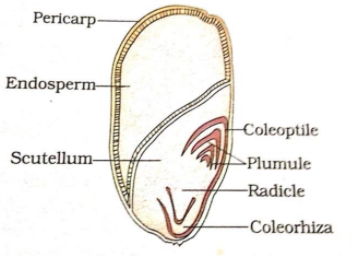
Draw a labelled diagram showing structure of L.S of Maize grain.
Answer
 Verified
617.7k+ views
Hint:A maize grain is a single-seeded fruit of which it is difficult to distinguish the seed coat and the fruit wall. A invisible, thin, whitish, deltoid region is seen to be separately marked out from the region on one side of the grain. The embryo in this region is embedded. The entire grain is covered by just a thin layer.
Complete answer:
During the rainy season, in India the maize grain is a sturdy annual plant cultivated for grains. In certain parts of India, it is a staple food. The roots are of the adventitious fibrous kind. After germination, the primary root dies and is replaced by fibrous adventitious ones from the stem base.
The grain of maize is a small-seeded fruit named caryopsis. The seed coat (testa) is merged with the fruit wall (pericarp) of the maize crop. The maize grain is externally yellow in colour and slightly triangular in shape, with the following:
The entire grain is covered by a thin layer. This layer consists of a seed-coat and a pericarp.
Maize grain is covered by a membrane called epithelium and consists of two separate parts. The greater part, the yellowish or whitish is the endosperm which is the grain's food storage tissue and is rich in starch. But the outermost layer only includes protein and is referred to as the layer of aleurone.
The embryo consists of one cotyledon, wide and shield-shaped. In the case of maize and other cereals, this is often recognised as scutellum. The embryo's axis is found in the scutellum. The axis is made up of the upper part called plumule and the lower end called radicle. Both the radicle and the plumule are enclosed in a coleoptile sheath and are known as coleorhiza which covers the radicle.
Note:We get to the germ by drilling deeper into the maize crop. As a source of oil, fibre and vitamins in the grain, a germ is essential. Over time, the oils inside the germ will oxidise and become rancid.
Complete answer:
During the rainy season, in India the maize grain is a sturdy annual plant cultivated for grains. In certain parts of India, it is a staple food. The roots are of the adventitious fibrous kind. After germination, the primary root dies and is replaced by fibrous adventitious ones from the stem base.
The grain of maize is a small-seeded fruit named caryopsis. The seed coat (testa) is merged with the fruit wall (pericarp) of the maize crop. The maize grain is externally yellow in colour and slightly triangular in shape, with the following:
The entire grain is covered by a thin layer. This layer consists of a seed-coat and a pericarp.
Maize grain is covered by a membrane called epithelium and consists of two separate parts. The greater part, the yellowish or whitish is the endosperm which is the grain's food storage tissue and is rich in starch. But the outermost layer only includes protein and is referred to as the layer of aleurone.
The embryo consists of one cotyledon, wide and shield-shaped. In the case of maize and other cereals, this is often recognised as scutellum. The embryo's axis is found in the scutellum. The axis is made up of the upper part called plumule and the lower end called radicle. Both the radicle and the plumule are enclosed in a coleoptile sheath and are known as coleorhiza which covers the radicle.
Note:We get to the germ by drilling deeper into the maize crop. As a source of oil, fibre and vitamins in the grain, a germ is essential. Over time, the oils inside the germ will oxidise and become rancid.
Recently Updated Pages
Master Class 11 English: Engaging Questions & Answers for Success

Master Class 11 Social Science: Engaging Questions & Answers for Success
Master Class 11 Maths: Engaging Questions & Answers for Success
Master Class 11 Biology: Engaging Questions & Answers for Success
Master Class 11 Physics: Engaging Questions & Answers for Success
Master Class 11 Chemistry: Engaging Questions & Answers for Success
Trending doubts
One Metric ton is equal to kg A 10000 B 1000 C 100 class 11 physics CBSE
Difference Between Prokaryotic Cells and Eukaryotic Cells
1 ton equals to A 100 kg B 1000 kg C 10 kg D 10000 class 11 physics CBSE
Find the value of the expression given below sin 30circ class 11 maths CBSE
Two of the body parts which do not appear in MRI are class 11 biology CBSE
What are hard magnetic materials class 11 physics CBSE