




The IUPAC name of the given structure is:
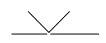
(a) tertiary butane
(b) 2,2-dimethylpropane
(c) neopentane
(d) neobutane
Answer
 Verified
601.8k+ views
Hint: While writing the IUPAC name of any compound, we will first identify the longest carbon chain and we will start numbering from that carbon from which the attached substituent is nearest and the substituent name is written first while writing the IUPAC name and ane, ene or yne is added as suffix if there is -C-C , -C=C or carbon triple bond carbon respectively. Now write the name of the compound.
Complete step by step solution: The IUPAC stands for the International Union of Pure and Applied Chemistry and it is the method that is used for the naming of the organic or inorganic compounds and the compounds are known by their IUPAC naming all over.
First of all, write the structural formula of the given compound as;
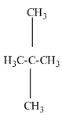
The compound belongs to the category of alkanes having carbon-carbon single bond present in it.
In the IUPAC naming of the alkane, the suffix ane is added at the end of the IUPAC name.
While naming , we have to first choose the longest carbon chain and label that carbon as number 1 from which the substituents that are attached is the closest and mark the labelling on the carbon atoms as 1,2,3---and so on like:
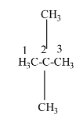
After that, we will look at the attached substituents and write the name of the substituent first . In the given compound, we can see that there are two methyl groups which are attached as the substituents , so we will write them as dimethyl and to dignify their position to which carbon atom they are attached , we will them as 2,2-dimethyl in the IUPAC naming.
Since, the carbon chain consists of three carbon atoms and there are no double and triple bond in it, so the prefix is prop (C=3) and suffix is ane(C-C) and the carbon chain is named as propane.
So, now the IUPAC name of the compound is:
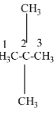
is; 2,2- dimethylpropane.
Thus, the IUPAC name of the given structure is:

2,2-dimethylpropane
Hence, option(b ) is correct.
Note: While labelling the carbon chain keep in mind, the chosen carbon should be the longest in the given compound and in that carbon chain also start the numbering from that carbon from where the attached functional groups are the nearest.
Complete step by step solution: The IUPAC stands for the International Union of Pure and Applied Chemistry and it is the method that is used for the naming of the organic or inorganic compounds and the compounds are known by their IUPAC naming all over.
First of all, write the structural formula of the given compound as;
The compound belongs to the category of alkanes having carbon-carbon single bond present in it.
In the IUPAC naming of the alkane, the suffix ane is added at the end of the IUPAC name.
While naming , we have to first choose the longest carbon chain and label that carbon as number 1 from which the substituents that are attached is the closest and mark the labelling on the carbon atoms as 1,2,3---and so on like:
After that, we will look at the attached substituents and write the name of the substituent first . In the given compound, we can see that there are two methyl groups which are attached as the substituents , so we will write them as dimethyl and to dignify their position to which carbon atom they are attached , we will them as 2,2-dimethyl in the IUPAC naming.
Since, the carbon chain consists of three carbon atoms and there are no double and triple bond in it, so the prefix is prop (C=3) and suffix is ane(C-C) and the carbon chain is named as propane.
So, now the IUPAC name of the compound is:
is; 2,2- dimethylpropane.
Thus, the IUPAC name of the given structure is:
2,2-dimethylpropane
Hence, option(b ) is correct.
Note: While labelling the carbon chain keep in mind, the chosen carbon should be the longest in the given compound and in that carbon chain also start the numbering from that carbon from where the attached functional groups are the nearest.
Recently Updated Pages
If x a + bt + ct2 where x is in meters and t is in class 11 physics CBSE

A car covers the first half distance between two places class 11 physics CBSE
The resultant of two vectors overrightarrow P and overrightarrow class 11 physics CBSE
Find the value of cos 135 class 11 maths CBSE
A mass M is held in place by an applied force F and class 11 physics CBSE
A solution of glucose in water is labelled as 10 dfracwv class 11 chemistry CBSE
Trending doubts
Find the value of the expression given below sin 30circ class 11 maths CBSE
One Metric ton is equal to kg A 10000 B 1000 C 100 class 11 physics CBSE
Draw a diagram of nephron and explain its structur class 11 biology CBSE
10 examples of friction in our daily life
Proton was discovered by A Thomson B Rutherford C Chadwick class 11 chemistry CBSE
Bond order ofO2 O2+ O2 and O22 is in order A O2 langle class 11 chemistry CBSE