




The hybridization of iron in ${K_4}[Fe{(CN)_6}]$ is?
(A) $ds{p^2}$
(B) $s{p^3}$
(C) ${d^2}s{p^3}$
(D) ${d^2}s{p^2}$
Answer
 Verified
602.4k+ views
Hint: First find out the oxidation state of iron in the complex and write its electronic configuration. Arrange the atoms keeping in mind that it is attached to a strong field ligand. Now see which orbitals will be involved in bonding with the ligand and accordingly see the hybridisation.
Complete step by step answer:
-First of all we will find out the oxidation state of Fe in the complex ${K_4}[Fe{(CN)_6}]$.
For any complex compound its overall charge is always equal to the sum of the oxidation states of all the constituent atoms and ligands.
The overall charge on the given complex is = 0
Oxidation state of ligand (CN) is = (-1)
Oxidation state of K here = (+1)
Let the oxidation state of Fe here be = x
So, O.S. of complex = 4(O.S. of K) + O.S. of Fe + 6(O.S. state of CN)
0 = 4 (+1) + x + 6 (-1)
0 = 4 + x – 6
x = +2
Here the oxidation state of iron is +2 .
-We know that atomic number of Fe is 26 and hence its electronic configuration in neutral state will be: $\left[ {Ar} \right]3{d^6}4{s^2}$
When iron exists as $F{e^{ + 2}}$ it has a configuration of: $\left[ {Ar} \right]3{d^6}$ and the orbitals split into eg and t2g orbitals with eg at higher energy than t2g.
-In the complex we can see that iron has a coordination number of 6 and the ligand attached to it which is $C{N^ - }$ is a strong field ligand and thus causes pairing of the electrons in the d subshell and so the 6 electrons from the 3d subshell accommodate in just the 3 t2g orbitals as shown below:
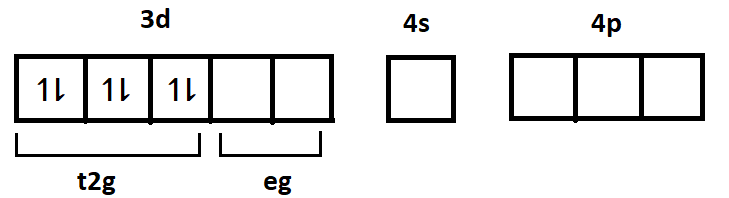
The remaining 2 orbitals from d subshell (e.g. orbitals) will participate in hybridisation. Since the coordination number of iron here is 6 and the ligand is cyanide ion ($C{N^ - }$), the 6 cyanide ions will donate their electron pair and get attached with the 2 ‘3d’ orbitals, 1 ‘4s’ orbital and 3 ‘4p’ orbitals ahead to form the complex. Hence the hybridisation of iron in this complex will be ${d^2}s{p^3}$.
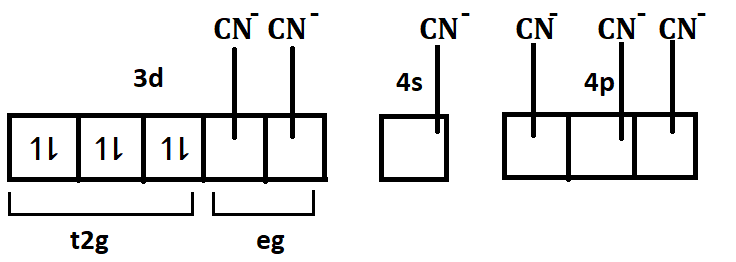
The correct option will be: (C) ${d^2}s{p^3}$
Note: Ligands which cause a large splitting are known as strong field ligands (like CO, $C{N^ - }$, $NO_2^ - $, etc), while those which cause small splitting are known as weak field ligands (like $C{l^ - }$, $B{r^ - }$, ${F^ - }$, etc). Due to the large splitting energy, the strong field ligands cause pairing of the electrons, since large energy input will be required for the electrons to pass this energy barrier.
Complete step by step answer:
-First of all we will find out the oxidation state of Fe in the complex ${K_4}[Fe{(CN)_6}]$.
For any complex compound its overall charge is always equal to the sum of the oxidation states of all the constituent atoms and ligands.
The overall charge on the given complex is = 0
Oxidation state of ligand (CN) is = (-1)
Oxidation state of K here = (+1)
Let the oxidation state of Fe here be = x
So, O.S. of complex = 4(O.S. of K) + O.S. of Fe + 6(O.S. state of CN)
0 = 4 (+1) + x + 6 (-1)
0 = 4 + x – 6
x = +2
Here the oxidation state of iron is +2 .
-We know that atomic number of Fe is 26 and hence its electronic configuration in neutral state will be: $\left[ {Ar} \right]3{d^6}4{s^2}$
When iron exists as $F{e^{ + 2}}$ it has a configuration of: $\left[ {Ar} \right]3{d^6}$ and the orbitals split into eg and t2g orbitals with eg at higher energy than t2g.
-In the complex we can see that iron has a coordination number of 6 and the ligand attached to it which is $C{N^ - }$ is a strong field ligand and thus causes pairing of the electrons in the d subshell and so the 6 electrons from the 3d subshell accommodate in just the 3 t2g orbitals as shown below:
The remaining 2 orbitals from d subshell (e.g. orbitals) will participate in hybridisation. Since the coordination number of iron here is 6 and the ligand is cyanide ion ($C{N^ - }$), the 6 cyanide ions will donate their electron pair and get attached with the 2 ‘3d’ orbitals, 1 ‘4s’ orbital and 3 ‘4p’ orbitals ahead to form the complex. Hence the hybridisation of iron in this complex will be ${d^2}s{p^3}$.
The correct option will be: (C) ${d^2}s{p^3}$
Note: Ligands which cause a large splitting are known as strong field ligands (like CO, $C{N^ - }$, $NO_2^ - $, etc), while those which cause small splitting are known as weak field ligands (like $C{l^ - }$, $B{r^ - }$, ${F^ - }$, etc). Due to the large splitting energy, the strong field ligands cause pairing of the electrons, since large energy input will be required for the electrons to pass this energy barrier.
Recently Updated Pages
Master Class 12 Social Science: Engaging Questions & Answers for Success

Master Class 12 Physics: Engaging Questions & Answers for Success
Master Class 12 Maths: Engaging Questions & Answers for Success
Master Class 12 Economics: Engaging Questions & Answers for Success
Master Class 12 Chemistry: Engaging Questions & Answers for Success
Master Class 12 Business Studies: Engaging Questions & Answers for Success
Trending doubts
Which are the Top 10 Largest Countries of the World?
Draw a labelled sketch of the human eye class 12 physics CBSE
Explain the structure of megasporangium class 12 biology CBSE
What are the major means of transport Explain each class 12 social science CBSE
How many chromosomes are found in human ovum a 46 b class 12 biology CBSE
The diagram of the section of a maize grain is given class 12 biology CBSE