




The graph of Kinetic Energy (K) of a body versus velocity (v) is represented as
(A) Hyperbola
(B) Parabola
(C) Straight line
(D) None of these
Answer
 Verified
608.7k+ views
Hint
The kinetic energy of a body moving in a straight line is directly proportional to the square of its velocity. This also implies that it has a graph whose slope is not constant.
Formula used: $ K = \dfrac{1}{2}m{v^2} $ where $ m $ is the mass of the body and $ v $ is the velocity of its motion.
Complete step by step answer
Firstly, let us write down the formula for kinetic energy
$\Rightarrow K = \dfrac{1}{2}m{v^2} $ where $ m $ is the mass of the body and $ v $ is the velocity of its motion.
For a graph of $ K $ versus $ v $, $ K $ is analogous to $ y $ and $ v $ is analogous to $ x $.
Thus, can be written representatively as $ y = a{x^2} $ where $ a $ is a constant equal to $ \dfrac{1}{2}m $.
Now, we compare each of the types of graph given in the option
First, the hyperbola:
The algebraic equation of a hyperbola centered at the origin is given as:
$\Rightarrow \dfrac{{{x^2}}}{{{a^2}}} - \dfrac{{{y^2}}}{{{b^2}}} = 1 $ where $ a $ and $ b $ are constants.
Comparing this equation to $ y = a{x^2} $ it can be observed that no form of algebraic manipulation will make them the same since the variable $ y $ doesn’t have the same exponent. Thus, we can rule it out.
Next, we compare it to that of a parabola:
Equation of a parabola at the origin can be given as:
$\Rightarrow y = 4p{x^2} $ where $ p $ is a constant
Comparing this to equation $ y = a{x^2} $, we can see that they are identical if we make $ a = 4p $. Thus, the equations are both equations of a parabola. In fact, $ y = 4p{x^2} $ is only called the focal point form while $ y = a{x^2} $ is called the Cartesian form.
The equation of a straight line is $ y = ax $. Comparing this with $ y = a{x^2} $ we also see that the exponent of $ x $ is not the same in the two equations. Thus, can be ruled out.
Therefore, we can conclude that the graph of kinetic energy versus velocity is represented by a parabola.
Hence, the correct option is B.
Note
Alternatively, we can actually compare the graphs each with a sketch of $ K $ against $ v $.
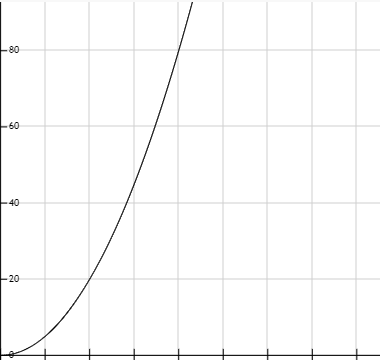
A quick sketch of $ K $ against $ v $ will give something similar to the graph below
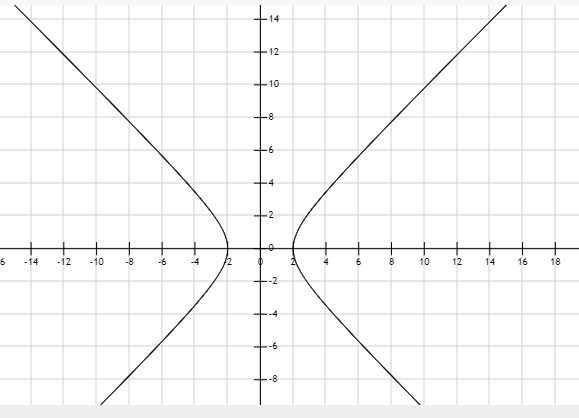
For hyperbola:
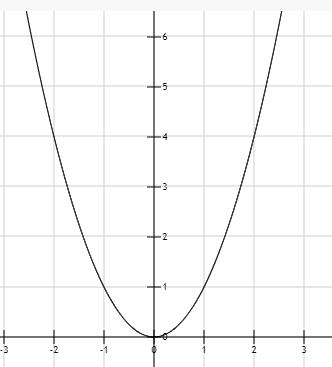
For parabola:
And for straight line:
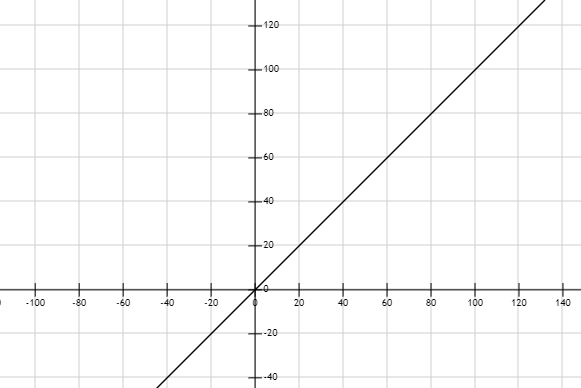
Comparing the graphs with the sketch of kinetic energy, we see that the most matching graph is that of the parabola but with the x-axis cut off.
The kinetic energy of a body moving in a straight line is directly proportional to the square of its velocity. This also implies that it has a graph whose slope is not constant.
Formula used: $ K = \dfrac{1}{2}m{v^2} $ where $ m $ is the mass of the body and $ v $ is the velocity of its motion.
Complete step by step answer
Firstly, let us write down the formula for kinetic energy
$\Rightarrow K = \dfrac{1}{2}m{v^2} $ where $ m $ is the mass of the body and $ v $ is the velocity of its motion.
For a graph of $ K $ versus $ v $, $ K $ is analogous to $ y $ and $ v $ is analogous to $ x $.
Thus, can be written representatively as $ y = a{x^2} $ where $ a $ is a constant equal to $ \dfrac{1}{2}m $.
Now, we compare each of the types of graph given in the option
First, the hyperbola:
The algebraic equation of a hyperbola centered at the origin is given as:
$\Rightarrow \dfrac{{{x^2}}}{{{a^2}}} - \dfrac{{{y^2}}}{{{b^2}}} = 1 $ where $ a $ and $ b $ are constants.
Comparing this equation to $ y = a{x^2} $ it can be observed that no form of algebraic manipulation will make them the same since the variable $ y $ doesn’t have the same exponent. Thus, we can rule it out.
Next, we compare it to that of a parabola:
Equation of a parabola at the origin can be given as:
$\Rightarrow y = 4p{x^2} $ where $ p $ is a constant
Comparing this to equation $ y = a{x^2} $, we can see that they are identical if we make $ a = 4p $. Thus, the equations are both equations of a parabola. In fact, $ y = 4p{x^2} $ is only called the focal point form while $ y = a{x^2} $ is called the Cartesian form.
The equation of a straight line is $ y = ax $. Comparing this with $ y = a{x^2} $ we also see that the exponent of $ x $ is not the same in the two equations. Thus, can be ruled out.
Therefore, we can conclude that the graph of kinetic energy versus velocity is represented by a parabola.
Hence, the correct option is B.
Note
Alternatively, we can actually compare the graphs each with a sketch of $ K $ against $ v $.
A quick sketch of $ K $ against $ v $ will give something similar to the graph below
For hyperbola:
For parabola:
And for straight line:
Comparing the graphs with the sketch of kinetic energy, we see that the most matching graph is that of the parabola but with the x-axis cut off.
Recently Updated Pages
Master Class 11 English: Engaging Questions & Answers for Success

Master Class 11 Social Science: Engaging Questions & Answers for Success
Master Class 11 Maths: Engaging Questions & Answers for Success
Master Class 11 Biology: Engaging Questions & Answers for Success
Master Class 11 Physics: Engaging Questions & Answers for Success
Master Class 11 Chemistry: Engaging Questions & Answers for Success
Trending doubts
One Metric ton is equal to kg A 10000 B 1000 C 100 class 11 physics CBSE
Difference Between Prokaryotic Cells and Eukaryotic Cells
1 ton equals to A 100 kg B 1000 kg C 10 kg D 10000 class 11 physics CBSE
Find the value of the expression given below sin 30circ class 11 maths CBSE
Two of the body parts which do not appear in MRI are class 11 biology CBSE
What are hard magnetic materials class 11 physics CBSE