




The graph between u and v for the convex mirror is
A.
B.
C.
D.
Answer
 Verified
597.3k+ views
Hint: We will define the terms used in the graphs given, as the graph depends on these parameters. Taking into consideration the convex mirror, we will find the
relation between these terms and the distance at which the image gets formed.
Complete answer:
The terms used are: “u”, “v” and “f”.
“u” – The distance between the object and the pole of the mirror is called the object distance.
“v” – The distance between the image formed and the pole of the mirror is called the image distance.
“f” – The distance between the principal focus and the pole of the mirror is called the focal length or the focus.
We will trace out the graph by changing the positions of the object.
The object will be placed on the left side of the mirror. So, the position of the object will be considered to be negative, whereas, the image gets formed on the right side of the mirror, so, the position of the image will be considered to be positive.
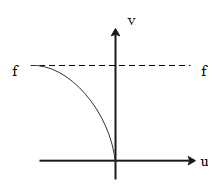
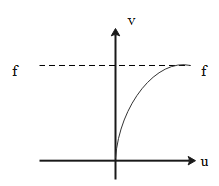
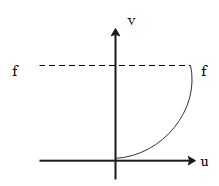
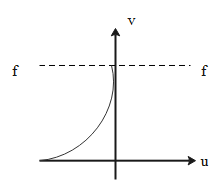
Let the object be placed at infinity, that is, \[(-\infty )\], the parallel rays hit the mirror and the image gets formed at the focus. The distance between the parallel plane and the rays passing through the mirror decreases as the position of the object with respect to the mirror decreases. Finally, when the object distance tends to zero, the image distance also tends to zero.
This nature of the graph is defined by the graph of (A).
\[\therefore \] As the graph (A) defines the graph between u and v for the convex mirror.
Thus, option (A) is correct.
Note:
The position of the formation of the image per change in the position of the object placed in front of the mirror gives the curve for the graph of u versus v. As we keep on tracing the formation of the image, we will get the required graph, even in the case of a concave mirror.
relation between these terms and the distance at which the image gets formed.
Complete answer:
The terms used are: “u”, “v” and “f”.
“u” – The distance between the object and the pole of the mirror is called the object distance.
“v” – The distance between the image formed and the pole of the mirror is called the image distance.
“f” – The distance between the principal focus and the pole of the mirror is called the focal length or the focus.
We will trace out the graph by changing the positions of the object.
The object will be placed on the left side of the mirror. So, the position of the object will be considered to be negative, whereas, the image gets formed on the right side of the mirror, so, the position of the image will be considered to be positive.
Let the object be placed at infinity, that is, \[(-\infty )\], the parallel rays hit the mirror and the image gets formed at the focus. The distance between the parallel plane and the rays passing through the mirror decreases as the position of the object with respect to the mirror decreases. Finally, when the object distance tends to zero, the image distance also tends to zero.
This nature of the graph is defined by the graph of (A).
\[\therefore \] As the graph (A) defines the graph between u and v for the convex mirror.
Thus, option (A) is correct.
Note:
The position of the formation of the image per change in the position of the object placed in front of the mirror gives the curve for the graph of u versus v. As we keep on tracing the formation of the image, we will get the required graph, even in the case of a concave mirror.
Recently Updated Pages
Explain the structure of megasporangium class 12 biology CBSE

Why is chloroform kept in dark coloured bottles class 12 chemistry CBSE
Derive the balancing condition of a Wheatstone bri class 12 physics CBSE
Draw VI characteristics of a pn junction diode Explain class 12 physics CBSE
Is it possible to carry pride in ones language too class 12 english CBSE
In a population at Hardy Weinberg equilibrium the allele class 12 biology CBSE
Trending doubts
Draw a labelled sketch of the human eye class 12 physics CBSE
Which are the Top 10 Largest Countries of the World?
Draw ray diagrams each showing i myopic eye and ii class 12 physics CBSE
Which is the correct genotypic ratio of mendel dihybrid class 12 biology CBSE
Differentiate between homogeneous and heterogeneous class 12 chemistry CBSE
Which animal never drinks water in its entire life class 12 biology CBSE