




The fraction of the volume of a glass flask that must be filled with mercury so that the volume of the empty space may be the same at all temperatures is given by $ ({{\alpha }_{glass}}=9\times {{10}^{-6}}/{}^\circ C,\,{{\gamma }_{Hg}}=18.9\times {{10}^{-5}}/{}^\circ C) $
(A) $ \dfrac{1}{2} $
(B) $ \dfrac{1}{7} $
(C) $ \dfrac{1}{4} $
(D) $ \dfrac{1}{5} $
Answer
 Verified
582.3k+ views
Hint
The volumetric expansion formula should be used to carry out the calculation. As the volume of the empty space remains the same, thus, we have to equate the change in volume of glass flask and that of the mercury to find the fraction of the volume of the glass flask.
$ \Delta V = V\gamma \Delta T $
Where, $ \Delta V $ is the change in volume, $ \gamma $ is a volumetric coefficient and $ \Delta T $ is the change in temperature.
Complete step by step solution
The question states that the volume of the empty space of the glass vessel will be at all temperatures when the volume of the mercury after expansion equals the volume of the glass flask after expansion.
Now we will express this statement in terms of the equations.
So, the expression used to represent the change in the volume is given as follows.
$ \Delta V = V\gamma \Delta T $
As the temperature remains the same, thus, the equation can be reduced to the form, $ {V_0}\gamma $
The diagram representing the glass flask filled with the mercury is as follows.
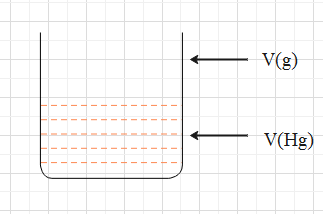
Now equate the expressions of mercury and glass flask.
$ {V_g}{\alpha _g} = {V_{Hg}}{\gamma _{Hg}} $ …… (1)
As $ {\alpha _g} $ is a linear coefficient, it should be converted to the volumetric coefficient, as the problem is all about the volumetric expansion.
So, the equation that converts linear to volumetric coefficient is as follows
$ \gamma = 3\alpha $
Substitute this value in the equation (1), to carry out the further calculations.
So, we get,
$
{V_g}(3{\alpha _g}) = {V_{Hg}}{\gamma _{Hg}} \\
\Rightarrow 3{V_g}{\alpha _g} = {V_{Hg}}{\gamma _{Hg}} \\
$
Now substitute the given values in the above equation.
$
\Rightarrow 3 \times {V_g} \times 9 \times {10^{ - 6}} = {V_{Hg}} \times 18.9 \times {10^{ - 5}} \\
\Rightarrow \dfrac{{{V_{Hg}}}}{{{V_g}}} = \dfrac{{27 \times {{10}^{ - 6}}}}{{189 \times {{10}^{ - 6}}}} \\
$
Upon further carrying out the calculations, we get,
$
\Rightarrow \dfrac{{{V_{Hg}}}}{{{V_g}}} = \dfrac{{27}}{{189}} \\
\Rightarrow \dfrac{{{V_{Hg}}}}{{{V_g}}} = \dfrac{1}{7} \\
$
$ \therefore $ The fraction of the volume of a glass flask that must be filled with mercury so that the volume of the empty space may be the same at all temperatures is given by $ \dfrac{1}{7} $ .
Thus, the option (B) is correct.
Note
Being an important part of the calculation, the conversion of the linear coefficient to the volumetric coefficient should be taken care of, as the whole calculation is based on finding the change in the volumetric expansion.
The volumetric expansion formula should be used to carry out the calculation. As the volume of the empty space remains the same, thus, we have to equate the change in volume of glass flask and that of the mercury to find the fraction of the volume of the glass flask.
$ \Delta V = V\gamma \Delta T $
Where, $ \Delta V $ is the change in volume, $ \gamma $ is a volumetric coefficient and $ \Delta T $ is the change in temperature.
Complete step by step solution
The question states that the volume of the empty space of the glass vessel will be at all temperatures when the volume of the mercury after expansion equals the volume of the glass flask after expansion.
Now we will express this statement in terms of the equations.
So, the expression used to represent the change in the volume is given as follows.
$ \Delta V = V\gamma \Delta T $
As the temperature remains the same, thus, the equation can be reduced to the form, $ {V_0}\gamma $
The diagram representing the glass flask filled with the mercury is as follows.
Now equate the expressions of mercury and glass flask.
$ {V_g}{\alpha _g} = {V_{Hg}}{\gamma _{Hg}} $ …… (1)
As $ {\alpha _g} $ is a linear coefficient, it should be converted to the volumetric coefficient, as the problem is all about the volumetric expansion.
So, the equation that converts linear to volumetric coefficient is as follows
$ \gamma = 3\alpha $
Substitute this value in the equation (1), to carry out the further calculations.
So, we get,
$
{V_g}(3{\alpha _g}) = {V_{Hg}}{\gamma _{Hg}} \\
\Rightarrow 3{V_g}{\alpha _g} = {V_{Hg}}{\gamma _{Hg}} \\
$
Now substitute the given values in the above equation.
$
\Rightarrow 3 \times {V_g} \times 9 \times {10^{ - 6}} = {V_{Hg}} \times 18.9 \times {10^{ - 5}} \\
\Rightarrow \dfrac{{{V_{Hg}}}}{{{V_g}}} = \dfrac{{27 \times {{10}^{ - 6}}}}{{189 \times {{10}^{ - 6}}}} \\
$
Upon further carrying out the calculations, we get,
$
\Rightarrow \dfrac{{{V_{Hg}}}}{{{V_g}}} = \dfrac{{27}}{{189}} \\
\Rightarrow \dfrac{{{V_{Hg}}}}{{{V_g}}} = \dfrac{1}{7} \\
$
$ \therefore $ The fraction of the volume of a glass flask that must be filled with mercury so that the volume of the empty space may be the same at all temperatures is given by $ \dfrac{1}{7} $ .
Thus, the option (B) is correct.
Note
Being an important part of the calculation, the conversion of the linear coefficient to the volumetric coefficient should be taken care of, as the whole calculation is based on finding the change in the volumetric expansion.
Recently Updated Pages
Master Class 12 Economics: Engaging Questions & Answers for Success

Master Class 12 Physics: Engaging Questions & Answers for Success
Master Class 12 English: Engaging Questions & Answers for Success
Master Class 12 Social Science: Engaging Questions & Answers for Success
Master Class 12 Maths: Engaging Questions & Answers for Success
Master Class 12 Business Studies: Engaging Questions & Answers for Success
Trending doubts
Which are the Top 10 Largest Countries of the World?
What are the major means of transport Explain each class 12 social science CBSE
Draw a labelled sketch of the human eye class 12 physics CBSE
What is a transformer Explain the principle construction class 12 physics CBSE
Why cannot DNA pass through cell membranes class 12 biology CBSE
Differentiate between insitu conservation and exsitu class 12 biology CBSE