




The formal charge of carbon atom in carbonate ion is-
(A) + 1
(B) - 1
(C) + 4
(D) zero
Answer
 Verified
616.8k+ views
Hint: Formal charge is only a theoretical charge over an individual atom of an ion a molecule.
To find out the answer we have to follow a simple expression formal charge of an atom \[ = \left[ {Total{\text{ }}no.{\text{ }}of{\text{ }}valence{\text{ }}electron{\text{ }}in{\text{ }}free{\text{ }}state} \right] - \left[ {Total{\text{ }}no.{\text{ }}of{\text{ }}non - bonding{\text{ }}electron} \right] - [\dfrac{{Total\,no.\,of\,bonding\,electron}}{2}]\]
Complete step by step answer:
We will have to know that formal charge of an atom is not equal to real charge of an ion or a molecule. Real charge is distributed over a polyatomic molecule or ion as a whole and not over a single atom.
Formal charge is the difference between the valence electron of that atom in Free State and the total no. of electrons assigned to that atom in Lewis dot model.
A mathematical expression to find out the formal charge of an atom is-
\[Formal\,charge = \left[ {Total{\text{ }}no.{\text{ }}of{\text{ }}valence{\text{ }}{e^ - }\,in{\text{ }}free{\text{ }}state} \right] - \left[ {Total{\text{ }}no.{\text{ }}of{\text{ }}non - bonding{\text{ }}electron} \right] - \dfrac{1}{2}[Total\,no.\,of\,bonding\,electron]\]
First, we have to know the Lewis dot structure of carbonate ions.
Which is shown below-
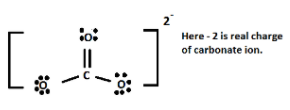
Now, we will find out the formal charge of the carbon atom.
Total no. of valence electron of electron in free state = 4
Total no. of non-bonding electron of carbon = 0
Total no of bonding electron of carbon = 8
So, the formal charge of carbon atom,
\[ = 4 - 0 - \dfrac{1}{2}[8]\]
= 4 - 4
= 0
Therefore the formal charge of the carbon atom is 0.
Hence the correct option is (D).
Note: 1. Formal charges help to select the lowest energy structure among different Lewis structures for a given species.
2. The smallest formal charges and the most distributed charges on atoms gives lowest energy structure.
To find out the answer we have to follow a simple expression formal charge of an atom \[ = \left[ {Total{\text{ }}no.{\text{ }}of{\text{ }}valence{\text{ }}electron{\text{ }}in{\text{ }}free{\text{ }}state} \right] - \left[ {Total{\text{ }}no.{\text{ }}of{\text{ }}non - bonding{\text{ }}electron} \right] - [\dfrac{{Total\,no.\,of\,bonding\,electron}}{2}]\]
Complete step by step answer:
We will have to know that formal charge of an atom is not equal to real charge of an ion or a molecule. Real charge is distributed over a polyatomic molecule or ion as a whole and not over a single atom.
Formal charge is the difference between the valence electron of that atom in Free State and the total no. of electrons assigned to that atom in Lewis dot model.
A mathematical expression to find out the formal charge of an atom is-
\[Formal\,charge = \left[ {Total{\text{ }}no.{\text{ }}of{\text{ }}valence{\text{ }}{e^ - }\,in{\text{ }}free{\text{ }}state} \right] - \left[ {Total{\text{ }}no.{\text{ }}of{\text{ }}non - bonding{\text{ }}electron} \right] - \dfrac{1}{2}[Total\,no.\,of\,bonding\,electron]\]
First, we have to know the Lewis dot structure of carbonate ions.
Which is shown below-
Now, we will find out the formal charge of the carbon atom.
Total no. of valence electron of electron in free state = 4
Total no. of non-bonding electron of carbon = 0
Total no of bonding electron of carbon = 8
So, the formal charge of carbon atom,
\[ = 4 - 0 - \dfrac{1}{2}[8]\]
= 4 - 4
= 0
Therefore the formal charge of the carbon atom is 0.
Hence the correct option is (D).
Note: 1. Formal charges help to select the lowest energy structure among different Lewis structures for a given species.
2. The smallest formal charges and the most distributed charges on atoms gives lowest energy structure.
Recently Updated Pages
Master Class 12 Economics: Engaging Questions & Answers for Success

Master Class 12 English: Engaging Questions & Answers for Success
Master Class 12 Social Science: Engaging Questions & Answers for Success
Master Class 12 Maths: Engaging Questions & Answers for Success
Master Class 12 Physics: Engaging Questions & Answers for Success
Master Class 11 Social Science: Engaging Questions & Answers for Success
Trending doubts
One Metric ton is equal to kg A 10000 B 1000 C 100 class 11 physics CBSE
Difference Between Prokaryotic Cells and Eukaryotic Cells
Find the value of the expression given below sin 30circ class 11 maths CBSE
1 ton equals to A 100 kg B 1000 kg C 10 kg D 10000 class 11 physics CBSE
Two of the body parts which do not appear in MRI are class 11 biology CBSE
Draw a diagram of nephron and explain its structur class 11 biology CBSE