




The foci of hyperbola \[9{{x}^{2}}-16{{y}^{2}}+18x+32y-151=0\] are
(a) (2, 3), (5, 7)
(b) (4, 1), (– 6, 1)
(c) (0, 0), (5, 2)
(d) None of these
Answer
 Verified
678.6k+ views
Hint:First of all, convert the given equation into the standard hyperbolic equation of the form \[\dfrac{{{\left( x-h \right)}^{2}}}{{{a}^{2}}}-\dfrac{{{\left( y-k \right)}^{2}}}{{{b}^{2}}}=1\] and then write the focus of the hyperbola as \[\left( h\pm ae,k \right)\] where \[e=\sqrt{1+\dfrac{{{b}^{2}}}{{{a}^{2}}}}\]. Take care while converting the given equation into standard form.
Complete step-by-step answer:
In this question, we have to find the foci of the hyperbola \[9{{x}^{2}}-16{{y}^{2}}+18x+32y-151=0\]. First of all, let us convert the given equation into the standard hyperbolic equation. We know that the standard hyperbola is of the form \[\dfrac{{{\left( x-h \right)}^{2}}}{{{a}^{2}}}-\dfrac{{{\left( y-k \right)}^{2}}}{{{b}^{2}}}=1\] where h and k can be any constants. Let us now consider our equation.
\[9{{x}^{2}}-16{{y}^{2}}+18x+32y-151=0\]
By rearranging the terms of the above equation, we get,
\[\left( 9{{x}^{2}}+18x \right)-\left( 16{{y}^{2}}-32y \right)-151=0\]
We can also write this above equation as,
\[\left[ {{\left( 3x \right)}^{2}}+2\left( 3x \right)\left( 3 \right) \right]-\left[ {{\left( 4y \right)}^{2}}-2\left( 4y \right)\left( 4 \right) \right]-151=0\]
We know that by adding and subtracting the same constant equation remains the same. So, we get,
\[\left[ {{\left( 3x \right)}^{2}}+2\left( 3x \right)\left( 3 \right)+{{\left( 3 \right)}^{2}}-{{\left( 3 \right)}^{2}} \right]-\left[ {{\left( 4y \right)}^{2}}-2\left( 4y \right)\left( 4 \right)+{{\left( 4 \right)}^{2}}-{{\left( 4 \right)}^{2}} \right]-151=0\]
\[\left[ {{\left( 3x \right)}^{2}}+2\left( 3x \right)\left( 3 \right)+{{\left( 3 \right)}^{2}} \right]-{{\left( 3 \right)}^{2}}-\left[ {{\left( 4y \right)}^{2}}-2\left( 4y \right)\left( 4 \right)+{{\left( 4 \right)}^{2}} \right]+{{\left( 4 \right)}^{2}}-151=0\]
We know that \[{{a}^{2}}+{{b}^{2}}+2ab={{\left( a+b \right)}^{2}}\] and \[{{a}^{2}}+{{b}^{2}}-2ab={{\left( a-b \right)}^{2}}\]. By using these in the above equation, we get,
\[{{\left( 3x+3 \right)}^{2}}-9-{{\left( 4y-4 \right)}^{2}}+16-151=0\]
\[{{\left( 3x+3 \right)}^{2}}-{{\left( 4y-4 \right)}^{2}}-9+16-151=0\]
\[{{\left( 3x+3 \right)}^{2}}-{{\left( 4y-4 \right)}^{2}}-144=0\]
By taking out the common value from the above equation, we get,
\[9{{\left( x+1 \right)}^{2}}-16{{\left( y-1 \right)}^{2}}-144=0\]
By dividing 144 in the above equation, we get,
\[\dfrac{9{{\left( x+1 \right)}^{2}}}{144}-\dfrac{16{{\left( y-1 \right)}^{2}}}{144}=1\]
\[\dfrac{{{\left( x+1 \right)}^{2}}}{16}-\dfrac{{{\left( y-1 \right)}^{2}}}{9}=1\]
\[\dfrac{{{\left( x-\left( -1 \right) \right)}^{2}}}{{{\left( 4 \right)}^{2}}}-\dfrac{{{\left( y-1 \right)}^{2}}}{{{\left( 3 \right)}^{2}}}=1\]
By comparing the above equation by standard equation,
\[\dfrac{{{\left( x-h \right)}^{2}}}{{{a}^{2}}}-\dfrac{{{\left( y-k \right)}^{2}}}{{{b}^{2}}}=1\]
We get, h = – 1, k = 1, a = 4 and b= 3.
Let us first find the eccentricity (e) of this hyperbola, we know that
\[{{e}^{2}}=1+\dfrac{{{b}^{2}}}{{{a}^{2}}}\]
By substituting the value of a and b, we get,
\[{{e}^{2}}=1+\dfrac{{{3}^{2}}}{{{4}^{2}}}\]
\[{{e}^{2}}=\dfrac{{{4}^{2}}+{{3}^{2}}}{{{4}^{2}}}=\dfrac{16+9}{16}\]
\[{{e}^{2}}=\dfrac{25}{16}\]
Therefore, \[e=\sqrt{\dfrac{25}{16}}=\dfrac{5}{4}\]
Now, we know that the focus of the given hyperbola lies at \[\left( x,y \right)=\left( h\pm ae,k \right)\]
So, we get the first focus as
\[x=h+ae\]
\[x=-1+4\left( \dfrac{5}{4} \right)\]
\[x=4\]
\[y=k=1\]
So, (x, y) = (4, 1)
We get the second focus as,
\[x=h-ae\]
\[x=-1-4\left( \dfrac{5}{4} \right)\]
\[x=-6\]
\[y=k=1\]
So, (x, y) = (– 6, 1)
We can also draw the given hyperbola as
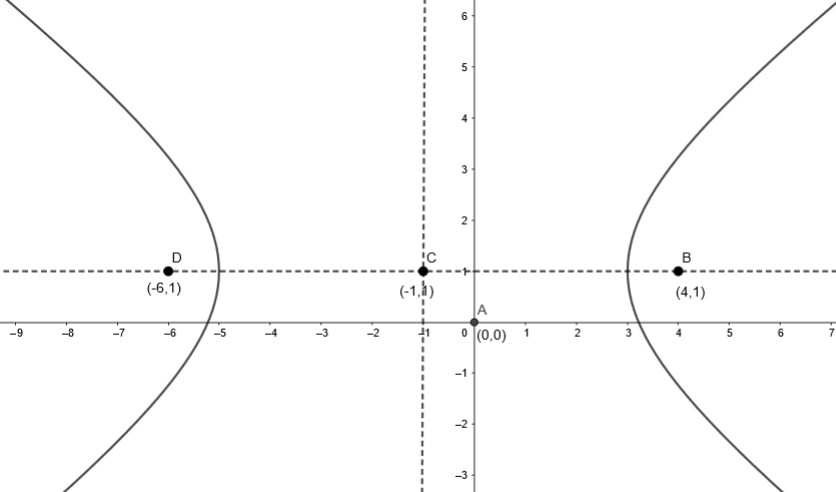
So, option (b) is the right answer.
Note: In this question, some students write the focus as \[\left( \pm ae,0 \right)\] which is wrong as that is true only for h = k = 0. But here, we can see that the vertex of the hyperbola is shifted. So, the focus would also shift accordingly. Also, students must take care that b is the conjugate axis while a is the transverse axis while finding the eccentricity. Also, for hyperbola, e is always greater than 1.
Complete step-by-step answer:
In this question, we have to find the foci of the hyperbola \[9{{x}^{2}}-16{{y}^{2}}+18x+32y-151=0\]. First of all, let us convert the given equation into the standard hyperbolic equation. We know that the standard hyperbola is of the form \[\dfrac{{{\left( x-h \right)}^{2}}}{{{a}^{2}}}-\dfrac{{{\left( y-k \right)}^{2}}}{{{b}^{2}}}=1\] where h and k can be any constants. Let us now consider our equation.
\[9{{x}^{2}}-16{{y}^{2}}+18x+32y-151=0\]
By rearranging the terms of the above equation, we get,
\[\left( 9{{x}^{2}}+18x \right)-\left( 16{{y}^{2}}-32y \right)-151=0\]
We can also write this above equation as,
\[\left[ {{\left( 3x \right)}^{2}}+2\left( 3x \right)\left( 3 \right) \right]-\left[ {{\left( 4y \right)}^{2}}-2\left( 4y \right)\left( 4 \right) \right]-151=0\]
We know that by adding and subtracting the same constant equation remains the same. So, we get,
\[\left[ {{\left( 3x \right)}^{2}}+2\left( 3x \right)\left( 3 \right)+{{\left( 3 \right)}^{2}}-{{\left( 3 \right)}^{2}} \right]-\left[ {{\left( 4y \right)}^{2}}-2\left( 4y \right)\left( 4 \right)+{{\left( 4 \right)}^{2}}-{{\left( 4 \right)}^{2}} \right]-151=0\]
\[\left[ {{\left( 3x \right)}^{2}}+2\left( 3x \right)\left( 3 \right)+{{\left( 3 \right)}^{2}} \right]-{{\left( 3 \right)}^{2}}-\left[ {{\left( 4y \right)}^{2}}-2\left( 4y \right)\left( 4 \right)+{{\left( 4 \right)}^{2}} \right]+{{\left( 4 \right)}^{2}}-151=0\]
We know that \[{{a}^{2}}+{{b}^{2}}+2ab={{\left( a+b \right)}^{2}}\] and \[{{a}^{2}}+{{b}^{2}}-2ab={{\left( a-b \right)}^{2}}\]. By using these in the above equation, we get,
\[{{\left( 3x+3 \right)}^{2}}-9-{{\left( 4y-4 \right)}^{2}}+16-151=0\]
\[{{\left( 3x+3 \right)}^{2}}-{{\left( 4y-4 \right)}^{2}}-9+16-151=0\]
\[{{\left( 3x+3 \right)}^{2}}-{{\left( 4y-4 \right)}^{2}}-144=0\]
By taking out the common value from the above equation, we get,
\[9{{\left( x+1 \right)}^{2}}-16{{\left( y-1 \right)}^{2}}-144=0\]
By dividing 144 in the above equation, we get,
\[\dfrac{9{{\left( x+1 \right)}^{2}}}{144}-\dfrac{16{{\left( y-1 \right)}^{2}}}{144}=1\]
\[\dfrac{{{\left( x+1 \right)}^{2}}}{16}-\dfrac{{{\left( y-1 \right)}^{2}}}{9}=1\]
\[\dfrac{{{\left( x-\left( -1 \right) \right)}^{2}}}{{{\left( 4 \right)}^{2}}}-\dfrac{{{\left( y-1 \right)}^{2}}}{{{\left( 3 \right)}^{2}}}=1\]
By comparing the above equation by standard equation,
\[\dfrac{{{\left( x-h \right)}^{2}}}{{{a}^{2}}}-\dfrac{{{\left( y-k \right)}^{2}}}{{{b}^{2}}}=1\]
We get, h = – 1, k = 1, a = 4 and b= 3.
Let us first find the eccentricity (e) of this hyperbola, we know that
\[{{e}^{2}}=1+\dfrac{{{b}^{2}}}{{{a}^{2}}}\]
By substituting the value of a and b, we get,
\[{{e}^{2}}=1+\dfrac{{{3}^{2}}}{{{4}^{2}}}\]
\[{{e}^{2}}=\dfrac{{{4}^{2}}+{{3}^{2}}}{{{4}^{2}}}=\dfrac{16+9}{16}\]
\[{{e}^{2}}=\dfrac{25}{16}\]
Therefore, \[e=\sqrt{\dfrac{25}{16}}=\dfrac{5}{4}\]
Now, we know that the focus of the given hyperbola lies at \[\left( x,y \right)=\left( h\pm ae,k \right)\]
So, we get the first focus as
\[x=h+ae\]
\[x=-1+4\left( \dfrac{5}{4} \right)\]
\[x=4\]
\[y=k=1\]
So, (x, y) = (4, 1)
We get the second focus as,
\[x=h-ae\]
\[x=-1-4\left( \dfrac{5}{4} \right)\]
\[x=-6\]
\[y=k=1\]
So, (x, y) = (– 6, 1)
We can also draw the given hyperbola as
So, option (b) is the right answer.
Note: In this question, some students write the focus as \[\left( \pm ae,0 \right)\] which is wrong as that is true only for h = k = 0. But here, we can see that the vertex of the hyperbola is shifted. So, the focus would also shift accordingly. Also, students must take care that b is the conjugate axis while a is the transverse axis while finding the eccentricity. Also, for hyperbola, e is always greater than 1.
Recently Updated Pages
Which of the following graphs shows the variation of class 12 physics CBSE

Draw a labelled diagram of the human male reproductive class 12 biology CBSE
Describe the experiment to compare the emf of two cells class 12 physics CBSE
What is standard hydrogen electrode
What is conventional current and electric current class 12 physics CBSE
2Bromopentane is treated with an alcoholic KOH solution class 12 chemistry CBSE
Trending doubts
Draw a labelled sketch of the human eye class 12 physics CBSE
Which are the Top 10 Largest Countries of the World?
A member of Simon commission later became Prime Minister class 12 social science CBSE
Differentiate between homogeneous and heterogeneous class 12 chemistry CBSE
Draw ray diagrams each showing i myopic eye and ii class 12 physics CBSE
Which is the correct genotypic ratio of mendel dihybrid class 12 biology CBSE