




The flux of the electric field due to charges distributed in a sphere of radius $5\;cm$ is $10\;Vm$. What will be the electric flux, through a concentric sphere of radius $10\;cm$?
A. $20\;Vm$
B. $30\;Vm$
C. $5\;Vm$
D. $10\;Vm$
Answer
 Verified
585.3k+ views
Hint: Recall the relation between the flux of the electric field and the charge enclosed in a volume by a surface. In other words, we know that the flux is directly proportional to the sum of all charges enclosed by a closed surface. Then, we know that the bigger sphere encases the smaller charge containing the sphere, so think of what charges would in turn be enclosed by the bigger sphere. Using these two statements, arrive at a conclusion that suggests an exclusive relationship between the flux and the charge enclosed, which will lead you to the solution.
Formula used: Total electric flux through a closed surface:
$\phi = \dfrac{\Sigma q_{enclosed}}{\epsilon_0}$, where q is the charge enclosed by the closed surface and $\epsilon_0$ is the permittivity of free space.
Complete step by step answer:
Let us begin by looking at what electric flux means.
Electric flux $\phi$ can be thought of as the number of electric field lines passing through a given surface area.
Now, a relation between the total flux linked with a closed surface and the charge enclosed by that surface can be established in what we call as the Gauss Law formula. It is given as:
$\phi = \dfrac{\Sigma q_{enclosed}}{\epsilon_0}$, where $\phi$ is the flux linked with the closed surface enclosing any volume V, $\Sigma q_{enclosed}$ is the sum of all charges enclosed within the volume V, and $\epsilon_0$ is the electric permittivity of free space.
Now, let us slip into the context of our question.
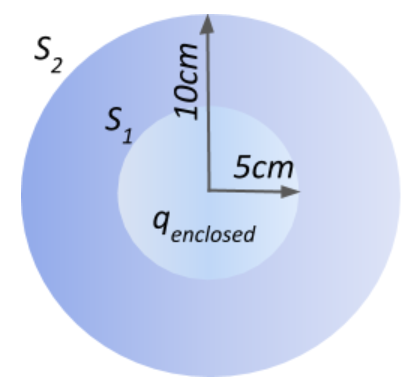
We are given with a sphere of radius $5\;cm$. Let the surface of this sphere be $S_1$, and let the volume of the sphere be V in which all the charges are contained. The flux produced as a result of these enclosed charges is given as $10\;Vm$
Now, if we have another sphere of radius $10\;cm$ built concentrically around the sphere with surface $S_1$, the volume of the bigger sphere houses the volume of the smaller sphere. This means that the charges enclosed by surface $S_2$ are the same as the charges enclosed by surface $S_1$ in this particular case. From this deduction, we can thus conclude that the electric flux through the bigger sphere will be the same as the flux through the smaller sphere since both the spheres enclose the same sum of charges.
Thus, flux for the sphere with surface $S_2$ will be 10Vm.
So, the correct answer is “Option D”.
Note: Note that the Gauss theorem gives an important corollary which states that the electric flux from any closed surface is due to the positive charges (sources) and negative charges (sinks) of the electric field enclosed by the surface. This means that no external charges contribute to the electric flux.
Formula used: Total electric flux through a closed surface:
$\phi = \dfrac{\Sigma q_{enclosed}}{\epsilon_0}$, where q is the charge enclosed by the closed surface and $\epsilon_0$ is the permittivity of free space.
Complete step by step answer:
Let us begin by looking at what electric flux means.
Electric flux $\phi$ can be thought of as the number of electric field lines passing through a given surface area.
Now, a relation between the total flux linked with a closed surface and the charge enclosed by that surface can be established in what we call as the Gauss Law formula. It is given as:
$\phi = \dfrac{\Sigma q_{enclosed}}{\epsilon_0}$, where $\phi$ is the flux linked with the closed surface enclosing any volume V, $\Sigma q_{enclosed}$ is the sum of all charges enclosed within the volume V, and $\epsilon_0$ is the electric permittivity of free space.
Now, let us slip into the context of our question.
We are given with a sphere of radius $5\;cm$. Let the surface of this sphere be $S_1$, and let the volume of the sphere be V in which all the charges are contained. The flux produced as a result of these enclosed charges is given as $10\;Vm$
Now, if we have another sphere of radius $10\;cm$ built concentrically around the sphere with surface $S_1$, the volume of the bigger sphere houses the volume of the smaller sphere. This means that the charges enclosed by surface $S_2$ are the same as the charges enclosed by surface $S_1$ in this particular case. From this deduction, we can thus conclude that the electric flux through the bigger sphere will be the same as the flux through the smaller sphere since both the spheres enclose the same sum of charges.
Thus, flux for the sphere with surface $S_2$ will be 10Vm.
So, the correct answer is “Option D”.
Note: Note that the Gauss theorem gives an important corollary which states that the electric flux from any closed surface is due to the positive charges (sources) and negative charges (sinks) of the electric field enclosed by the surface. This means that no external charges contribute to the electric flux.
Recently Updated Pages
Master Class 12 Economics: Engaging Questions & Answers for Success

Master Class 12 Physics: Engaging Questions & Answers for Success
Master Class 12 English: Engaging Questions & Answers for Success
Master Class 12 Social Science: Engaging Questions & Answers for Success
Master Class 12 Maths: Engaging Questions & Answers for Success
Master Class 12 Business Studies: Engaging Questions & Answers for Success
Trending doubts
Which are the Top 10 Largest Countries of the World?
What are the major means of transport Explain each class 12 social science CBSE
Draw a labelled sketch of the human eye class 12 physics CBSE
What is a transformer Explain the principle construction class 12 physics CBSE
Why cannot DNA pass through cell membranes class 12 biology CBSE
Differentiate between insitu conservation and exsitu class 12 biology CBSE