




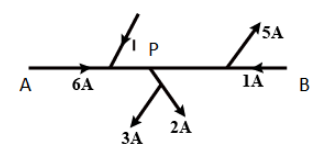
The figure shows in a part of an electric circuit, then the current $I$ is
A. $1A$
B. $3A$
C. $2A$
D. $4A$
Answer
 Verified
514.2k+ views
Hint: This problem is based on Kirchhoff's current law. According to Kirchhoff’s current law the current entering the node is equal to the current leaving the node or the algebraic sum of the current meeting at the junction or node is equal to zero. To determine the magnitude or the amount of electrical current that is flowing around an electronic circuit or the electrical circuit, we need to utilize certain rules or the laws that make us write down these currents in the form of an equation.
Complete step by step answer:
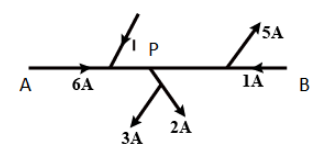
From the given circuit diagram, The current meeting at junction or node $P$ is
$I + 6 + 1$ ………. $\left( 1 \right)$
And , The current leaving at junction or node $P$ is
$5 + 3 + 2$………. $\left( 2 \right)$
Applying Kirchhoff’s current law to the given circuit, we can write the equation as
By using equation $\left( 1 \right)$ and equation $\left( 2 \right)$, current entering the junction or node is equal to the current leaving the node.
Therefore, It can be equated as
$I + 6 + 1 = 5 + 3 + 2$
On simplifying the above equation we get
$I + 7 = 10$
Therefore,
$I = 10 - 7 \\
\therefore I = 3\,A$
Hence, option B is correct.
Note: The Kirchhoff’s second law is also known as Kirchhoff’s voltage law which states that the algebraic sum of electromotive force $\left( {emf} \right)$ and the change in potential difference are equal to zero. Kirchhoff's first law or Kirchhoff’s current law obeys the law of conservation because it deals with conservation of the current entering and leaving a junction or node. This is because it has no other place to go as no charge is lost.
Complete step by step answer:
From the given circuit diagram, The current meeting at junction or node $P$ is
$I + 6 + 1$ ………. $\left( 1 \right)$
And , The current leaving at junction or node $P$ is
$5 + 3 + 2$………. $\left( 2 \right)$
Applying Kirchhoff’s current law to the given circuit, we can write the equation as
By using equation $\left( 1 \right)$ and equation $\left( 2 \right)$, current entering the junction or node is equal to the current leaving the node.
Therefore, It can be equated as
$I + 6 + 1 = 5 + 3 + 2$
On simplifying the above equation we get
$I + 7 = 10$
Therefore,
$I = 10 - 7 \\
\therefore I = 3\,A$
Hence, option B is correct.
Note: The Kirchhoff’s second law is also known as Kirchhoff’s voltage law which states that the algebraic sum of electromotive force $\left( {emf} \right)$ and the change in potential difference are equal to zero. Kirchhoff's first law or Kirchhoff’s current law obeys the law of conservation because it deals with conservation of the current entering and leaving a junction or node. This is because it has no other place to go as no charge is lost.
Recently Updated Pages
Master Class 12 Economics: Engaging Questions & Answers for Success

Master Class 12 Physics: Engaging Questions & Answers for Success
Master Class 12 English: Engaging Questions & Answers for Success
Master Class 12 Social Science: Engaging Questions & Answers for Success
Master Class 12 Maths: Engaging Questions & Answers for Success
Master Class 12 Business Studies: Engaging Questions & Answers for Success
Trending doubts
Why cannot DNA pass through cell membranes class 12 biology CBSE
Differentiate between insitu conservation and exsitu class 12 biology CBSE
Draw a neat and well labeled diagram of TS of ovary class 12 biology CBSE
In a human foetus the limbs and digits develop after class 12 biology CBSE
AABbCc genotype forms how many types of gametes a 4 class 12 biology CBSE
The correct structure of ethylenediaminetetraacetic class 12 chemistry CBSE