



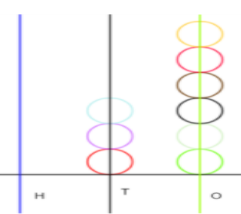
The factor of the number on the spike of abacus is :
(A) 8
(B) 7
(C) 5
(D) 9
Answer
 Verified
666.9k+ views
Hint: We needed to know what does the symbols ‘H’, ‘T’, ‘O’ represents in the given diagram. The H in the given diagram represents hundreds places. The T in the given diagram represents ten’s place. The O in the given diagram represents one’s place. We generally represent numbers through abacus scale. Let us assume there are i rows on abacus scale. The formulae for number represented on abacus scale is equal to \[\sum\limits_{i=1}^{n}{(number\text{ of beads on }{{\text{i}}^{th}}\text{ row)}{{(10)}^{i}}}\].
Complete step-by-step solution -
Before solving the question, we needed to have a basic knowledge on abacus system. Abacus is used to represents numbers. The number of beads on the last line represents the one’s place on given number. The number of beads on the last before line represents the ten’s place on given number. The number of beads on the 2nd last before line represents the hundred’s place on given number. The number of beads on the 3rd last before line represents the thousand’s place on given number. In the same way, ten thousand’s place, hundred thousand’s place etc… can be represented by abacus.
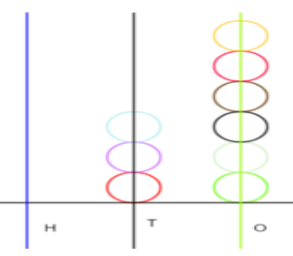
In the given diagram, the last line represents one’s place. The last before line represents hundred’s place. The 2nd last line represents hundred’s place. So, the O in the diagram represents one’s place. The T in the diagram represents ten’s place. The H in the diagram represents hundred’s place.
Number of beads on line O =6.
Number of beads on line T = 3
Number of beads on line H =0
Therefore,
One’s digit place on required number = 6
Tens’ digit place on required number = 3
Hundreds’ digit on required number = 0.
Hence,
Required number = (number of beads on line H) (100) + (number of beads on line T) (10)
+ (number of beads on line O) (1)
Required number = \[\text{(0)(100)+(3)(10)+(6)(1)=0+30+6=36}\]
Hence, the number represented on the given diagram is equal to 36.
We know that the factors of 36 are 1,2,3,4,6,9,12,18 and 36.
From the options, it is clear that 9 is the correct answer.
Hence, option (D) is correct.
Note: We should carefully calculate the number of beads on each line to represent a number. If a small mistake is made, we will get wrong results. Remember that the number of beads on the last before nth line represents the nth digit of the given number. Abacus is an old system which is used for representing numbers, counting numbers etc
Complete step-by-step solution -
Before solving the question, we needed to have a basic knowledge on abacus system. Abacus is used to represents numbers. The number of beads on the last line represents the one’s place on given number. The number of beads on the last before line represents the ten’s place on given number. The number of beads on the 2nd last before line represents the hundred’s place on given number. The number of beads on the 3rd last before line represents the thousand’s place on given number. In the same way, ten thousand’s place, hundred thousand’s place etc… can be represented by abacus.
In the given diagram, the last line represents one’s place. The last before line represents hundred’s place. The 2nd last line represents hundred’s place. So, the O in the diagram represents one’s place. The T in the diagram represents ten’s place. The H in the diagram represents hundred’s place.
Number of beads on line O =6.
Number of beads on line T = 3
Number of beads on line H =0
Therefore,
One’s digit place on required number = 6
Tens’ digit place on required number = 3
Hundreds’ digit on required number = 0.
Hence,
Required number = (number of beads on line H) (100) + (number of beads on line T) (10)
+ (number of beads on line O) (1)
Required number = \[\text{(0)(100)+(3)(10)+(6)(1)=0+30+6=36}\]
Hence, the number represented on the given diagram is equal to 36.
We know that the factors of 36 are 1,2,3,4,6,9,12,18 and 36.
From the options, it is clear that 9 is the correct answer.
Hence, option (D) is correct.
Note: We should carefully calculate the number of beads on each line to represent a number. If a small mistake is made, we will get wrong results. Remember that the number of beads on the last before nth line represents the nth digit of the given number. Abacus is an old system which is used for representing numbers, counting numbers etc
Recently Updated Pages
What are the two major island groups in India class 9 social science CBSE

What is Jhum cultivation class 9 biology CBSE
Write an Article on Save Earth Save Life
Silk is obtained from of the silk moth APupa BLarva class 9 chemistry CBSE
Write chemical formulas of the following compounds class 9 chemistry CBSE
The Indo Gangetic Plains of India are fertile due to class 9 social science CBSE
Trending doubts
Fill the blanks with the suitable prepositions 1 The class 9 english CBSE
Who was referred to as Amitraghata by the Greeks AChandragupta class 9 social science CBSE
Difference Between Plant Cell and Animal Cell
Name 10 Living and Non living things class 9 biology CBSE
What is the full form of pH?
On an outline map of India show its neighbouring c class 9 social science CBSE