




The distance between two consecutive compressions(c) or two consecutive rarefactions (R ) is called the
(A). Wavelength
(B). Full Length
(C). Amplitude
(D). Frequency
Answer
 Verified
653.1k+ views
Hint: Compressions and rarefactions are two different regions in a wave which is related to the answer. We can create compressions and rarefactions by a tuning fork and propagate through the air in an open tube.
Complete step by step solution:
The compressions and rarefactions in a wave are shown below:
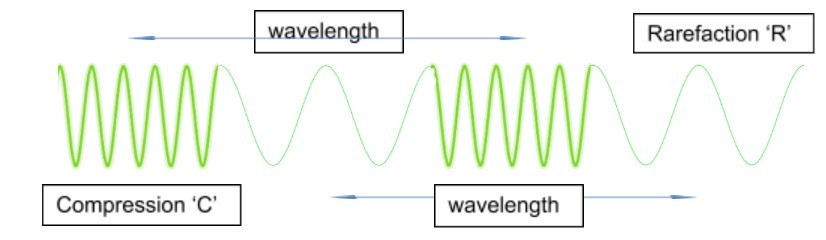
Compressions: A region in the longitudinal wave where the particles are close to each other.
Rarefactions: A region in the longitudinal wave where the particles are apart from each other.
So, we can determine the wavelength by measuring the distance between two consecutive compressions or two rarefactions.
Therefore, the correct option is wavelength i.e., option A.
Note: The wavelength of sinusoidal wave is defined as the spatial period of the wave i.e., the distance after which the shape of the wave repeats itself. So, care must be taken about right consideration of right compression and rarefaction while answering.
Complete step by step solution:
The compressions and rarefactions in a wave are shown below:
Compressions: A region in the longitudinal wave where the particles are close to each other.
Rarefactions: A region in the longitudinal wave where the particles are apart from each other.
So, we can determine the wavelength by measuring the distance between two consecutive compressions or two rarefactions.
Therefore, the correct option is wavelength i.e., option A.
Note: The wavelength of sinusoidal wave is defined as the spatial period of the wave i.e., the distance after which the shape of the wave repeats itself. So, care must be taken about right consideration of right compression and rarefaction while answering.
Recently Updated Pages
If x a + bt + ct2 where x is in meters and t is in class 11 physics CBSE

A car covers the first half distance between two places class 11 physics CBSE
The resultant of two vectors overrightarrow P and overrightarrow class 11 physics CBSE
Find the value of cos 135 class 11 maths CBSE
A mass M is held in place by an applied force F and class 11 physics CBSE
A solution of glucose in water is labelled as 10 dfracwv class 11 chemistry CBSE
Trending doubts
One Metric ton is equal to kg A 10000 B 1000 C 100 class 11 physics CBSE
Find the value of the expression given below sin 30circ class 11 maths CBSE
Draw a diagram of nephron and explain its structur class 11 biology CBSE
10 examples of friction in our daily life
Proton was discovered by A Thomson B Rutherford C Chadwick class 11 chemistry CBSE
Bond order ofO2 O2+ O2 and O22 is in order A O2 langle class 11 chemistry CBSE