




The definition of inductance can be stated as the ability of an inductor or conductor to The point \[P\] lies on the axis of a dipole. If the dipole is rotated by \[{90^0}\] anticlockwise, the electric field vector \[\vec E\] at \[P\] will rotate by,
A. \[{90^0}\] clockwise
B. \[{180^0}\] clockwise
C. \[{90^0}\] anti-clock wise
D. None
Answer
 Verified
497.4k+ views
Hint:The electric dipole is a measure of the separation of positive and negative electrical charges. It is a measure of the system’s overall polarity. The direction of the electric field is from the positive charge to the negative charge and the direction of the dipole moment for a given dipole is from the negative charge towards the positive charge. Dipole moments tend to point along the direction of the surrounding field.
Complete step by step solution:
We know that dipole means two equal and opposite charges separated by a distance. Every charged particle produces an electric field. The system has two charges and both these charges will affect the electric field due to the other charge at any point.
Let’s try and draw a diagram.
Diagram:
Firstly we will draw the case given in the question.
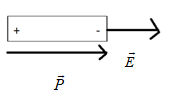
It is given that the point \[P\] lies on the axis of the dipole. We also know that the direction of the electric field is from the positive charge to the negative charge. Now after the dipole is turned around\[{90^0}\]anticlockwise the direction of the electric field also changes. We know that the direction of the dipole moment and the electric field are opposite to each other. The dipole’s direction is from the negative charge to the positive charge and the direction of the electric field is from the positive charge to the negative charge. Since the dipole is turned \[{90^0}\] anticlockwise we can say that the direction of the electric field will rotate by \[{90^0}\] clockwise. Therefore the correct option is A.
The diagram of the dipole in its final state is given below.
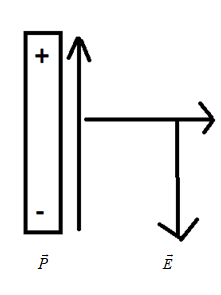
We can see that the electric field vector is rotated by \[{90^0}\] anti-clockwise.
Note:
The SI units for electric dipole moment are coulomb-meter (C-m); however, a commonly used unit in atomic physics and chemistry is the Debye (D). Note that in an electric field a dipole undergoes a torque, which tends to rotate so that its axis becomes aligned with the direction of the electric field. The magnitude of this torque depends on the strength of the electric field and also on the separation of the two electric charges and magnitudes.
Complete step by step solution:
We know that dipole means two equal and opposite charges separated by a distance. Every charged particle produces an electric field. The system has two charges and both these charges will affect the electric field due to the other charge at any point.
Let’s try and draw a diagram.
Diagram:
Firstly we will draw the case given in the question.
It is given that the point \[P\] lies on the axis of the dipole. We also know that the direction of the electric field is from the positive charge to the negative charge. Now after the dipole is turned around\[{90^0}\]anticlockwise the direction of the electric field also changes. We know that the direction of the dipole moment and the electric field are opposite to each other. The dipole’s direction is from the negative charge to the positive charge and the direction of the electric field is from the positive charge to the negative charge. Since the dipole is turned \[{90^0}\] anticlockwise we can say that the direction of the electric field will rotate by \[{90^0}\] clockwise. Therefore the correct option is A.
The diagram of the dipole in its final state is given below.
We can see that the electric field vector is rotated by \[{90^0}\] anti-clockwise.
Note:
The SI units for electric dipole moment are coulomb-meter (C-m); however, a commonly used unit in atomic physics and chemistry is the Debye (D). Note that in an electric field a dipole undergoes a torque, which tends to rotate so that its axis becomes aligned with the direction of the electric field. The magnitude of this torque depends on the strength of the electric field and also on the separation of the two electric charges and magnitudes.
Recently Updated Pages
Master Class 12 Economics: Engaging Questions & Answers for Success

Master Class 12 Physics: Engaging Questions & Answers for Success
Master Class 12 English: Engaging Questions & Answers for Success
Master Class 12 Social Science: Engaging Questions & Answers for Success
Master Class 12 Maths: Engaging Questions & Answers for Success
Master Class 12 Business Studies: Engaging Questions & Answers for Success
Trending doubts
Which are the Top 10 Largest Countries of the World?
What are the major means of transport Explain each class 12 social science CBSE
Draw a labelled sketch of the human eye class 12 physics CBSE
What is a transformer Explain the principle construction class 12 physics CBSE
Why cannot DNA pass through cell membranes class 12 biology CBSE
Differentiate between insitu conservation and exsitu class 12 biology CBSE