




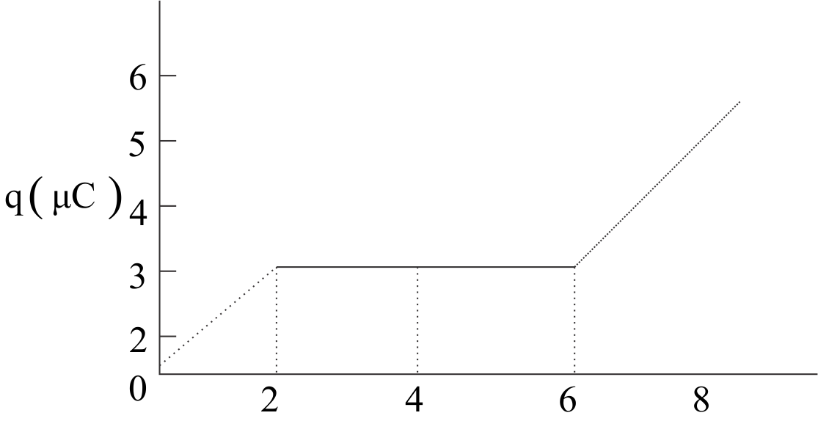
The charge on a capacitor plate in a circuit, as a function of time, is shown in the given figure. What is the value of current at t = 4 s?
A) 3 \[\mu \]A
B) 2 \[\mu \]A
C) Zero
D) 1.5 \[\mu \]A
Answer
 Verified
604.5k+ views
Hint: The current flowing through the circuit is equal to the change in charge per unit time. It can be found out by finding out the slope of the graph at the required point.
Complete step by step answer:The charge on a capacitor plate is given as the function of time. Since, we have the graphical representation of the charge with respect to time, we can easily find out the rate of change of charge on the capacitor plate with respect to time.
As we see in the graph, there is a change in the slope at t = 2 s and again at t = 6 s. So, we can divide the graph into three parts. Let us name the part of the graph from t = 0 s to t = 2 s as part A, from t = 2 s to t = 6 s as part B and from t = 6 s onwards as part C.
According to the question, we need to find out the value of current at t = 4 s. So, only the slop of the graph at t = 4 s is required. In part B of the graph, the slope is constant. So, we consider part B of the graph. The graph is a straight line in part B.
We find out the slope of a straight line by using the equation,
Slope = \[\dfrac{{\Delta y}}{{\Delta x}} = \dfrac{{{y_2} - {y_1}}}{{{x_2} - {x_1}}}\] …equation (1)
In part B, at t = 2 s, q = 3 \[\mu \]C, and at t = 6 s, q = 3 \[\mu \]C. On substituting these values in equation (1), we obtain,
${\left. {\dfrac{{dq}}{{dt}}} \right|_{t = 4s}} = \dfrac{{{q_2} - {q_1}}}{{{t_2} - {t_1}}} = \dfrac{{3 - 3}}{{6 - 2}} = 0$
Hence, at t = 4 s, the current flowing in the circuit is zero.
Therefore, option C is the correct answer.
Note:The slope of the graph can also be found out by finding out the equation of the lines and then differentiating it. However, it would involve more steps, which would be unnecessary.
Complete step by step answer:The charge on a capacitor plate is given as the function of time. Since, we have the graphical representation of the charge with respect to time, we can easily find out the rate of change of charge on the capacitor plate with respect to time.
As we see in the graph, there is a change in the slope at t = 2 s and again at t = 6 s. So, we can divide the graph into three parts. Let us name the part of the graph from t = 0 s to t = 2 s as part A, from t = 2 s to t = 6 s as part B and from t = 6 s onwards as part C.
According to the question, we need to find out the value of current at t = 4 s. So, only the slop of the graph at t = 4 s is required. In part B of the graph, the slope is constant. So, we consider part B of the graph. The graph is a straight line in part B.
We find out the slope of a straight line by using the equation,
Slope = \[\dfrac{{\Delta y}}{{\Delta x}} = \dfrac{{{y_2} - {y_1}}}{{{x_2} - {x_1}}}\] …equation (1)
In part B, at t = 2 s, q = 3 \[\mu \]C, and at t = 6 s, q = 3 \[\mu \]C. On substituting these values in equation (1), we obtain,
${\left. {\dfrac{{dq}}{{dt}}} \right|_{t = 4s}} = \dfrac{{{q_2} - {q_1}}}{{{t_2} - {t_1}}} = \dfrac{{3 - 3}}{{6 - 2}} = 0$
Hence, at t = 4 s, the current flowing in the circuit is zero.
Therefore, option C is the correct answer.
Note:The slope of the graph can also be found out by finding out the equation of the lines and then differentiating it. However, it would involve more steps, which would be unnecessary.
Recently Updated Pages
Master Class 12 Business Studies: Engaging Questions & Answers for Success

Master Class 12 Biology: Engaging Questions & Answers for Success
Master Class 12 Chemistry: Engaging Questions & Answers for Success
Class 12 Question and Answer - Your Ultimate Solutions Guide
Master Class 11 Social Science: Engaging Questions & Answers for Success
Master Class 11 English: Engaging Questions & Answers for Success
Trending doubts
Which are the Top 10 Largest Countries of the World?
Draw a labelled sketch of the human eye class 12 physics CBSE
Differentiate between homogeneous and heterogeneous class 12 chemistry CBSE
Sulphuric acid is known as the king of acids State class 12 chemistry CBSE
Why is the cell called the structural and functional class 12 biology CBSE
Which is the correct genotypic ratio of mendel dihybrid class 12 biology CBSE