




The car A of mass 1500 kg travelling at 25 m/s collides with another car B of mass 1000 kg travelling at 15 m/s in the same direction. After collision, the velocity of the car A becomes 20 m/s. The velocity of the car B after the collision is
Answer
 Verified
582k+ views
Hint: If the final momentum is the same as the initial momentum then the total momentum is conserved. If two bodies collide with each other, the collision between the two bodies is either elastic or inelastic. In both elastic and inelastic collision, the total momentum is conserved.
Complete step by step answer:
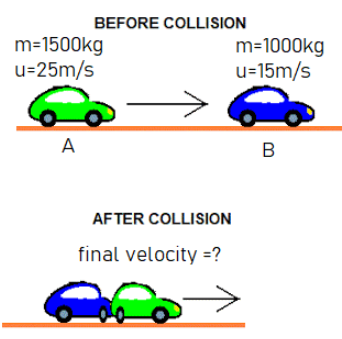
According to the law of conservation of momentum,
Initial momentum = Final momentum.
Thus, we write this as follows:
$m_{1}u_{1}+m_{2}u_{2}=m_{1}v_{1}+m_{2}v_{2}……..(1)$
Here, $m_{1}=1500kg$ is the mass of the car A.
$m_{2}=1000kg$ is the mass of the car B.
$u_{1}=25m/s$ is the initial velocity of the car A.
$u_{2}=15m/s$ is the intial velocity of the car B.
$v_{1}=20m/s$ is the final velocity of the car A.
$v_{2}=?$ is the final velocity of the car B.
From equation (1),
$1500\times25+1000\times15=1500\times20+1000\times v_{2}$
$37500+15000=30000+1000\times v_{2}$
$52500=30000+1000\times v_{2}$
$1000\times v_{2}=52500-30000$
$1000\times v_{2}=22500$
$v_{2}=22.5\,m/s$
Thus, the speed of the car B is 22.5 m/s.
Note:
Velocity is the vector quantity, the numerical value of the velocity is either positive or negative depending on the direction stated for the motion of an object. If two objects are in the same direction then the velocity is positive, if both are moving in opposite directions then one of the velocity of the object is negative.
Complete step by step answer:
According to the law of conservation of momentum,
Initial momentum = Final momentum.
Thus, we write this as follows:
$m_{1}u_{1}+m_{2}u_{2}=m_{1}v_{1}+m_{2}v_{2}……..(1)$
Here, $m_{1}=1500kg$ is the mass of the car A.
$m_{2}=1000kg$ is the mass of the car B.
$u_{1}=25m/s$ is the initial velocity of the car A.
$u_{2}=15m/s$ is the intial velocity of the car B.
$v_{1}=20m/s$ is the final velocity of the car A.
$v_{2}=?$ is the final velocity of the car B.
From equation (1),
$1500\times25+1000\times15=1500\times20+1000\times v_{2}$
$37500+15000=30000+1000\times v_{2}$
$52500=30000+1000\times v_{2}$
$1000\times v_{2}=52500-30000$
$1000\times v_{2}=22500$
$v_{2}=22.5\,m/s$
Thus, the speed of the car B is 22.5 m/s.
Note:
Velocity is the vector quantity, the numerical value of the velocity is either positive or negative depending on the direction stated for the motion of an object. If two objects are in the same direction then the velocity is positive, if both are moving in opposite directions then one of the velocity of the object is negative.
Recently Updated Pages
Master Class 12 Business Studies: Engaging Questions & Answers for Success

Master Class 12 Biology: Engaging Questions & Answers for Success
Master Class 12 Chemistry: Engaging Questions & Answers for Success
Class 12 Question and Answer - Your Ultimate Solutions Guide
Master Class 11 Social Science: Engaging Questions & Answers for Success
Master Class 11 English: Engaging Questions & Answers for Success
Trending doubts
Which is more stable and why class 12 chemistry CBSE
Which are the Top 10 Largest Countries of the World?
Draw a labelled sketch of the human eye class 12 physics CBSE
Differentiate between homogeneous and heterogeneous class 12 chemistry CBSE
What are the major means of transport Explain each class 12 social science CBSE
Sulphuric acid is known as the king of acids State class 12 chemistry CBSE