



The area of a right-angled isosceles triangle, whose hypotenuse is equal to 270 m, is:
A. \[19,000{\text{ }}{{\text{m}}^2}\]
B. \[18,225{\text{ }}{{\text{m}}^2}\]
C. \[17,256{\text{ }}{{\text{m}}^2}\]
D. \[18,325{\text{ }}{{\text{m}}^2}\]
Answer
 Verified
653.4k+ views
Hint: The area of a right-angled triangle is given by \[\dfrac{1}{2} \times {\text{Height}} \times {\text{Base}}\]. Pythagoras theorem states that \[{\left( {{\text{Hypotenuse}}} \right)^2} = {\left( {{\text{Height}}} \right)^2} + {\left( {{\text{Base}}} \right)^2}\]. In a right-angled isosceles triangle, the two adjacent sides at the right angle are equal in length.
Use this concept to solve this particular problem.
Complete step-by-step answer:
Let \[\Delta ABC\] be right angled isosceles triangle with \[\angle ABC = {90^0}\] and \[AB = BC = a\]
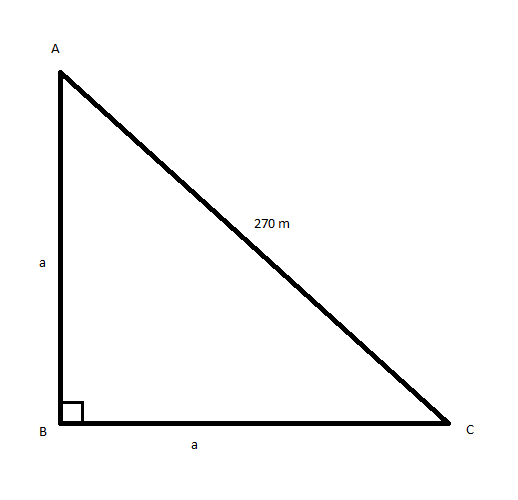
Given hypotenuse \[AC = 270{\text{ m}}\]
By using Pythagoras theorem i.e., \[{\left( {{\text{Hypotenuse}}} \right)^2} = {\left( {{\text{Height}}} \right)^2} + {\left( {{\text{Base}}} \right)^2}\] we have
\[
\Rightarrow {\left( {AC} \right)^2} = {\left( {AB} \right)^2} + {\left( {BC} \right)^2} \\
\Rightarrow \left( {270} \right) = {a^2} + {a^2} \\
\Rightarrow {\left( {270} \right)^2} = 2{a^2} \\
\Rightarrow {a^2} = \dfrac{{270 \times 270}}{2}{\text{ }}{{\text{m}}^2}.......................................\left( 1 \right) \\
\]
We know that the area of a right-angled triangle is given by \[\dfrac{1}{2} \times {\text{Height}} \times {\text{Base}}\]
So, the area of \[\Delta ABC\] is
\[ \Rightarrow \Delta = \dfrac{1}{2} \times a \times a = \dfrac{{{a^2}}}{2}\]
from equation (1), we have
\[
\Rightarrow \Delta = \dfrac{{{a^2}}}{2} \\
\Rightarrow \Delta = \dfrac{{\dfrac{{270 \times 270}}{2}}}{2} \\
\Rightarrow \Delta = \dfrac{{270 \times 270}}{{2 \times 2}} \\
\therefore \Delta = 18,225{\text{ }}{{\text{m}}^2} \\
\]
Thus, the correct option is B. \[18,225{\text{ }}{{\text{m}}^2}\]
Note: In this question, first of all draw the diagram of the right-angled isosceles triangle and then find the side of the triangle. Then find the area of the triangle which is the required answer. So, use this concept to reach the solution of the given problem.
Use this concept to solve this particular problem.
Complete step-by-step answer:
Let \[\Delta ABC\] be right angled isosceles triangle with \[\angle ABC = {90^0}\] and \[AB = BC = a\]
Given hypotenuse \[AC = 270{\text{ m}}\]
By using Pythagoras theorem i.e., \[{\left( {{\text{Hypotenuse}}} \right)^2} = {\left( {{\text{Height}}} \right)^2} + {\left( {{\text{Base}}} \right)^2}\] we have
\[
\Rightarrow {\left( {AC} \right)^2} = {\left( {AB} \right)^2} + {\left( {BC} \right)^2} \\
\Rightarrow \left( {270} \right) = {a^2} + {a^2} \\
\Rightarrow {\left( {270} \right)^2} = 2{a^2} \\
\Rightarrow {a^2} = \dfrac{{270 \times 270}}{2}{\text{ }}{{\text{m}}^2}.......................................\left( 1 \right) \\
\]
We know that the area of a right-angled triangle is given by \[\dfrac{1}{2} \times {\text{Height}} \times {\text{Base}}\]
So, the area of \[\Delta ABC\] is
\[ \Rightarrow \Delta = \dfrac{1}{2} \times a \times a = \dfrac{{{a^2}}}{2}\]
from equation (1), we have
\[
\Rightarrow \Delta = \dfrac{{{a^2}}}{2} \\
\Rightarrow \Delta = \dfrac{{\dfrac{{270 \times 270}}{2}}}{2} \\
\Rightarrow \Delta = \dfrac{{270 \times 270}}{{2 \times 2}} \\
\therefore \Delta = 18,225{\text{ }}{{\text{m}}^2} \\
\]
Thus, the correct option is B. \[18,225{\text{ }}{{\text{m}}^2}\]
Note: In this question, first of all draw the diagram of the right-angled isosceles triangle and then find the side of the triangle. Then find the area of the triangle which is the required answer. So, use this concept to reach the solution of the given problem.
Recently Updated Pages
Master Class 11 English: Engaging Questions & Answers for Success

Master Class 11 Social Science: Engaging Questions & Answers for Success
Master Class 11 Maths: Engaging Questions & Answers for Success
Master Class 11 Biology: Engaging Questions & Answers for Success
Master Class 11 Physics: Engaging Questions & Answers for Success
Master Class 11 Chemistry: Engaging Questions & Answers for Success
Trending doubts