




Taylor conducted the experiments to semiconservative mode of chromosome replication on
A. Drosophila melanogaster
B. E. coli
C. Vinca rosea
D. Vicia faba
Answer
 Verified
590.1k+ views
Hint: Various experiments were performed by different scientists to prove that the DNA replication is semi-conservative in eukaryotes. This means that every newly replicated chromosome contains at least one strand from parent strands, and one strand is the newly replicated one.
Complete answer:
Messelson and Stahl conducted a series of experiments on bacteria E.coli to study the semi conservative nature of DNA replication using radio-isotope of nitrogen (\[{N_{15}}\]). However, this experiment could not prove that DNA replication is semi-conservative in Eukaryotes.
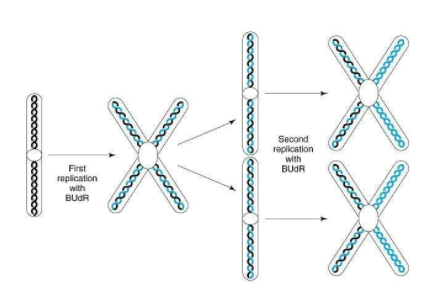
In \[1958\], it was J.H Taylor who performed a series of experiments on root tip cells of Vicia faba. In the experiment, he used radioactive \[3\]H-thymidine. The root tips were grown in a culture containing \[3\]H-thymidine. This radioactive isotope, when decayed, produces β-particles that form a black spot upon striking a photographic plate.
During the first round of DNA replication, the cells were kept in a medium containing \[3\]H. During the next replication cycle, the cells were transferred to another medium containing non-radioactive isotope of thymidine. At the end of the second replication cycle it was found that only one of the two strands of the chromosome showed radioactivity while the other was non-radioactive. This showed the semiconservative replication of DNA in eukaryotes.
Therefore, on Vicia faba, the experiments to semiconservative mode of chromosome replication were conducted by Taylor.
Hence, the correct answer is option (D).
Additional information:
Messelson and Stahl performed an experiment involving replication of DNA in \[{N_{15}}\] for several generations. It was found that \[{N_{15}}\]was incorporated into DNA which could be separated from the normal DNA by centrifugation in cesium chloride. They then transferred the cells into another medium containing another isotope of nitrogen \[{N_{14}}\]and performed DNA replication. They evaluated the cells after every \[20\] minutes (as E.coli divides every \[20\] minutes) and found that the cells extracted after \[20\] minutes had intermediate density because it contained \[1\] DNA strand of \[{N_{15}}\] and other of \[{N_{14}}\]. Whereas the cells extracted after \[40\]min show equal amounts of intermediate (\[{N_{14}}\]\[{N_{15}}\]) and light density (\[{N_{14}}\]\[{N_{14}}\]).
Note: A series of experiments were performed on various organisms to study the semi-conservative nature of DNA replication. For this purpose, the organisms like E.Coli and other plant cells were used. The semi-conservative mode of replication suggested that one of the two parental strands of DNA can be found in the newly replicated DNA strand.
Complete answer:
Messelson and Stahl conducted a series of experiments on bacteria E.coli to study the semi conservative nature of DNA replication using radio-isotope of nitrogen (\[{N_{15}}\]). However, this experiment could not prove that DNA replication is semi-conservative in Eukaryotes.
In \[1958\], it was J.H Taylor who performed a series of experiments on root tip cells of Vicia faba. In the experiment, he used radioactive \[3\]H-thymidine. The root tips were grown in a culture containing \[3\]H-thymidine. This radioactive isotope, when decayed, produces β-particles that form a black spot upon striking a photographic plate.
During the first round of DNA replication, the cells were kept in a medium containing \[3\]H. During the next replication cycle, the cells were transferred to another medium containing non-radioactive isotope of thymidine. At the end of the second replication cycle it was found that only one of the two strands of the chromosome showed radioactivity while the other was non-radioactive. This showed the semiconservative replication of DNA in eukaryotes.
Therefore, on Vicia faba, the experiments to semiconservative mode of chromosome replication were conducted by Taylor.
Hence, the correct answer is option (D).
Additional information:
Messelson and Stahl performed an experiment involving replication of DNA in \[{N_{15}}\] for several generations. It was found that \[{N_{15}}\]was incorporated into DNA which could be separated from the normal DNA by centrifugation in cesium chloride. They then transferred the cells into another medium containing another isotope of nitrogen \[{N_{14}}\]and performed DNA replication. They evaluated the cells after every \[20\] minutes (as E.coli divides every \[20\] minutes) and found that the cells extracted after \[20\] minutes had intermediate density because it contained \[1\] DNA strand of \[{N_{15}}\] and other of \[{N_{14}}\]. Whereas the cells extracted after \[40\]min show equal amounts of intermediate (\[{N_{14}}\]\[{N_{15}}\]) and light density (\[{N_{14}}\]\[{N_{14}}\]).
Note: A series of experiments were performed on various organisms to study the semi-conservative nature of DNA replication. For this purpose, the organisms like E.Coli and other plant cells were used. The semi-conservative mode of replication suggested that one of the two parental strands of DNA can be found in the newly replicated DNA strand.
Recently Updated Pages
Master Class 12 Business Studies: Engaging Questions & Answers for Success

Master Class 12 Biology: Engaging Questions & Answers for Success
Master Class 12 Chemistry: Engaging Questions & Answers for Success
Class 12 Question and Answer - Your Ultimate Solutions Guide
Master Class 11 Social Science: Engaging Questions & Answers for Success
Master Class 11 English: Engaging Questions & Answers for Success
Trending doubts
Which are the Top 10 Largest Countries of the World?
Draw a labelled sketch of the human eye class 12 physics CBSE
Differentiate between homogeneous and heterogeneous class 12 chemistry CBSE
Sulphuric acid is known as the king of acids State class 12 chemistry CBSE
Why is the cell called the structural and functional class 12 biology CBSE
Which is the correct genotypic ratio of mendel dihybrid class 12 biology CBSE