




Study the given pedigree chart for sickle cell anaemia and select the most appropriate option for the genotypes.
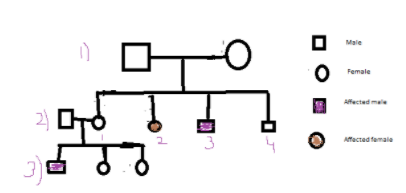
A. Genotypes of parents - H${b^A}$H${b^S}$ H${b^A}$H${b^A}$. Genotypes of 1 st and 3 rd child in F1 - H${b^A}$H${b^A}$ H${b^A}$H${b^S}$ B. Genotypes of parents- H${b^A}$H${b^S}$ H${b^A}$H${b^S}$ Genotypes of 1 st and 3 rd child in F1 - H${b^A}$H${b^A}$ H${b^A}$H${b^A}$ C. Genotypes of parents- H${b^A}$HbA HbA H${b^S}$ Genotypes of 1 st and 3 rd child in F1 - H${b^A}$H${b^A}$ H${b^S}$ H ${b^S}$ D. Genotypes of parents- H${b^A}$H${b^S}$ H${b^A}$H${b^S}$ Genotypes of 1 st and 3 rd child in F1- H${b^A}$H${b^S}$ H${b^S}$H${b^S}
Answer
 Verified
620.1k+ views
Hint: Different Mendelian disorders can be analyse using pedigree chart. These disorders are caused due to abnormalities in the genome. Sickle cell anaemia is also one of the autosomal genetic disorder.
Complete answer:
Pedigree analysis is a graphical representation which helps in studying the pattern of inheritance in the family. There are series of symbols which represents distinct aspects of pedigree square depicts male and circle depicts female. The chart gives the idea about the genotype of specific organism from one generation to another. Sickle cell anaemia is an autosomal recessive genetic disorder in which glutamic acid present in the sixth position of haemoglobin is replaced by valine. The mutant haemoglobin molecule changes its biconcave shape to sickle cell shape. In sickle cell anaemia the oxygen binding capacity of haemoglobin becomes very less. Recessive allele cause the sickle cell disease which means that the expression of gene should be homozygous for the recessive allele.
So the gene for affected individual for sickle cell anaemia is H${b^S}$H${b^S}$
The gene for the unaffected or carrier individual is H${b^A}$H${b^S}$
The gene for the normal individual is H${b^A}$H${b^A}$
According to the given chart (i) Parents are unaffected they are Heterozygous meaning they contain H${b^A}$H${b^S}$ H${b^A}$H${b^S}$genotype. Crossing of these two leads to:
Parents H${b^A}$H${b^S} \times $ H${b^A}$H${b^S}$
F1 Generation
Normal H${b^A}$H${b^A}$
Unaffected/Carrier H${b^A}$H${b^S}$ H${b^A}$H${b^S}$
Affected Individual H${b^S}$H${b^S}$
So the genome of the parent will be H${b^A}$H${b^S}$ H${b^A}$H${b^S}$
(ii) In the F1 generation 2 and 3 individuals are affected whereas 1 and 4 individuals are not affected. So the genotype of 1 st individual in F1 generation is H${b^A}$H${b^S}$. The genome of 2 and 3 individual in F1 generation will be same as both are affected H${b^S}$H${b^S}$.
iii) In the iii it is shown that normal male is heterozygous with H${b^A}$H${b^S}$means it is unaffected or carrier it may affect the next generation. So as per chart a is affected and the genotype is H${b^S}$H${b^S}$whereas b and c are normal.
Hence, the correct answer is option (D).
Note: Pedigree analysis helps in knowing the genetically inherited diseases so that it cannot be transmitted from one generation to another. The recessive and dominant traits can be known easily by pedigree chart.
Complete answer:
Pedigree analysis is a graphical representation which helps in studying the pattern of inheritance in the family. There are series of symbols which represents distinct aspects of pedigree square depicts male and circle depicts female. The chart gives the idea about the genotype of specific organism from one generation to another. Sickle cell anaemia is an autosomal recessive genetic disorder in which glutamic acid present in the sixth position of haemoglobin is replaced by valine. The mutant haemoglobin molecule changes its biconcave shape to sickle cell shape. In sickle cell anaemia the oxygen binding capacity of haemoglobin becomes very less. Recessive allele cause the sickle cell disease which means that the expression of gene should be homozygous for the recessive allele.
So the gene for affected individual for sickle cell anaemia is H${b^S}$H${b^S}$
The gene for the unaffected or carrier individual is H${b^A}$H${b^S}$
The gene for the normal individual is H${b^A}$H${b^A}$
According to the given chart (i) Parents are unaffected they are Heterozygous meaning they contain H${b^A}$H${b^S}$ H${b^A}$H${b^S}$genotype. Crossing of these two leads to:
Parents H${b^A}$H${b^S} \times $ H${b^A}$H${b^S}$
F1 Generation
Normal H${b^A}$H${b^A}$
Unaffected/Carrier H${b^A}$H${b^S}$ H${b^A}$H${b^S}$
Affected Individual H${b^S}$H${b^S}$
So the genome of the parent will be H${b^A}$H${b^S}$ H${b^A}$H${b^S}$
(ii) In the F1 generation 2 and 3 individuals are affected whereas 1 and 4 individuals are not affected. So the genotype of 1 st individual in F1 generation is H${b^A}$H${b^S}$. The genome of 2 and 3 individual in F1 generation will be same as both are affected H${b^S}$H${b^S}$.
iii) In the iii it is shown that normal male is heterozygous with H${b^A}$H${b^S}$means it is unaffected or carrier it may affect the next generation. So as per chart a is affected and the genotype is H${b^S}$H${b^S}$whereas b and c are normal.
Hence, the correct answer is option (D).
Note: Pedigree analysis helps in knowing the genetically inherited diseases so that it cannot be transmitted from one generation to another. The recessive and dominant traits can be known easily by pedigree chart.
Recently Updated Pages
Basicity of sulphurous acid and sulphuric acid are

Master Class 12 Economics: Engaging Questions & Answers for Success
Master Class 12 Biology: Engaging Questions & Answers for Success
Master Class 11 English: Engaging Questions & Answers for Success
Master Class 11 Physics: Engaging Questions & Answers for Success
Master Class 11 Computer Science: Engaging Questions & Answers for Success
Trending doubts
Draw a labelled sketch of the human eye class 12 physics CBSE
The chemical formula of tear gas is A CO Cl 2 B C 10 class 12 chemistry CBSE
Draw ray diagrams each showing i myopic eye and ii class 12 physics CBSE
Which are the Top 10 Largest Countries of the World?
Differentiate between homogeneous and heterogeneous class 12 chemistry CBSE
Which is the correct genotypic ratio of mendel dihybrid class 12 biology CBSE