




State the principle of an electric generator.
Answer
 Verified
634.2k+ views
Hint: An electric generator is an electronic device which converts the mechanical energy into electrical energy. The electric generators are operated on electrostatic principles, based on the phenomenon of the electromagnetic induction.
Complete answer:
The electric generator is an application of electromagnetic induction. Electromagnetic induction is defined as the process in which a conductor is fixed in a particular position and the magnetic field keeps varying or instead the magnetic field is stationary and the conductor keeps moving. This process results in the production of a voltage or electromotive force (EMF) across the electrical conductor.
The electric generator works on the principle of electromagnetic induction, in which when a straight conductor moves in a magnetic field, then the current is induced in the conductor.
For better understand of the working of an electric generator let us see the diagram of an electric generator:
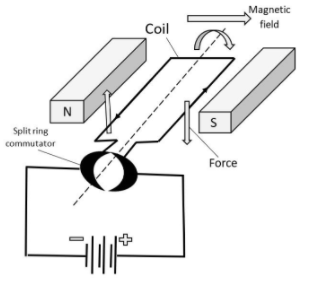
In an electric generator a rectangular coil is made to rotate rapidly in the magnetic field between the poles of a horseshoe type magnet. When the coil rotates it cuts the magnetic field lines because of which the current is produced in the coil.
The electric generators are further classified as:
AC generators: These are known as single – phase generators.
DC generators: These generators are further divided in three categories, i.e. shunt, series and compound wound.
There are various uses of an electric generator:
1) These are used for driving motors.
2) Small scale electric generators provide a good backup for household power needs.
3) It is energy efficient as it reduces the fuel consumption.
Hence, the principle of an electric generator is based on electromagnetic induction.
Note:
Students tend to get confused between electric generators and electric motors. An electric motor works on the reverse conversion of electrical energy to mechanical energy. Both electric motors and electric generators have many similarities.
Complete answer:
The electric generator is an application of electromagnetic induction. Electromagnetic induction is defined as the process in which a conductor is fixed in a particular position and the magnetic field keeps varying or instead the magnetic field is stationary and the conductor keeps moving. This process results in the production of a voltage or electromotive force (EMF) across the electrical conductor.
The electric generator works on the principle of electromagnetic induction, in which when a straight conductor moves in a magnetic field, then the current is induced in the conductor.
For better understand of the working of an electric generator let us see the diagram of an electric generator:
In an electric generator a rectangular coil is made to rotate rapidly in the magnetic field between the poles of a horseshoe type magnet. When the coil rotates it cuts the magnetic field lines because of which the current is produced in the coil.
The electric generators are further classified as:
AC generators: These are known as single – phase generators.
DC generators: These generators are further divided in three categories, i.e. shunt, series and compound wound.
There are various uses of an electric generator:
1) These are used for driving motors.
2) Small scale electric generators provide a good backup for household power needs.
3) It is energy efficient as it reduces the fuel consumption.
Hence, the principle of an electric generator is based on electromagnetic induction.
Note:
Students tend to get confused between electric generators and electric motors. An electric motor works on the reverse conversion of electrical energy to mechanical energy. Both electric motors and electric generators have many similarities.
Recently Updated Pages
Differentiate between voluntary action and reflex class 10 biology CBSE

The uses of bleaching powder are A It is used bleaching class 10 chemistry CBSE
Fill in the blanks with abstract nouns of the words class 10 english CBSE
How many threedigit numbers are there class 10 maths CBSE
What is a reflex arc class 10 biology CBSE
Construct a square whose diagonal is 6cm Measure the class 10 maths CBSE
Trending doubts
Explain the Treaty of Vienna of 1815 class 10 social science CBSE
The slogan Jai Hind was given by A Lal Bahadur Shastri class 10 social science CBSE
10 examples of evaporation in daily life with explanations
What is the full form of POSCO class 10 social science CBSE
Identify the feminine form of noun nephew a shenephew class 10 english CBSE
Make a sketch of the human nerve cell What function class 10 biology CBSE