




State and explain Kepler’s law of planetary motion. Draw diagrams to illustrate these laws.
Answer
 Verified
558.3k+ views
Hint: In order to solve this question, we should know that all the planets revolve around the sun, and it was kepler who first introduced three basic laws which tells us about the nature of motion of these planets around the sun, here we will discuss each law one by one and their statements which are known as Kepler’s law of planetary motion.
Complete step by step answer:
There are three laws of kepler’s planetary motion which are stated as:
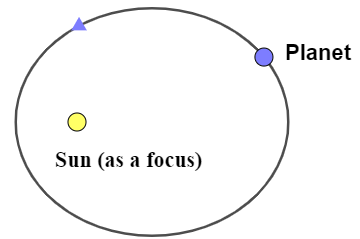
Kepler’s first law: This law states that. all the planets revolve around the sun in an elliptical orbit with the sun as their one of the focus. And as we know the ellipse is a locus of all points whose sum of distance from both the focus always remain constant. Kepler’s first law can be shown in diagram as, sun as one of the focus of the elliptical orbit of a planet revolving around it.
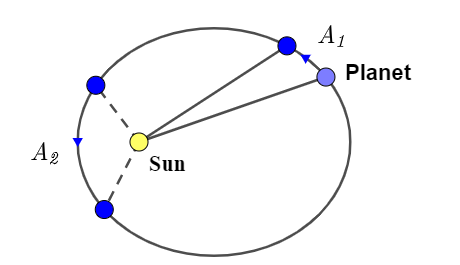
Kepler’s second law: This law states that, planet covers equal area in equal periods of time. which means the areal velocity of a planet is constant. From diagram we can see that, when planet if far from sun then it covers some area say ${A_1}$ in time t and when planet is near the sun it covers area of ${A_2}$ in period of time t, then both the areas will be equal ${A_1} = {A_2}$
Kepler’s Third law: This law states that, The square of time period of revolution of a planet is directly proportional to the cube of the radius of its orbit. Mathematically if T be the time period of a planet and R be the radius of the orbit then this law can be written as
${T^2} \propto {R^3}.$
Hence, these three laws are known as Kepler’s law of planetary motion.
Note: It should be remembered that, due to strong gravitational field of sun when planet passes close to it the velocity of a planet is large as compared to the case when planet is far away from the sun, this is the reason of covering large area near the sun in short period of time.
Complete step by step answer:
There are three laws of kepler’s planetary motion which are stated as:
Kepler’s first law: This law states that. all the planets revolve around the sun in an elliptical orbit with the sun as their one of the focus. And as we know the ellipse is a locus of all points whose sum of distance from both the focus always remain constant. Kepler’s first law can be shown in diagram as, sun as one of the focus of the elliptical orbit of a planet revolving around it.
Kepler’s second law: This law states that, planet covers equal area in equal periods of time. which means the areal velocity of a planet is constant. From diagram we can see that, when planet if far from sun then it covers some area say ${A_1}$ in time t and when planet is near the sun it covers area of ${A_2}$ in period of time t, then both the areas will be equal ${A_1} = {A_2}$
Kepler’s Third law: This law states that, The square of time period of revolution of a planet is directly proportional to the cube of the radius of its orbit. Mathematically if T be the time period of a planet and R be the radius of the orbit then this law can be written as
${T^2} \propto {R^3}.$
Hence, these three laws are known as Kepler’s law of planetary motion.
Note: It should be remembered that, due to strong gravitational field of sun when planet passes close to it the velocity of a planet is large as compared to the case when planet is far away from the sun, this is the reason of covering large area near the sun in short period of time.
Recently Updated Pages
Difference Between Prokaryotic Cells and Eukaryotic Cells

If x a + bt + ct2 where x is in meters and t is in class 11 physics CBSE
A car covers the first half distance between two places class 11 physics CBSE
The resultant of two vectors overrightarrow P and overrightarrow class 11 physics CBSE
Find the value of cos 135 class 11 maths CBSE
A mass M is held in place by an applied force F and class 11 physics CBSE
Trending doubts
One Metric ton is equal to kg A 10000 B 1000 C 100 class 11 physics CBSE
Find the value of the expression given below sin 30circ class 11 maths CBSE
Draw a diagram of nephron and explain its structur class 11 biology CBSE
10 examples of friction in our daily life
Proton was discovered by A Thomson B Rutherford C Chadwick class 11 chemistry CBSE
Bond order ofO2 O2+ O2 and O22 is in order A O2 langle class 11 chemistry CBSE