




Show that the area of the rhombus is half the product of the lengths of its diagonals.
Answer
 Verified
592.2k+ views
Hint: In this question, we need to prove that the area of the rhombus is half the product of the lengths of its diagonals. For this, we will use the geometrical, mathematical formulae along with the properties of the rhombus.
Complete step-by-step answer:
Let ABCD be a rhombus with AC and BD as the diagonals with the length $ {d_2} $ and $ {d_1} $
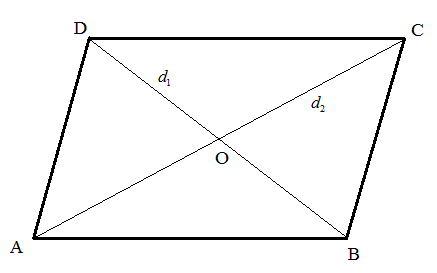
As the diagonals of the rhombus bisect each other at 90 degrees. So, the following figure has been generated.
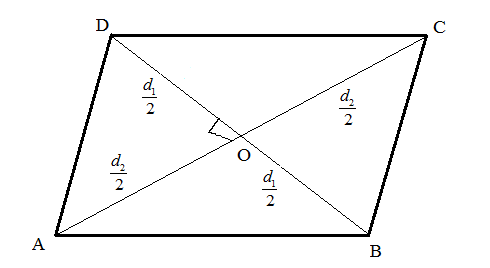
From the above figure, we can write that the area of the rhombus ABCD has been divided into the area of the triangles ABC and ADC.
Now, the triangles ABC and ADC are two right-angled triangles with BO perpendicular to AC and DO perpendicular to AC.
Half of the product of the base and the height of a triangle is the area of the triangle. Mathematically, $ A = \dfrac{1}{2} \times b \times h $ .
So, the area of the triangle ABC is given as
$
\Rightarrow {A_{ABC}} = \dfrac{1}{2} \times b \times h \\
= \dfrac{1}{2} \times AC \times BO - - - - (i) \\
$
Similarly, the area of the triangle ADC is given as
$
\Rightarrow {A_{ADC}} = \dfrac{1}{2} \times b \times h \\
= \dfrac{1}{2} \times AC \times DO - - - - (ii) \\
$
As, the sum of the areas of the triangles ABC and ADC is equal to the area of the rhombus ABCD. Mathematically, $ {A_{rhombus}} = {A_{ABC}} + {A_{ADC}} $ .
Substituting the values of the areas of the triangles in the equation $ {A_{rhombus}} = {A_{ABC}} + {A_{ADC}} $ to determine the area of the rhombus.
$
\Rightarrow {A_{rhombus}} = {A_{ABC}} + {A_{ADC}} \\
= \dfrac{1}{2} \times AC \times BO + \dfrac{1}{2} \times AC \times DO \\
= \dfrac{1}{2} \times AC\left( {BO + DO} \right) - - - - (iii) \\
$
From the figure, we can see that the sum of BO and DO is equalled to the length of the diagonal BD. So, substituting (BO+DO=BD) in the equation (iii), we get
$
\Rightarrow {A_{rhombus}} = \dfrac{1}{2} \times AC\left( {BO + DO} \right) \\
= \dfrac{1}{2} \times AC \times BD - - - - (iv) \\
$
Also, from the figure, we can see that the length of the diagonal AC is $ {d_1} $ and the diagonal BD is $ {d_2} $ . So, substituting the values in the equation (iv), we get
$
\Rightarrow {A_{rhombus}} = \dfrac{1}{2} \times AC \times BD \\
= \dfrac{1}{2} \times {d_1} \times {d_2} \\
$
Hence, we can say that the area of the rhombus is half of the product of the length of the diagonals.
Note: Students must note that the length of the diagonals in a rhombus are different and they bisect each other at 90 degrees. Moreover, rhombus differs from the square in one thing only that the length of the diagonals in the square are the same.
Complete step-by-step answer:
Let ABCD be a rhombus with AC and BD as the diagonals with the length $ {d_2} $ and $ {d_1} $
As the diagonals of the rhombus bisect each other at 90 degrees. So, the following figure has been generated.
From the above figure, we can write that the area of the rhombus ABCD has been divided into the area of the triangles ABC and ADC.
Now, the triangles ABC and ADC are two right-angled triangles with BO perpendicular to AC and DO perpendicular to AC.
Half of the product of the base and the height of a triangle is the area of the triangle. Mathematically, $ A = \dfrac{1}{2} \times b \times h $ .
So, the area of the triangle ABC is given as
$
\Rightarrow {A_{ABC}} = \dfrac{1}{2} \times b \times h \\
= \dfrac{1}{2} \times AC \times BO - - - - (i) \\
$
Similarly, the area of the triangle ADC is given as
$
\Rightarrow {A_{ADC}} = \dfrac{1}{2} \times b \times h \\
= \dfrac{1}{2} \times AC \times DO - - - - (ii) \\
$
As, the sum of the areas of the triangles ABC and ADC is equal to the area of the rhombus ABCD. Mathematically, $ {A_{rhombus}} = {A_{ABC}} + {A_{ADC}} $ .
Substituting the values of the areas of the triangles in the equation $ {A_{rhombus}} = {A_{ABC}} + {A_{ADC}} $ to determine the area of the rhombus.
$
\Rightarrow {A_{rhombus}} = {A_{ABC}} + {A_{ADC}} \\
= \dfrac{1}{2} \times AC \times BO + \dfrac{1}{2} \times AC \times DO \\
= \dfrac{1}{2} \times AC\left( {BO + DO} \right) - - - - (iii) \\
$
From the figure, we can see that the sum of BO and DO is equalled to the length of the diagonal BD. So, substituting (BO+DO=BD) in the equation (iii), we get
$
\Rightarrow {A_{rhombus}} = \dfrac{1}{2} \times AC\left( {BO + DO} \right) \\
= \dfrac{1}{2} \times AC \times BD - - - - (iv) \\
$
Also, from the figure, we can see that the length of the diagonal AC is $ {d_1} $ and the diagonal BD is $ {d_2} $ . So, substituting the values in the equation (iv), we get
$
\Rightarrow {A_{rhombus}} = \dfrac{1}{2} \times AC \times BD \\
= \dfrac{1}{2} \times {d_1} \times {d_2} \\
$
Hence, we can say that the area of the rhombus is half of the product of the length of the diagonals.
Note: Students must note that the length of the diagonals in a rhombus are different and they bisect each other at 90 degrees. Moreover, rhombus differs from the square in one thing only that the length of the diagonals in the square are the same.
Recently Updated Pages
Basicity of sulphurous acid and sulphuric acid are

Master Class 8 Social Science: Engaging Questions & Answers for Success
Master Class 8 Science: Engaging Questions & Answers for Success
Master Class 8 Maths: Engaging Questions & Answers for Success
Class 8 Question and Answer - Your Ultimate Solutions Guide
Master Class 11 Business Studies: Engaging Questions & Answers for Success
Trending doubts
What are gulf countries and why they are called Gulf class 8 social science CBSE
What is BLO What is the full form of BLO class 8 social science CBSE
What are the 12 elements of nature class 8 chemistry CBSE
In Indian rupees 1 trillion is equal to how many c class 8 maths CBSE
Who created the image of Bharat Mata for the first class 8 social science CBSE
What is the Balkan issue in brief class 8 social science CBSE