




What is Rosenmund’s reaction? What is the purpose of adding \[BaS{{O}_{4}}\]in this reaction?
Answer
 Verified
654.6k+ views
Hint: Rosenmund’s reaction is an organic reaction. It is a reduction hydrogenation process. \[BaS{{O}_{4}}\] is a catalyst used in this reaction.
Complete step by step answer:
> The Rosenmund reaction is a hydrogenation process where molecular hydrogen reacts with the acyl chloride in the presence of catalyst – palladium on barium sulfate.
> The Rosenmund reaction is catalyzed by palladium on barium sulfate. The barium sulfate reduces the activity of the palladium due to its low surface area, thereby preventing over reduction. Barium sulfate reduces the activity of palladium due to its low surface area meaning it decreases the reducing power of palladium in order to prevent over-reduction of the acid.
> A poison can be added to totally deactivate the palladium catalyst. The need for deactivation arises because the subsequent aldehyde formed from the reduction of the acyl chloride will also be reduced to a primary alcohol by the system. And below reaction chlorine gets replaced by hydrogen. \[Pd/BaS{{O}_{4}}\] is the catalyst for this reaction don’t take part in chemical change. Below given is the rosenmund reaction:
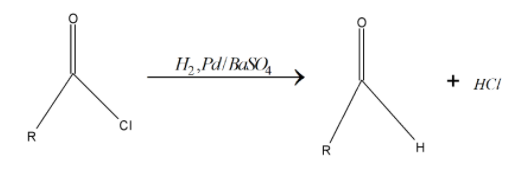
Due to the high reactivity of hydrogen gas it readily initiates a substitution in the acyl chloride, forming HCl and the required aldehyde.
Note:
Common poisons used to limit palladium activity in the Rosenmund technique are thioquinanthrene and thiourea. \[Pd/BaS{{O}_{4}}\]is known as lindlar’s catalyst.
Complete step by step answer:
> The Rosenmund reaction is a hydrogenation process where molecular hydrogen reacts with the acyl chloride in the presence of catalyst – palladium on barium sulfate.
> The Rosenmund reaction is catalyzed by palladium on barium sulfate. The barium sulfate reduces the activity of the palladium due to its low surface area, thereby preventing over reduction. Barium sulfate reduces the activity of palladium due to its low surface area meaning it decreases the reducing power of palladium in order to prevent over-reduction of the acid.
> A poison can be added to totally deactivate the palladium catalyst. The need for deactivation arises because the subsequent aldehyde formed from the reduction of the acyl chloride will also be reduced to a primary alcohol by the system. And below reaction chlorine gets replaced by hydrogen. \[Pd/BaS{{O}_{4}}\] is the catalyst for this reaction don’t take part in chemical change. Below given is the rosenmund reaction:
Due to the high reactivity of hydrogen gas it readily initiates a substitution in the acyl chloride, forming HCl and the required aldehyde.
Note:
Common poisons used to limit palladium activity in the Rosenmund technique are thioquinanthrene and thiourea. \[Pd/BaS{{O}_{4}}\]is known as lindlar’s catalyst.
Recently Updated Pages
Explain the structure of megasporangium class 12 biology CBSE

Why is chloroform kept in dark coloured bottles class 12 chemistry CBSE
Derive the balancing condition of a Wheatstone bri class 12 physics CBSE
Draw VI characteristics of a pn junction diode Explain class 12 physics CBSE
Is it possible to carry pride in ones language too class 12 english CBSE
In a population at Hardy Weinberg equilibrium the allele class 12 biology CBSE
Trending doubts
Draw a labelled sketch of the human eye class 12 physics CBSE
Which are the Top 10 Largest Countries of the World?
Draw ray diagrams each showing i myopic eye and ii class 12 physics CBSE
Which is the correct genotypic ratio of mendel dihybrid class 12 biology CBSE
Differentiate between homogeneous and heterogeneous class 12 chemistry CBSE
Which animal never drinks water in its entire life class 12 biology CBSE