




What is the role of the helicase enzyme in DNA replication?
Answer
 Verified
564.6k+ views
Hint: DNA replication is the process by which the DNA divides or forms its replica during cell division. It is a very important process that leads to inheritance. In this process, the double-stranded DNA helix separates into two followed by the copying of the strand. This is brought about by the enzymes.
Complete answer:
DNA is a complex molecule that is present in the chromosome. The DNA is a double-stranded helix. In this, the two strands are complementary to each other and are joined by the hydrogen bond between the complementary bases present in the strands.
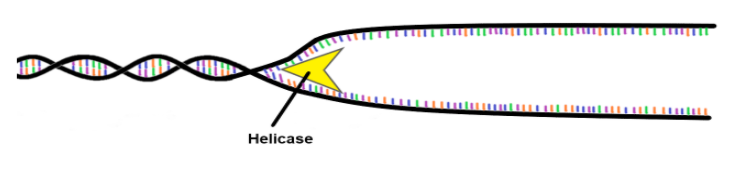
The replication of DNA begins with the separating or breaking of the double strands into the single strand. This work is done by the enzyme helicase which breaks the hydrogen bond between the two strands and unwinds the DNA. This forms the Y shaped replication fork. Now the two strands act as a template for the further enzymatic actions like the binding of DNA polymerase and the primer and the making of a new strand.
The helicase enzyme separates the two strands until the replication process is complete. The helicases are the enzymes that help in unzipping the DNA.
Note: There are around 95 types of helicases present in human beings. The other role of helicase are-
- They are required in transcription.
- The helicases help in the repair of the DNA.
- Helicase is also important for recombination and bacterial conjugation.
- The mutation in the helicase activity leads to genetic diseases.
Complete answer:
DNA is a complex molecule that is present in the chromosome. The DNA is a double-stranded helix. In this, the two strands are complementary to each other and are joined by the hydrogen bond between the complementary bases present in the strands.
The replication of DNA begins with the separating or breaking of the double strands into the single strand. This work is done by the enzyme helicase which breaks the hydrogen bond between the two strands and unwinds the DNA. This forms the Y shaped replication fork. Now the two strands act as a template for the further enzymatic actions like the binding of DNA polymerase and the primer and the making of a new strand.
The helicase enzyme separates the two strands until the replication process is complete. The helicases are the enzymes that help in unzipping the DNA.
Note: There are around 95 types of helicases present in human beings. The other role of helicase are-
- They are required in transcription.
- The helicases help in the repair of the DNA.
- Helicase is also important for recombination and bacterial conjugation.
- The mutation in the helicase activity leads to genetic diseases.
Recently Updated Pages
If x a + bt + ct2 where x is in meters and t is in class 11 physics CBSE

A car covers the first half distance between two places class 11 physics CBSE
The resultant of two vectors overrightarrow P and overrightarrow class 11 physics CBSE
Find the value of cos 135 class 11 maths CBSE
A mass M is held in place by an applied force F and class 11 physics CBSE
A solution of glucose in water is labelled as 10 dfracwv class 11 chemistry CBSE
Trending doubts
Find the value of the expression given below sin 30circ class 11 maths CBSE
One Metric ton is equal to kg A 10000 B 1000 C 100 class 11 physics CBSE
Draw a diagram of nephron and explain its structur class 11 biology CBSE
10 examples of friction in our daily life
Proton was discovered by A Thomson B Rutherford C Chadwick class 11 chemistry CBSE
Bond order ofO2 O2+ O2 and O22 is in order A O2 langle class 11 chemistry CBSE