




Rate constant k of a reaction varies with temperature according to the equation \[{\text{log}}\,{\text{k}}\,{\text{ = }}\,{\text{constant}}\,{\text{ - }}\,\dfrac{{{{\text{E}}_{\text{a}}}}}{{{\text{2}}{\text{.303}}}}\,{\text{ \times }}\,\dfrac{{\text{1}}}{{\text{T}}}\] where \[{E_a}\] is the energy of activation for the reaction. When a graph is plotted for \[{\text{log}}\,{\text{k}}\] vs \[\dfrac{{\text{1}}}{{\text{T}}}\] a straight line with a slope \[ - 6670\,K\] is obtained. The activation energy for this reaction will be: \[(R\, = \,8.314\,J{K^{ - 1}}mo{l^{ - 1}})\]
\[A.\,122.65\,kJmo{l^{ - 1}}\]
\[B.\,127.71\,kJmo{l^{ - 1}}\]
\[C.\,142.34\,kJmo{l^{ - 1}}\]
\[D.\,150.00\,kJmo{l^{ - 1}}\]
Answer
 Verified
572.4k+ views
Hint:The minimum amount of extra energy required by a reacting molecule to get converted into product is called the activation energy. In the presence of a catalyst, the activation energy decreases a bit. The activation energy can also be described as the minimum amount of energy needed to activate molecules or atoms so that they can undergo a chemical reaction. Activation energy is denoted by \[{E_a}\] . It is usually measured in joules \[\left( J \right)\] and or \[k\,J\,mo{l^{ - 1}}\] or \[k\,cal\,mo{l^{ - 1}}\] .
Complete step-by-step answer:The given Arrhenius equation;
\[{\text{log}}\,{\text{k}}\,{\text{ = }}\,{\text{constant}}\,{\text{ - }}\,\dfrac{{{{\text{E}}_{\text{a}}}}}{{{\text{2}}{\text{.303}}}}\,{\text{ \times }}\,\dfrac{{\text{1}}}{{\text{T}}}\]
Let’s write constant as \[log{\text{ }}A\] ;
Now, we know that the plotted graph is a straight line; which means,
\[y\, = \,c\, + \,mx\]
Therefore, \[y\] will be \[\log \,k\], \[c\] will be \[\,{\text{constant}}\,\]i.e., \[log{\text{ }}A\] and the remaining term \[mx\] will be \[{\text{ - }}\,\dfrac{{{{\text{E}}_{\text{a}}}}}{{{\text{2}}{\text{.303}}}}\,{\text{ \times }}\,\dfrac{{\text{1}}}{{\text{T}}}\] where \[x\]will be \[\left[ {\dfrac{{\text{1}}}{{\text{T}}}} \right]\].
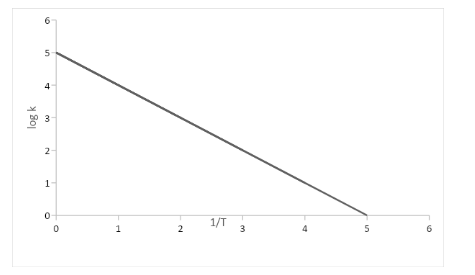
In this graph, we are able to observe that \[\left[ {\dfrac{{\text{1}}}{{\text{T}}}} \right]\] which is on \[x\] axis and \[\log \,k\] values on \[y\] axis.
Where the given intercept value which will be our term \[c\] .
\[ = \, - \,\dfrac{{{E_a}}}{{2.303\,R}}\]
Now, we need to find \[{E_a}\], i.e., activation energy.
So, let’s write the reaction in which the values are given;
slope \[ = \, - 6670\,K\]
let’s observe the equation, we need to find activation and we have the value of slope.
So,
Slope of the line \[ = \, - \,\dfrac{{{E_a}}}{{2.303\,R}}\]
\[{E_a}\, = \, - 2.303\,R\, \times \,slope\,of\,the\,line\]
\[slope\, = \, - 6670\,K\]
\[{E_a}\, = \, - 2.303\,R\, \times \,8.314\, \times \,( - 6670)\]
\[ = 127711.4\]
\[ = 127.71\,KJmo{l^{ - 1}}\]
So, the activation energy is \[127.71\,KJmo{l^{ - 1}}\]
Therefore, the correct answer is option \[B.\,127.71\,kJmo{l^{ - 1}}\]
Note:A catalyst is a chemical substance that either increases or decreases the rate of a chemical reaction. In the case of activation energy, a catalyst lowers it. Since, the energies of the reactants will remain the same. A catalyst only changes the activation energy. There can be positive catalysts or else negative catalysts too.
Complete step-by-step answer:The given Arrhenius equation;
\[{\text{log}}\,{\text{k}}\,{\text{ = }}\,{\text{constant}}\,{\text{ - }}\,\dfrac{{{{\text{E}}_{\text{a}}}}}{{{\text{2}}{\text{.303}}}}\,{\text{ \times }}\,\dfrac{{\text{1}}}{{\text{T}}}\]
Let’s write constant as \[log{\text{ }}A\] ;
Now, we know that the plotted graph is a straight line; which means,
\[y\, = \,c\, + \,mx\]
Therefore, \[y\] will be \[\log \,k\], \[c\] will be \[\,{\text{constant}}\,\]i.e., \[log{\text{ }}A\] and the remaining term \[mx\] will be \[{\text{ - }}\,\dfrac{{{{\text{E}}_{\text{a}}}}}{{{\text{2}}{\text{.303}}}}\,{\text{ \times }}\,\dfrac{{\text{1}}}{{\text{T}}}\] where \[x\]will be \[\left[ {\dfrac{{\text{1}}}{{\text{T}}}} \right]\].
In this graph, we are able to observe that \[\left[ {\dfrac{{\text{1}}}{{\text{T}}}} \right]\] which is on \[x\] axis and \[\log \,k\] values on \[y\] axis.
Where the given intercept value which will be our term \[c\] .
\[ = \, - \,\dfrac{{{E_a}}}{{2.303\,R}}\]
Now, we need to find \[{E_a}\], i.e., activation energy.
So, let’s write the reaction in which the values are given;
slope \[ = \, - 6670\,K\]
let’s observe the equation, we need to find activation and we have the value of slope.
So,
Slope of the line \[ = \, - \,\dfrac{{{E_a}}}{{2.303\,R}}\]
\[{E_a}\, = \, - 2.303\,R\, \times \,slope\,of\,the\,line\]
\[slope\, = \, - 6670\,K\]
\[{E_a}\, = \, - 2.303\,R\, \times \,8.314\, \times \,( - 6670)\]
\[ = 127711.4\]
\[ = 127.71\,KJmo{l^{ - 1}}\]
So, the activation energy is \[127.71\,KJmo{l^{ - 1}}\]
Therefore, the correct answer is option \[B.\,127.71\,kJmo{l^{ - 1}}\]
Note:A catalyst is a chemical substance that either increases or decreases the rate of a chemical reaction. In the case of activation energy, a catalyst lowers it. Since, the energies of the reactants will remain the same. A catalyst only changes the activation energy. There can be positive catalysts or else negative catalysts too.
Recently Updated Pages
Master Class 12 Business Studies: Engaging Questions & Answers for Success

Master Class 12 Biology: Engaging Questions & Answers for Success
Master Class 12 Chemistry: Engaging Questions & Answers for Success
Class 12 Question and Answer - Your Ultimate Solutions Guide
Master Class 11 Social Science: Engaging Questions & Answers for Success
Master Class 11 English: Engaging Questions & Answers for Success
Trending doubts
Which are the Top 10 Largest Countries of the World?
Draw a labelled sketch of the human eye class 12 physics CBSE
Differentiate between homogeneous and heterogeneous class 12 chemistry CBSE
Sulphuric acid is known as the king of acids State class 12 chemistry CBSE
Why is the cell called the structural and functional class 12 biology CBSE
Which is the correct genotypic ratio of mendel dihybrid class 12 biology CBSE