




Prove that $ \tan \left( {{\tan }^{-1}}x \right)=x,x\in \mathbb{R} $
Answer
 Verified
614.7k+ views
Hint: Use the fact that if $ y={{\tan }^{-1}}x $ , then $ x=\tan y $ . Assume $ y={{\tan }^{-1}}x $ . Write $ \tan \left( {{\tan }^{-1}}x \right) $ in terms of y and hence prove the above result.
Complete step-by-step answer:
Before dwelling into the proof of the above question, we must understand how $ {{\tan }^{-1}}x $ is defined even when $ \tan x $ is not one-one.
We know that tanx is a periodic function.
Let us draw the graph of tanx
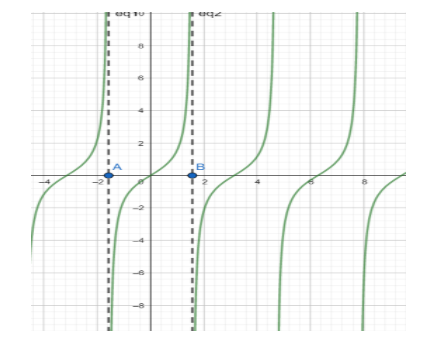
As is evident from the graph tanx is a repeated chunk of the graph of tanx within the interval (A, B) and it attains all its possible values in the interval (A, B)
Hence if we consider tanx in the interval [A, B], we will lose no value attained by tanx, and at the same time, tanx will be one-one and onto.
Hence $ {{\tan }^{-1}}x $ is defined over the Domain $ \mathbb{R} $ , with codomain $ \left( \dfrac{-\pi }{2},\dfrac{\pi }{2} \right) $ as in the Domain $ \left( \dfrac{-\pi }{2},\dfrac{\pi }{2} \right) $ , tanx is one-one and $ \text{Range}\left( \tan x \right)=\mathbb{R} $ .
Now since $ {{\tan }^{-1}}x $ is the inverse of tanx it satisfies the fact that if $ y={{\tan }^{-1}}x $ , then $ \tan y=x $ .
So let $ y={{\tan }^{-1}}x $
Hence we have tany = x.
Now $ \tan \left( {{\tan }^{-1}}x \right)=\tan y $
Hence we have $ \tan \left( {{\tan }^{-1}}x \right)=x $ .
Also as x is the Domain of $ {{\tan }^{-1}}x $ , we have $ x\in \mathbb{R} $ .
Hence $ \tan \left( {{\tan }^{-1}}x \right)=x,x\in \mathbb{R} $
Note: [1] The above-specified codomain for arctanx is called principal branch for $ {{\tan }^{-1}}x $ . We can select any branch as long as $ \tan x $ is one-one and onto and Range $ =\mathbb{R} $ . Like instead of $ \left( -\dfrac{\pi }{2},\dfrac{\pi }{2} \right) $ , we can select the interval $ \left( \dfrac{\pi }{2},\dfrac{3\pi }{2} \right) $ . The proof will remain the same as above.
Complete step-by-step answer:
Before dwelling into the proof of the above question, we must understand how $ {{\tan }^{-1}}x $ is defined even when $ \tan x $ is not one-one.
We know that tanx is a periodic function.
Let us draw the graph of tanx
As is evident from the graph tanx is a repeated chunk of the graph of tanx within the interval (A, B) and it attains all its possible values in the interval (A, B)
Hence if we consider tanx in the interval [A, B], we will lose no value attained by tanx, and at the same time, tanx will be one-one and onto.
Hence $ {{\tan }^{-1}}x $ is defined over the Domain $ \mathbb{R} $ , with codomain $ \left( \dfrac{-\pi }{2},\dfrac{\pi }{2} \right) $ as in the Domain $ \left( \dfrac{-\pi }{2},\dfrac{\pi }{2} \right) $ , tanx is one-one and $ \text{Range}\left( \tan x \right)=\mathbb{R} $ .
Now since $ {{\tan }^{-1}}x $ is the inverse of tanx it satisfies the fact that if $ y={{\tan }^{-1}}x $ , then $ \tan y=x $ .
So let $ y={{\tan }^{-1}}x $
Hence we have tany = x.
Now $ \tan \left( {{\tan }^{-1}}x \right)=\tan y $
Hence we have $ \tan \left( {{\tan }^{-1}}x \right)=x $ .
Also as x is the Domain of $ {{\tan }^{-1}}x $ , we have $ x\in \mathbb{R} $ .
Hence $ \tan \left( {{\tan }^{-1}}x \right)=x,x\in \mathbb{R} $
Note: [1] The above-specified codomain for arctanx is called principal branch for $ {{\tan }^{-1}}x $ . We can select any branch as long as $ \tan x $ is one-one and onto and Range $ =\mathbb{R} $ . Like instead of $ \left( -\dfrac{\pi }{2},\dfrac{\pi }{2} \right) $ , we can select the interval $ \left( \dfrac{\pi }{2},\dfrac{3\pi }{2} \right) $ . The proof will remain the same as above.
Recently Updated Pages
Three beakers labelled as A B and C each containing 25 mL of water were taken A small amount of NaOH anhydrous CuSO4 and NaCl were added to the beakers A B and C respectively It was observed that there was an increase in the temperature of the solutions contained in beakers A and B whereas in case of beaker C the temperature of the solution falls Which one of the following statements isarecorrect i In beakers A and B exothermic process has occurred ii In beakers A and B endothermic process has occurred iii In beaker C exothermic process has occurred iv In beaker C endothermic process has occurred

Master Class 12 Social Science: Engaging Questions & Answers for Success
Master Class 12 Physics: Engaging Questions & Answers for Success
Master Class 12 Maths: Engaging Questions & Answers for Success
Master Class 12 Economics: Engaging Questions & Answers for Success
Master Class 12 Chemistry: Engaging Questions & Answers for Success
Three beakers labelled as A B and C each containing 25 mL of water were taken A small amount of NaOH anhydrous CuSO4 and NaCl were added to the beakers A B and C respectively It was observed that there was an increase in the temperature of the solutions contained in beakers A and B whereas in case of beaker C the temperature of the solution falls Which one of the following statements isarecorrect i In beakers A and B exothermic process has occurred ii In beakers A and B endothermic process has occurred iii In beaker C exothermic process has occurred iv In beaker C endothermic process has occurred
Master Class 12 Social Science: Engaging Questions & Answers for Success
Master Class 12 Physics: Engaging Questions & Answers for Success
Trending doubts
Which are the Top 10 Largest Countries of the World?
Draw a labelled sketch of the human eye class 12 physics CBSE
What are the major means of transport Explain each class 12 social science CBSE
Differentiate between homogeneous and heterogeneous class 12 chemistry CBSE
Sulphuric acid is known as the king of acids State class 12 chemistry CBSE
Why should a magnesium ribbon be cleaned before burning class 12 chemistry CBSE