




What is the product of the oxidation of a ketone?
Answer
 Verified
555.6k+ views
Hint : In a chemical reaction, oxidation happens when an atom, molecule, or ion loses one or more electrons. The oxidation state of a chemical species increases as it undergoes oxidation. Oxidation does not always require the presence of oxygen.
Complete Step By Step Answer:
A ketone is a functional group that has the structure,
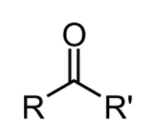
\[R\] can be any carbon-based substituent, carbonyl groups, a carbon-oxygen double bond, found in ketone molecules.
A ketone can't be oxidized any further by removing a hydrogen atom. When attempting to oxidize a ketone in this manner, there is no substance.
After that, we're attempting to reduce a ketone. We'll move on to secondary alcohol.
Using the secondary alcohol, we're attempting to achieve a ketone through the Swern oxidation, which necessitates the attachment of a proton to the carbonyl carbon. Since there are no protons attached to the carbonyl carbon in a ketone, this method is impossible to perform.
Baeyer-Villiger oxidation could result in the formation of an ester, but that's a rare reaction.
So, there is no oxidation product for a ketone.
Additional Information:
A difference between an aldehyde and a ketone is that an aldehyde has a hydrogen atom attached to its carbonyl group, making it easier to oxidize. Ketones are more prone to oxidation because they do not have a hydrogen atom bound to the carbonyl group.
Note :
Ketones can be found all over the place in nature. Many carbohydrates are ketones, which are referred to as ketoses collectively. Fructose is the most well-known ketose; it exists as a cyclic hemiketal that hides the ketone functional group. Ketones are used in the synthesis of fatty acids. Acetoacetate is a product of the Krebs cycle, which converts sugars and carbohydrates into energy.
Complete Step By Step Answer:
A ketone is a functional group that has the structure,
\[R\] can be any carbon-based substituent, carbonyl groups, a carbon-oxygen double bond, found in ketone molecules.
A ketone can't be oxidized any further by removing a hydrogen atom. When attempting to oxidize a ketone in this manner, there is no substance.
After that, we're attempting to reduce a ketone. We'll move on to secondary alcohol.
Using the secondary alcohol, we're attempting to achieve a ketone through the Swern oxidation, which necessitates the attachment of a proton to the carbonyl carbon. Since there are no protons attached to the carbonyl carbon in a ketone, this method is impossible to perform.
Baeyer-Villiger oxidation could result in the formation of an ester, but that's a rare reaction.
So, there is no oxidation product for a ketone.
Additional Information:
A difference between an aldehyde and a ketone is that an aldehyde has a hydrogen atom attached to its carbonyl group, making it easier to oxidize. Ketones are more prone to oxidation because they do not have a hydrogen atom bound to the carbonyl group.
Note :
Ketones can be found all over the place in nature. Many carbohydrates are ketones, which are referred to as ketoses collectively. Fructose is the most well-known ketose; it exists as a cyclic hemiketal that hides the ketone functional group. Ketones are used in the synthesis of fatty acids. Acetoacetate is a product of the Krebs cycle, which converts sugars and carbohydrates into energy.
Recently Updated Pages
Master Class 12 Economics: Engaging Questions & Answers for Success

Master Class 12 English: Engaging Questions & Answers for Success
Master Class 12 Social Science: Engaging Questions & Answers for Success
Master Class 12 Maths: Engaging Questions & Answers for Success
Master Class 12 Physics: Engaging Questions & Answers for Success
Master Class 9 General Knowledge: Engaging Questions & Answers for Success
Trending doubts
Which are the Top 10 Largest Countries of the World?
Draw a labelled sketch of the human eye class 12 physics CBSE
Differentiate between homogeneous and heterogeneous class 12 chemistry CBSE
Sulphuric acid is known as the king of acids State class 12 chemistry CBSE
Why is the cell called the structural and functional class 12 biology CBSE
Draw ray diagrams each showing i myopic eye and ii class 12 physics CBSE