




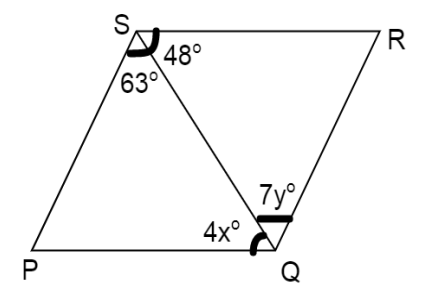
PQRS is a parallelogram. From the information given in the figure, find the values of $x$ and $y$.
Answer
 Verified
593.1k+ views
Hint: We can solve this problem by using properties of angles of triangle and parallelogram. Since the diagonal is drawn, it is divided into two triangles. Also, these two triangles are congruent. Angle sum of a triangle and relation between opposite angles of a parallelogram are known.
Useful formula:
Sum of angles of a triangle is \[{180^ \circ }\].
Opposite angles of a parallelogram are equal.
Complete step by step solution:
Given a parallelogram with one of the diagonals drawn. So, we have two triangles here, $\Delta PQS$ and $\Delta SQR$.
Sum of angles of a triangle is \[{180^ \circ }\].
Consider $\Delta PQS$
we have, $\angle P + \angle PQS + \angle QSP = {180^ \circ }$
$ \Rightarrow \angle P + 4x + {63^ \circ } = {180^ \circ }$
Simplifying we get,
$ \Rightarrow \angle P + 4x = {180^ \circ } - {63^ \circ }$
$ \Rightarrow \angle P + 4x = {117^ \circ } - - - (i)$
Similarly consider $\Delta SQR$,
$\angle RSQ + SQR + QRS = {180^ \circ }$
Substituting we get,
$ \Rightarrow {48^ \circ } + 7y + \angle R = {180^ \circ }$
Simplifying we get,
$ \Rightarrow 7y + \angle R = {180^ \circ } - {48^ \circ }$
$ \Rightarrow 7y + \angle R = {132^ \circ } - - - (ii)$
Opposite angles of a parallelogram are equal.
$ \Rightarrow \angle P = \angle R = k(say)$
$(i) \Rightarrow k + 4x = {117^ \circ }$
$(ii) \Rightarrow 7y + k = {132^ \circ }$
Adding these two equations we get,
$k + 4x + 7y + k = {117^ \circ } + {132^ \circ }$
$ \Rightarrow 4x + 7y + 2k = {249^ \circ } - - - (iii)$
Also, $\angle Q = \angle S \Rightarrow 4x + 7y = {63^ \circ } + {48^ \circ }$
$ \Rightarrow 4x + 7y = {111^ \circ } - - - (iv)$
Comparing $(iii)$ and $(iv)$ we get,
$2k = {249^ \circ } - {111^ \circ } = {138^ \circ }$
Dividing by $2$ we have,
$ \Rightarrow k = \dfrac{{138}}{2} = {69^ \circ }$
Therefore, $\angle P = \angle R = {69^ \circ }$
So, from $(i),4x = {117^ \circ } - \angle P = 117^\circ - 69^\circ = 48^\circ $
$ \Rightarrow x = \dfrac{{48^\circ }}{4} = 12^\circ $
Also, from $(ii),7y = 132^\circ - 69^\circ = 63^\circ $
$ \Rightarrow y = \dfrac{{{{63}^ \circ }}}{7} = {9^ \circ }$
$\therefore x = {12^ \circ },y = {9^ \circ }$
Additional information:
For any polygon with $n$ sides,
Sum of interior angles is equal to $(n - 2){90^ \circ }$.
Sum of exterior angles is equal to ${360^ \circ }$.
Note:Here we used two properties to establish the relation between the given angles. Sum of angles of a triangle is \[{180^ \circ }\] and opposite angles of a parallelogram are equal. Also, we have other facts as well. Sum of angles of a parallelogram (actually any quadrilateral) is ${360^ \circ }$. And also, adjacent angles of a parallelogram are supplementary (that is angle sum is equal to ${180^ \circ }$). We can consider any of these properties individually or combined to solve this question.
Useful formula:
Sum of angles of a triangle is \[{180^ \circ }\].
Opposite angles of a parallelogram are equal.
Complete step by step solution:
Given a parallelogram with one of the diagonals drawn. So, we have two triangles here, $\Delta PQS$ and $\Delta SQR$.
Sum of angles of a triangle is \[{180^ \circ }\].
Consider $\Delta PQS$
we have, $\angle P + \angle PQS + \angle QSP = {180^ \circ }$
$ \Rightarrow \angle P + 4x + {63^ \circ } = {180^ \circ }$
Simplifying we get,
$ \Rightarrow \angle P + 4x = {180^ \circ } - {63^ \circ }$
$ \Rightarrow \angle P + 4x = {117^ \circ } - - - (i)$
Similarly consider $\Delta SQR$,
$\angle RSQ + SQR + QRS = {180^ \circ }$
Substituting we get,
$ \Rightarrow {48^ \circ } + 7y + \angle R = {180^ \circ }$
Simplifying we get,
$ \Rightarrow 7y + \angle R = {180^ \circ } - {48^ \circ }$
$ \Rightarrow 7y + \angle R = {132^ \circ } - - - (ii)$
Opposite angles of a parallelogram are equal.
$ \Rightarrow \angle P = \angle R = k(say)$
$(i) \Rightarrow k + 4x = {117^ \circ }$
$(ii) \Rightarrow 7y + k = {132^ \circ }$
Adding these two equations we get,
$k + 4x + 7y + k = {117^ \circ } + {132^ \circ }$
$ \Rightarrow 4x + 7y + 2k = {249^ \circ } - - - (iii)$
Also, $\angle Q = \angle S \Rightarrow 4x + 7y = {63^ \circ } + {48^ \circ }$
$ \Rightarrow 4x + 7y = {111^ \circ } - - - (iv)$
Comparing $(iii)$ and $(iv)$ we get,
$2k = {249^ \circ } - {111^ \circ } = {138^ \circ }$
Dividing by $2$ we have,
$ \Rightarrow k = \dfrac{{138}}{2} = {69^ \circ }$
Therefore, $\angle P = \angle R = {69^ \circ }$
So, from $(i),4x = {117^ \circ } - \angle P = 117^\circ - 69^\circ = 48^\circ $
$ \Rightarrow x = \dfrac{{48^\circ }}{4} = 12^\circ $
Also, from $(ii),7y = 132^\circ - 69^\circ = 63^\circ $
$ \Rightarrow y = \dfrac{{{{63}^ \circ }}}{7} = {9^ \circ }$
$\therefore x = {12^ \circ },y = {9^ \circ }$
Additional information:
For any polygon with $n$ sides,
Sum of interior angles is equal to $(n - 2){90^ \circ }$.
Sum of exterior angles is equal to ${360^ \circ }$.
Note:Here we used two properties to establish the relation between the given angles. Sum of angles of a triangle is \[{180^ \circ }\] and opposite angles of a parallelogram are equal. Also, we have other facts as well. Sum of angles of a parallelogram (actually any quadrilateral) is ${360^ \circ }$. And also, adjacent angles of a parallelogram are supplementary (that is angle sum is equal to ${180^ \circ }$). We can consider any of these properties individually or combined to solve this question.
Recently Updated Pages
Basicity of sulphurous acid and sulphuric acid are

Master Class 8 Social Science: Engaging Questions & Answers for Success
Master Class 8 Science: Engaging Questions & Answers for Success
Master Class 8 Maths: Engaging Questions & Answers for Success
Class 8 Question and Answer - Your Ultimate Solutions Guide
Master Class 11 Business Studies: Engaging Questions & Answers for Success
Trending doubts
What are gulf countries and why they are called Gulf class 8 social science CBSE
What is BLO What is the full form of BLO class 8 social science CBSE
What are the 12 elements of nature class 8 chemistry CBSE
In Indian rupees 1 trillion is equal to how many c class 8 maths CBSE
Who created the image of Bharat Mata for the first class 8 social science CBSE
What is the Balkan issue in brief class 8 social science CBSE