




Positive and negative point charges of equal magnitude are kept at $\left(0,0,\dfrac{a}{2}\right)$ and $\left(0,0,\dfrac{-a}{2}\right)$, respectively. The work done by the electric field when another positive point charge is moved from $(-a,0,0)$ to $(0,a,0)$ is:
A. positive
B. negative
C. Zero
D. depends on the path connecting the initial and the final positions
Answer
 Verified
583.8k+ views
Hint: Electric field is the electric force due to a unit positive charge which is at rest would exert on its surrounding. We also know that the electric potential due to a charge is defined as the amount of energy needed to move a unit positive charge to infinity.
Formula:
$V=\dfrac{kq}{r}$
Complete step-by-step solution
We also know that the electric potential due to a charge $q$ is defined as the amount of energy needed to move a unit positive charge to infinity. Also the potential at any point is the vector sum of potentials at that point. Also, potential energy is defined as the work done in moving a unit positive charge from infinity.
Also, potential is proportional to the charge and inversely proportional to the distance between the point and the charge. $V = \dfrac{{kq}}{r}$, where $r$ is the distance between the unit charges and which is a constant.
Consider the point A $\left( {0,0,\dfrac{a}{2}} \right)$ and B $\left( {0,0,\dfrac{{ - a}}{2}} \right)$ in space. Such that $q$ and $ - q$ are placed respectively. Consider another positive charge $Q$ to move from S $( - a,0,0)$ to T $(0,a,0)$as shown in figure below:
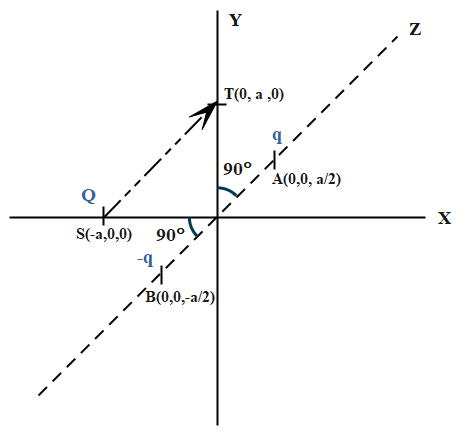
From the diagram it is clear that the two point charges q and –q form a dipole with distance 2a between them. Also, that angle between the three axes must be 90 degrees as they are mutually perpendicular to each other.
Now, the work done W, to move the charge Q from point S to T will be given by:
$W = q\left( {{V_B} - {V_A}} \right)$
But if we look at the dipole system alone, then the charge Q lies on its equatorial surface as shown in figure below:
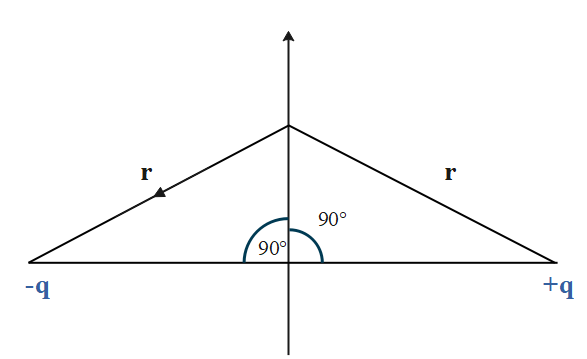
So if we find potential at a point having distance r from both the charges, we have:
$\eqalign{
& V = {V_{ - q}} + {V_{ + q}} \cr
& V = \dfrac{1}{{4\pi {\varepsilon _ \circ }}}\left( { - q + q} \right) = 0 \cr} $
Hence clearly for the given system also, ${V_B} - {V_A} = 0$ as the axes are mutually perpendicular to each other. So the work done will be given as:
$\eqalign{
& W = q\left( {{V_B} - {V_A}} \right) \cr
& \Rightarrow W = q\left( 0 \right) \cr
& \therefore W = 0 \cr} $
Therefore, the correct option is C, i.e. the work done by the electric field when another positive point charge is moved from $( - a,0,0)$ to $(0,a,0)$ is zero.
Note: Since the charges are opposite to each other, we can say that AB acts as dipoles of some length along the z-axis. Now the point S and T are on the x and y-axis respectively. Since x, y, and z are perpendicular to each other, we can say that the new point is at the equatorial position with respect to the AB dipole. Hence the potential at S and T with respect to the dipole AB is always 0.
Formula:
$V=\dfrac{kq}{r}$
Complete step-by-step solution
We also know that the electric potential due to a charge $q$ is defined as the amount of energy needed to move a unit positive charge to infinity. Also the potential at any point is the vector sum of potentials at that point. Also, potential energy is defined as the work done in moving a unit positive charge from infinity.
Also, potential is proportional to the charge and inversely proportional to the distance between the point and the charge. $V = \dfrac{{kq}}{r}$, where $r$ is the distance between the unit charges and which is a constant.
Consider the point A $\left( {0,0,\dfrac{a}{2}} \right)$ and B $\left( {0,0,\dfrac{{ - a}}{2}} \right)$ in space. Such that $q$ and $ - q$ are placed respectively. Consider another positive charge $Q$ to move from S $( - a,0,0)$ to T $(0,a,0)$as shown in figure below:
From the diagram it is clear that the two point charges q and –q form a dipole with distance 2a between them. Also, that angle between the three axes must be 90 degrees as they are mutually perpendicular to each other.
Now, the work done W, to move the charge Q from point S to T will be given by:
$W = q\left( {{V_B} - {V_A}} \right)$
But if we look at the dipole system alone, then the charge Q lies on its equatorial surface as shown in figure below:
So if we find potential at a point having distance r from both the charges, we have:
$\eqalign{
& V = {V_{ - q}} + {V_{ + q}} \cr
& V = \dfrac{1}{{4\pi {\varepsilon _ \circ }}}\left( { - q + q} \right) = 0 \cr} $
Hence clearly for the given system also, ${V_B} - {V_A} = 0$ as the axes are mutually perpendicular to each other. So the work done will be given as:
$\eqalign{
& W = q\left( {{V_B} - {V_A}} \right) \cr
& \Rightarrow W = q\left( 0 \right) \cr
& \therefore W = 0 \cr} $
Therefore, the correct option is C, i.e. the work done by the electric field when another positive point charge is moved from $( - a,0,0)$ to $(0,a,0)$ is zero.
Note: Since the charges are opposite to each other, we can say that AB acts as dipoles of some length along the z-axis. Now the point S and T are on the x and y-axis respectively. Since x, y, and z are perpendicular to each other, we can say that the new point is at the equatorial position with respect to the AB dipole. Hence the potential at S and T with respect to the dipole AB is always 0.
Recently Updated Pages
Master Class 12 Business Studies: Engaging Questions & Answers for Success

Master Class 12 Biology: Engaging Questions & Answers for Success
Master Class 12 Chemistry: Engaging Questions & Answers for Success
Class 12 Question and Answer - Your Ultimate Solutions Guide
Master Class 11 Social Science: Engaging Questions & Answers for Success
Master Class 11 English: Engaging Questions & Answers for Success
Trending doubts
Which are the Top 10 Largest Countries of the World?
Draw a labelled sketch of the human eye class 12 physics CBSE
Differentiate between homogeneous and heterogeneous class 12 chemistry CBSE
Sulphuric acid is known as the king of acids State class 12 chemistry CBSE
Why is the cell called the structural and functional class 12 biology CBSE
Which is the correct genotypic ratio of mendel dihybrid class 12 biology CBSE