




Pollen grain of insect-pollinated flowers is
(a)Smooth and sticky
(b)Smooth and rough
(c)Rough and dry
(d)Rough and sticky
Answer
 Verified
657.9k+ views
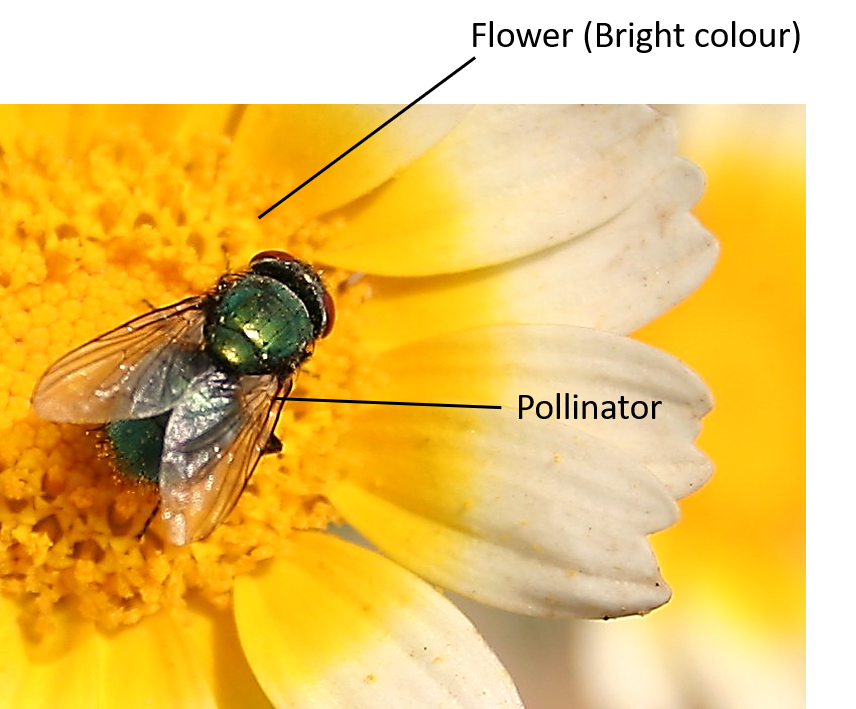
Hint: Bright colored flowers attract insects, which tend to sit on those flowers. For pollination, by an insect, the pollen must attach to the insects thus, such pollen grain has spines and has oily substances around the pollen grain.
Complete answer:
Many flowering plants rely on animals or insects for cross-pollination. Pollen grain sticks to the insect's bodies and is transferred when the insect goes to another flower. The insects pollinate plants to get a reward, which is food or nectar in exchange for moving their pollen to another flower. Flowers can produce two kinds of pollen: a normal and a sterile but tasty for the insects which are highly rich in protein thus, some bees and beetles eat it. Flower to be pollinated by an insect should have the following characters-
They are showy or bright-colored
Most insect-pollinated flowers have a landing platform.
The pollen is spiny, heavy, rough, and surrounded by a yellow oily sticky substance called pollen kit
The stigma is often inserted and sticky.
Some flowers provide a safe place to insects for laying eggs, for example- yucca.
Additional Information: -Insects and animals in pollination are-
Insects- bees, wasps, flies, butterflies, moths
Birds- hummingbirds, honeycreepers
Mammals- bats, mice, monkeys
-Nectar is a sugary solution produced in special flower glands called nectarines. Nectar contraction matches the energy requirements of the pollinator like a bird and bee-pollinated flowers have different sugar concentrations.
So, the correct answer is, ‘rough and sticky.’
Note: -Entomophily condition when the pollen grains are transferred to a mature though the agents of insects like the moth, butterflies, wasps, bees, beetles, etc.
-Ornithophily is a mode of allogamy performed by birds. Such flowers are bright in color, have leathery floral parts and absence of scent.
Complete answer:
Many flowering plants rely on animals or insects for cross-pollination. Pollen grain sticks to the insect's bodies and is transferred when the insect goes to another flower. The insects pollinate plants to get a reward, which is food or nectar in exchange for moving their pollen to another flower. Flowers can produce two kinds of pollen: a normal and a sterile but tasty for the insects which are highly rich in protein thus, some bees and beetles eat it. Flower to be pollinated by an insect should have the following characters-
They are showy or bright-colored
Most insect-pollinated flowers have a landing platform.
The pollen is spiny, heavy, rough, and surrounded by a yellow oily sticky substance called pollen kit
The stigma is often inserted and sticky.
Some flowers provide a safe place to insects for laying eggs, for example- yucca.
Additional Information: -Insects and animals in pollination are-
Insects- bees, wasps, flies, butterflies, moths
Birds- hummingbirds, honeycreepers
Mammals- bats, mice, monkeys
-Nectar is a sugary solution produced in special flower glands called nectarines. Nectar contraction matches the energy requirements of the pollinator like a bird and bee-pollinated flowers have different sugar concentrations.
So, the correct answer is, ‘rough and sticky.’
Note: -Entomophily condition when the pollen grains are transferred to a mature though the agents of insects like the moth, butterflies, wasps, bees, beetles, etc.
-Ornithophily is a mode of allogamy performed by birds. Such flowers are bright in color, have leathery floral parts and absence of scent.
Recently Updated Pages
If x a + bt + ct2 where x is in meters and t is in class 11 physics CBSE

A car covers the first half distance between two places class 11 physics CBSE
The resultant of two vectors overrightarrow P and overrightarrow class 11 physics CBSE
Find the value of cos 135 class 11 maths CBSE
A mass M is held in place by an applied force F and class 11 physics CBSE
A solution of glucose in water is labelled as 10 dfracwv class 11 chemistry CBSE
Trending doubts
Find the value of the expression given below sin 30circ class 11 maths CBSE
One Metric ton is equal to kg A 10000 B 1000 C 100 class 11 physics CBSE
Draw a diagram of nephron and explain its structur class 11 biology CBSE
10 examples of friction in our daily life
Proton was discovered by A Thomson B Rutherford C Chadwick class 11 chemistry CBSE
Bond order ofO2 O2+ O2 and O22 is in order A O2 langle class 11 chemistry CBSE