




Photon with kinetic energy of $1\,MeV$ moves from south to north. It gets an acceleration of ${10^{12}}m{\text{ }}{s^{ - 2}}$ by an applied magnetic field (west to east). The value of magnetic field: (Rest mass of proton is $1.6 \times {10^{ - 27}}kg$):
A. $0.071\,mT$
B. $71\,mT$
C. $0.71\,mT$
D. $7.1\,mT$
Answer
 Verified
478.5k+ views
Hint: To solve this question, one must have a concept of force acting on a magnetic field and kinetic energy then one can easily solve this question. First, we have changed the unit of kinetic energy and then found the velocity of the particle and then using Newton's law of motion we have found the value of the magnetic field and hence we got our required solution.
Formula used:
$Bqv = ma$
Where, $B$ is the magnetic field, $q$ is the charge, $v$ is the velocity, $m$ is the mass and $a$ is the acceleration.
Complete step by step answer:
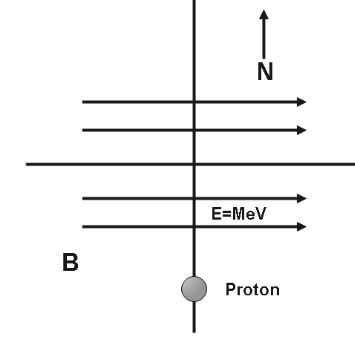
According to the question we have given that,
Kinetic energy of a photon is $1MeV$ and we know that \[1\,eV = 1.6 \times {10^{ - 19}}J\]
$1MeV = 1 \times 10eV = 1.6 \times {10^{ - 13}}J$
Therefore, we can say that,
$K.E = \dfrac{1}{2}m{v^2} = \dfrac{1}{2} \times 1.6 \times {10^{ - 27}} \times {v^2}$
And we have given the mass of the proton i.e., $1.6 \times {10^{ - 27}}kg$
Therefore,
$1.6 \times {10^{ - 13}} = \dfrac{1}{2} \times 1.6 \times {10^{ - 27}} \times {v^2} \\
\Rightarrow v = \sqrt {2 \times {{10}^7}} m{\text{ }}{s^{ - 1}} \\ $
And also, from newton's law we know that, $F = ma$ and in magnet field case the force is equal to $Bqv$
$Bqv = ma$
Now solving for magnetic field,
$Bqv = ma \\
\Rightarrow B = \dfrac{{ma}}{{qv}} \\
\Rightarrow B = \dfrac{{1.6 \times {{10}^{ - 27}} \times {{10}^{12}}}}{{1.6 \times {{10}^{ - 19}} \times \sqrt {2 \times {{10}^7}} }} \\ $
And now on further solving we get,
$B = \dfrac{{1.6 \times {{10}^{ - 27}} \times {{10}^{12}}}}{{1.6 \times {{10}^{ - 19}} \times \sqrt {2 \times {{10}^7}} }} \\
\Rightarrow B = 0.71 \times {10^{ - 3}} \\
\therefore B = 0.71\,mT \\ $
Hence, option A is the correct answer.
Note: Note that unit conversion is must here because we are solving here in standard units. Otherwise you will get the wrong answer. You must remember the formula of force acting on the magnetic field and the relation between the force and acceleration. Also, for easy understanding, draw the diagram Note that direction of magnetic field is given by cross product.
Formula used:
$Bqv = ma$
Where, $B$ is the magnetic field, $q$ is the charge, $v$ is the velocity, $m$ is the mass and $a$ is the acceleration.
Complete step by step answer:
According to the question we have given that,
Kinetic energy of a photon is $1MeV$ and we know that \[1\,eV = 1.6 \times {10^{ - 19}}J\]
$1MeV = 1 \times 10eV = 1.6 \times {10^{ - 13}}J$
Therefore, we can say that,
$K.E = \dfrac{1}{2}m{v^2} = \dfrac{1}{2} \times 1.6 \times {10^{ - 27}} \times {v^2}$
And we have given the mass of the proton i.e., $1.6 \times {10^{ - 27}}kg$
Therefore,
$1.6 \times {10^{ - 13}} = \dfrac{1}{2} \times 1.6 \times {10^{ - 27}} \times {v^2} \\
\Rightarrow v = \sqrt {2 \times {{10}^7}} m{\text{ }}{s^{ - 1}} \\ $
And also, from newton's law we know that, $F = ma$ and in magnet field case the force is equal to $Bqv$
$Bqv = ma$
Now solving for magnetic field,
$Bqv = ma \\
\Rightarrow B = \dfrac{{ma}}{{qv}} \\
\Rightarrow B = \dfrac{{1.6 \times {{10}^{ - 27}} \times {{10}^{12}}}}{{1.6 \times {{10}^{ - 19}} \times \sqrt {2 \times {{10}^7}} }} \\ $
And now on further solving we get,
$B = \dfrac{{1.6 \times {{10}^{ - 27}} \times {{10}^{12}}}}{{1.6 \times {{10}^{ - 19}} \times \sqrt {2 \times {{10}^7}} }} \\
\Rightarrow B = 0.71 \times {10^{ - 3}} \\
\therefore B = 0.71\,mT \\ $
Hence, option A is the correct answer.
Note: Note that unit conversion is must here because we are solving here in standard units. Otherwise you will get the wrong answer. You must remember the formula of force acting on the magnetic field and the relation between the force and acceleration. Also, for easy understanding, draw the diagram Note that direction of magnetic field is given by cross product.
Recently Updated Pages
Master Class 12 Economics: Engaging Questions & Answers for Success

Master Class 12 Physics: Engaging Questions & Answers for Success
Master Class 12 English: Engaging Questions & Answers for Success
Master Class 12 Social Science: Engaging Questions & Answers for Success
Master Class 12 Maths: Engaging Questions & Answers for Success
Master Class 12 Business Studies: Engaging Questions & Answers for Success
Trending doubts
Why cannot DNA pass through cell membranes class 12 biology CBSE
Differentiate between insitu conservation and exsitu class 12 biology CBSE
Draw a neat and well labeled diagram of TS of ovary class 12 biology CBSE
In a human foetus the limbs and digits develop after class 12 biology CBSE
AABbCc genotype forms how many types of gametes a 4 class 12 biology CBSE
The correct structure of ethylenediaminetetraacetic class 12 chemistry CBSE