




Pasteur’s experiments and similar ones that followed, convinced most people that spontaneous generation of life did not happen because
A. Pasteur was extremely meticulous.
B. Pasteur used very fine mesh screens to cover his flasks.
C. Pasteur did not boil his flasks for a long time.
D. Pasteur’s swan-necked flasks ruled out the objection that spoiled air could have contaminated his experiments.
Answer
 Verified
590.7k+ views
Hint: The old concept of the formation of the living organism suggested that organisms arise from non-living matter. This was named the theory of spontaneous generation. Pasteur with his well-designed experiments using S-shaped flask and broth disproved this concept.
Complete answer: Pasteur, the father of immunology was a French scientist who in 1859 performed a groundbreaking experiment on ‘Biogenesis theory.’ In the old times, people believed that life arose from non-living matter. This thought was named as the theory of spontaneous generation and was widely accepted earlier. In the middle of the eighteenth century, another theory that contrasted the concept of spontaneous theory originated was named the theory of biogenesis. The concept of biogenesis was based on the fact that life arises from pre-existing life. This thought was highly rejected by many people. In support of this thought, Pasteur performed the famous swan-neck flask experiment.
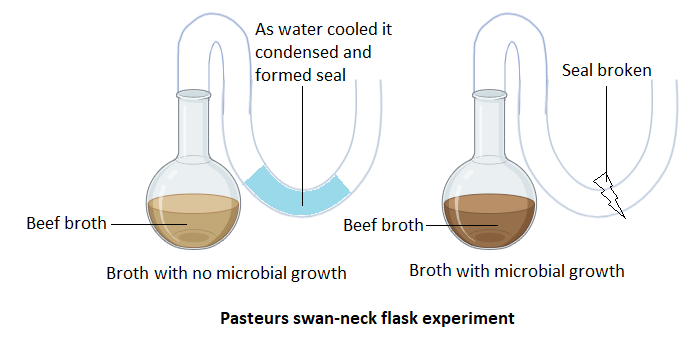
Pasteur’s experiment aimed to prove that microbes live suspended in air and can cause contamination of water, food, etc. Pasteur boiled the beef broth in a flask which was specially designed to have a long bent neck downwards and then upwards. This special flask was named a swan-neck flask or S-flask. This flask was specialized to allow free diffusion of air and at the same time prevention of bacterial contamination was ensured. Pasteur first sterilized the broth and then left it for cooling. The condensing water formed the bubble on the S-part of the flask which was sealed effectively. This allowed the prevention of growth of any microbe on the broth even if the broth was in contact with the environment. This confirmed that microbes cannot originate from thin air. Microbes were able to grow on the broth only when the swan neck was broken. So, Pasteur was successful in proving that the growth of microbes was not spontaneous.
Thus, option D is the right answer.
Note: The idea of spontaneous generation dates back to the time of Aristotle. He was the first to propound the theory of spontaneous generation in Ancient Greece. At that time the spontaneous generation thought was named Aristotelian Abiogenesis.
Complete answer: Pasteur, the father of immunology was a French scientist who in 1859 performed a groundbreaking experiment on ‘Biogenesis theory.’ In the old times, people believed that life arose from non-living matter. This thought was named as the theory of spontaneous generation and was widely accepted earlier. In the middle of the eighteenth century, another theory that contrasted the concept of spontaneous theory originated was named the theory of biogenesis. The concept of biogenesis was based on the fact that life arises from pre-existing life. This thought was highly rejected by many people. In support of this thought, Pasteur performed the famous swan-neck flask experiment.
Pasteur’s experiment aimed to prove that microbes live suspended in air and can cause contamination of water, food, etc. Pasteur boiled the beef broth in a flask which was specially designed to have a long bent neck downwards and then upwards. This special flask was named a swan-neck flask or S-flask. This flask was specialized to allow free diffusion of air and at the same time prevention of bacterial contamination was ensured. Pasteur first sterilized the broth and then left it for cooling. The condensing water formed the bubble on the S-part of the flask which was sealed effectively. This allowed the prevention of growth of any microbe on the broth even if the broth was in contact with the environment. This confirmed that microbes cannot originate from thin air. Microbes were able to grow on the broth only when the swan neck was broken. So, Pasteur was successful in proving that the growth of microbes was not spontaneous.
Thus, option D is the right answer.
Note: The idea of spontaneous generation dates back to the time of Aristotle. He was the first to propound the theory of spontaneous generation in Ancient Greece. At that time the spontaneous generation thought was named Aristotelian Abiogenesis.
Recently Updated Pages
Master Class 12 Business Studies: Engaging Questions & Answers for Success

Master Class 12 Biology: Engaging Questions & Answers for Success
Master Class 12 Chemistry: Engaging Questions & Answers for Success
Class 12 Question and Answer - Your Ultimate Solutions Guide
Master Class 11 Social Science: Engaging Questions & Answers for Success
Master Class 11 English: Engaging Questions & Answers for Success
Trending doubts
Which are the Top 10 Largest Countries of the World?
Draw a labelled sketch of the human eye class 12 physics CBSE
Differentiate between homogeneous and heterogeneous class 12 chemistry CBSE
Sulphuric acid is known as the king of acids State class 12 chemistry CBSE
Why is the cell called the structural and functional class 12 biology CBSE
Which is the correct genotypic ratio of mendel dihybrid class 12 biology CBSE