




Pashmina is obtained from a variety of
(a)Sheep
(b)Goat
(c)Chicken
(d)Horse
Answer
 Verified
662.1k+ views
Hint: Pashmina refers to a fine variant of spun cashmere. It is made up of the animal-hair fibers that form the downy undercoat of the cashmere animal. The horns of this animal are rounded and always move upward.
Complete Answer:Pashmina is obtained from a variety of goats. The Pashmina goats are the breed of goat living in the plateaus in Tibet, Nepal, and neighboring areas of Ladakh in Jammu and Kashmir, India. They are also known as Changthangi goats. Pashmina refers to only those fibers that range from 12–16 microns. For pashmina, Goats used to shed their winter coat every spring. A single goat sheds nearly 80–170 grams of fiber.
Additional information: -The material obtained importance through its use in the Kashmir shawl.
-Pashmina blankets are also famous material.
-Pashmina fabric is famous for its softness and warmth.
-The most common pashmina fabric includes 70% pashmina and 30% silk blend.
-It is tightly woven that has an elegant sheen and drapes nicely, but it is quite soft and light-weight.
-China produces 70% of the world’s total cashmere production.
-Changthangi goats are raised for ultra-fine cashmere wool.
-Pure pashmina is a slightly gauzy, open weave, as the fiber cannot tolerate high tension.
-Changpa is the traditional producers of pashmina wool in the Ladakh region of the Himalaya. They rear sheep for meat and Pashmina goats for wool in these harsh climates.
So, the correct answer is ‘Goat’.
Note: -India’s 80% pashmina wool is produced from Kharnak nomads who are one of the four major Changpa tribes.
-Shahmina refers to a type of shawl that is made in Kashmir from Pashmina, with a fiber range of 13 micrometers or less.
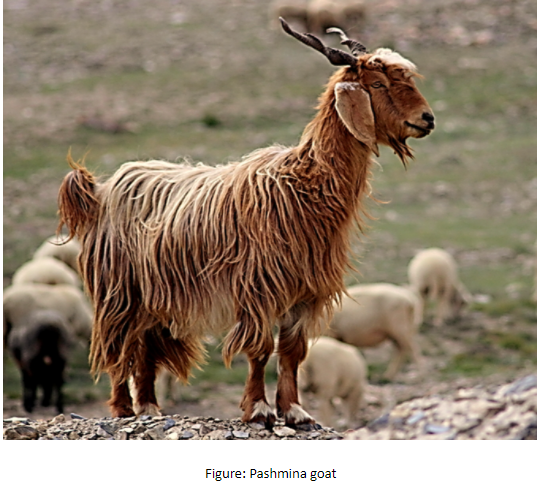
Complete Answer:Pashmina is obtained from a variety of goats. The Pashmina goats are the breed of goat living in the plateaus in Tibet, Nepal, and neighboring areas of Ladakh in Jammu and Kashmir, India. They are also known as Changthangi goats. Pashmina refers to only those fibers that range from 12–16 microns. For pashmina, Goats used to shed their winter coat every spring. A single goat sheds nearly 80–170 grams of fiber.
Additional information: -The material obtained importance through its use in the Kashmir shawl.
-Pashmina blankets are also famous material.
-Pashmina fabric is famous for its softness and warmth.
-The most common pashmina fabric includes 70% pashmina and 30% silk blend.
-It is tightly woven that has an elegant sheen and drapes nicely, but it is quite soft and light-weight.
-China produces 70% of the world’s total cashmere production.
-Changthangi goats are raised for ultra-fine cashmere wool.
-Pure pashmina is a slightly gauzy, open weave, as the fiber cannot tolerate high tension.
-Changpa is the traditional producers of pashmina wool in the Ladakh region of the Himalaya. They rear sheep for meat and Pashmina goats for wool in these harsh climates.
So, the correct answer is ‘Goat’.
Note: -India’s 80% pashmina wool is produced from Kharnak nomads who are one of the four major Changpa tribes.
-Shahmina refers to a type of shawl that is made in Kashmir from Pashmina, with a fiber range of 13 micrometers or less.
Recently Updated Pages
Write any three differences between metals and nonmetals class 10 social science CBSE

Amit standing on a horizontal plane finds a bird flying class 10 maths CBSE
Two circles of radii 5 cm and 3 cm intersect at two class 10 maths CBSE
Solve the following i John and Jivanti together have class 10 maths CBSE
What is the relation between orthocenter circumcentre class 10 maths CBSE
Two plane mirrors are inclined at 70circ A ray incident class 10 physics CBSE
Trending doubts
Explain the Treaty of Vienna of 1815 class 10 social science CBSE
Which country is known as "The land of Fire and Ice"?
1 GB equals how many MB?
10 examples of evaporation in daily life with explanations
What is the full form of POSCO class 10 social science CBSE
Which is the hottest planet in the Solar system A Earth class 10 social science CBSE