



When p- aminophenol reacts with one molar equivalent of acetic anhydride, a compound A $({{C}_{8}}{{H}_{9}}N{{O}_{2}})$is formed that dissolves in dilute NaOH. When A is treated with one equivalent of NaOH followed by ethyl iodide, an ethyl ether B is formed.
Calculate the total number of delocalized $\pi \,{{e}^{-}}s$ in compound B.
Answer
 Verified
600.9k+ views
Hint:Delocalized pi electrons are the electrons that are present in the pi bond. These electrons get delocalized to provide stability to the molecule in the condition of resonance. These electrons move from the nuclei of one atom to another.
Complete step-by-step answer:We have been given a series of reactions that the compound, para- aminophenol undergoes. First it reacts with 1 equimolar of acetic anhydride, ${{\left( C{{H}_{3}}CO \right)}_{2}}O$, through this reaction it forms compound A which has a amide bond in place of amine with hydroxyl on para position. This compound dissolves in NaOH and removes the proton from the hydroxyl group. Now this compound reacts with ethyl iodide to form an aromatic compound that contains an amide group and an ethyl ether. The reactions are as follows:
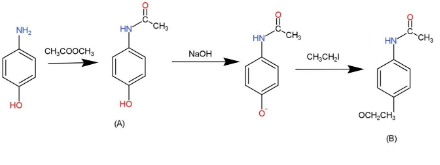
The delocalization of pi bonds in compound B is, as, the amide bond contains 1 double bond so, 2 pi electrons, the carbon ring has 3 double bonds that means 6 pi electrons, while the ether contains 1 double bond in carbonyl group so 2 pi electrons.
So, number of $\pi \,{{e}^{-}}s$= 2 + 6 + 2
Number of $\pi \,{{e}^{-}}s$= 10
Hence, the compound B contains 10$\pi \,{{e}^{-}}s$ that results in delocalization.
Note:As sigma bond is the basis of pi bond, so wherever there is a double bond, that means 2 pi electrons, and in triple bonds 4 pi electrons. The compound A formed is known as paracetamol, which is used as a medicine.
Complete step-by-step answer:We have been given a series of reactions that the compound, para- aminophenol undergoes. First it reacts with 1 equimolar of acetic anhydride, ${{\left( C{{H}_{3}}CO \right)}_{2}}O$, through this reaction it forms compound A which has a amide bond in place of amine with hydroxyl on para position. This compound dissolves in NaOH and removes the proton from the hydroxyl group. Now this compound reacts with ethyl iodide to form an aromatic compound that contains an amide group and an ethyl ether. The reactions are as follows:
The delocalization of pi bonds in compound B is, as, the amide bond contains 1 double bond so, 2 pi electrons, the carbon ring has 3 double bonds that means 6 pi electrons, while the ether contains 1 double bond in carbonyl group so 2 pi electrons.
So, number of $\pi \,{{e}^{-}}s$= 2 + 6 + 2
Number of $\pi \,{{e}^{-}}s$= 10
Hence, the compound B contains 10$\pi \,{{e}^{-}}s$ that results in delocalization.
Note:As sigma bond is the basis of pi bond, so wherever there is a double bond, that means 2 pi electrons, and in triple bonds 4 pi electrons. The compound A formed is known as paracetamol, which is used as a medicine.
Recently Updated Pages
Which of the following graphs shows the variation of class 12 physics CBSE

Draw a labelled diagram of the human male reproductive class 12 biology CBSE
Describe the experiment to compare the emf of two cells class 12 physics CBSE
What is standard hydrogen electrode
What is conventional current and electric current class 12 physics CBSE
2Bromopentane is treated with an alcoholic KOH solution class 12 chemistry CBSE
Trending doubts
Draw a labelled sketch of the human eye class 12 physics CBSE
Which are the Top 10 Largest Countries of the World?
Differentiate between homogeneous and heterogeneous class 12 chemistry CBSE
Draw ray diagrams each showing i myopic eye and ii class 12 physics CBSE
Which is the correct genotypic ratio of mendel dihybrid class 12 biology CBSE
What is the Full Form of PVC, PET, HDPE, LDPE, PP and PS ?