




Out of the given diagram, the correctly labelled diagram showing budding in yeast is :
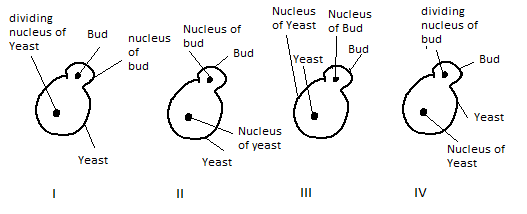
A)I
B)II
C)III
D)IV
Answer
 Verified
606.6k+ views
Hint: In an asymmetric separation mechanism called budding, most yeasts replicate asexually. Next, the parent cell develops a small protuberance that expands to a full size and forms a bud. The nucleus divides into a daughter nucleus of the parent cell and migrates to the daughter cell.
Complete answer:
Asexual reproduction mode of reproduction by budding, where the parent cell develops a small bud (also known as a bleb or daughter cell), is the most common mode of yeast vegetative growth. The nucleus splits into the parent cell's daughter nucleus and migrates to the daughter cell.
This differs but may be as short as one hour, with the pressure, the growth medium, and the temperature. At this point, in one day, a single cell will develop to become a barely visible colony. In yeast cultures, the growth activity is close to that of bacteria.
The essential characteristics of asexual reproduction include the following:
1)A single parent is involved.
2)No fertilization or development of the gamete takes place.
3)This replication process takes place during a relatively brief amount of time.
4)Organisms rapidly replicate and expand.
5)The offspring are genetically equivalent.
Hence, the correct answer is option (B)
Note: There are differences between budding in yeast and hydra:
1)Although hydra is a multicellular organism, yeast is a single-cell organism.
2)The bud originates in the yeast from a tiny protuberance on the parent body, while the bud occurs because of the repeated mitotic division in hydra.
3)The yeast gets its daughter nuclei and it may or may not differentiate from the parent body, while the daughter buds are multicellular in hydra and daughter buds do not grow.
Complete answer:
Asexual reproduction mode of reproduction by budding, where the parent cell develops a small bud (also known as a bleb or daughter cell), is the most common mode of yeast vegetative growth. The nucleus splits into the parent cell's daughter nucleus and migrates to the daughter cell.
This differs but may be as short as one hour, with the pressure, the growth medium, and the temperature. At this point, in one day, a single cell will develop to become a barely visible colony. In yeast cultures, the growth activity is close to that of bacteria.
The essential characteristics of asexual reproduction include the following:
1)A single parent is involved.
2)No fertilization or development of the gamete takes place.
3)This replication process takes place during a relatively brief amount of time.
4)Organisms rapidly replicate and expand.
5)The offspring are genetically equivalent.
Hence, the correct answer is option (B)
Note: There are differences between budding in yeast and hydra:
1)Although hydra is a multicellular organism, yeast is a single-cell organism.
2)The bud originates in the yeast from a tiny protuberance on the parent body, while the bud occurs because of the repeated mitotic division in hydra.
3)The yeast gets its daughter nuclei and it may or may not differentiate from the parent body, while the daughter buds are multicellular in hydra and daughter buds do not grow.
Recently Updated Pages
Basicity of sulphurous acid and sulphuric acid are

Master Class 12 Economics: Engaging Questions & Answers for Success
Master Class 12 Biology: Engaging Questions & Answers for Success
Master Class 11 English: Engaging Questions & Answers for Success
Master Class 11 Physics: Engaging Questions & Answers for Success
Master Class 11 Computer Science: Engaging Questions & Answers for Success
Trending doubts
Which are the Top 10 Largest Countries of the World?
Differentiate between homogeneous and heterogeneous class 12 chemistry CBSE
Give 10 examples of unisexual and bisexual flowers
Draw the diagram of the chloroplast class 12 biology CBSE
Lipids are insoluble in water because they are A Neutral class 12 biology CBSE
Decomposer also called as ATransducers BReducers CMicroconsumer class 12 biology CBSE