



Out of 100 students 15 passed in English, 12 passed in Mathematics, 8 in Science,6 in English and Mathematics, 7 in Mathematics and Science, 4 in English and Science, 4 in all the three. Find how many passed in English and mathematics but not in science?
Answer
 Verified
688.2k+ views
Hint: For solving this problem, first draw the Venn diagram of the situation by analyzing the statement provided in the problem. Now we assign different values to different parts of the circle. By using this data representation, we can easily evaluate our answer.
Complete step by step answer:
The Venn diagram for our problem could be represented as:
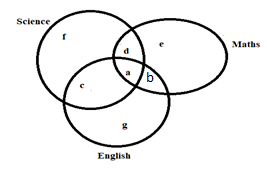
According to the problem statement, total number of students (U) = 100, number of students passed in English = n(E) = 15, number of students passed in Math’s = n(M) = 12 and number of students passed in Science = n(S) = 8.
The intersection of two events is defined as the occurrence of both events at one time. It is represented by $\cap $. Now, other statements could be represented as:
Number of students passed in both English and math =\[n(E\cap M)=6\]
Number of students passed in Math and Science =\[n(S\cap M)=6\]
Number of students passed in English and science$=n(E\cap S)=4$
Number of students passed in all 3 subjects$=n(E\cap M\cap S)=4$
By using the representation from Venn diagram, we get values for different variables such as a, b, c, d, e, f and g as concluded from the above statements. So, their respective values are:
\[\begin{align}
& a=n(E\cap M\cap S)=4 \\
& a+d=n(M\cap S)=7 \\
& d=7-4 \\
& \therefore d=3 \\
& a+b=n(M\cap E)=6 \\
& b=6-4 \\
& \therefore b=2 \\
& a+c=n(S\cap E)=4 \\
& c=4-4 \\
& \therefore c=0 \\
\end{align}\]
Hence, the number of students passed in English and Mathematics but not in science is displayed by c in the Venn diagram. The obtained value of c = 0.
Therefore, the number of students passed in English and Mathematics but not in science is 0.
Note: The key concept involved in solving this problem is the knowledge of Venn diagrams. Students must not get confused by seeing the area of c in the Venn diagram. The above representation is a possible representation but the value on calculation is the correct value.
Complete step by step answer:
The Venn diagram for our problem could be represented as:
According to the problem statement, total number of students (U) = 100, number of students passed in English = n(E) = 15, number of students passed in Math’s = n(M) = 12 and number of students passed in Science = n(S) = 8.
The intersection of two events is defined as the occurrence of both events at one time. It is represented by $\cap $. Now, other statements could be represented as:
Number of students passed in both English and math =\[n(E\cap M)=6\]
Number of students passed in Math and Science =\[n(S\cap M)=6\]
Number of students passed in English and science$=n(E\cap S)=4$
Number of students passed in all 3 subjects$=n(E\cap M\cap S)=4$
By using the representation from Venn diagram, we get values for different variables such as a, b, c, d, e, f and g as concluded from the above statements. So, their respective values are:
\[\begin{align}
& a=n(E\cap M\cap S)=4 \\
& a+d=n(M\cap S)=7 \\
& d=7-4 \\
& \therefore d=3 \\
& a+b=n(M\cap E)=6 \\
& b=6-4 \\
& \therefore b=2 \\
& a+c=n(S\cap E)=4 \\
& c=4-4 \\
& \therefore c=0 \\
\end{align}\]
Hence, the number of students passed in English and Mathematics but not in science is displayed by c in the Venn diagram. The obtained value of c = 0.
Therefore, the number of students passed in English and Mathematics but not in science is 0.
Note: The key concept involved in solving this problem is the knowledge of Venn diagrams. Students must not get confused by seeing the area of c in the Venn diagram. The above representation is a possible representation but the value on calculation is the correct value.
Recently Updated Pages
Master Class 10 Computer Science: Engaging Questions & Answers for Success

Differentiate between voluntary action and reflex class 10 biology CBSE
The uses of bleaching powder are A It is used bleaching class 10 chemistry CBSE
Fill in the blanks with abstract nouns of the words class 10 english CBSE
How many threedigit numbers are there class 10 maths CBSE
What is a reflex arc class 10 biology CBSE
Trending doubts
Explain the Treaty of Vienna of 1815 class 10 social science CBSE
10 examples of evaporation in daily life with explanations
What is the full form of POSCO class 10 social science CBSE
Make a sketch of the human nerve cell What function class 10 biology CBSE
GST is a direct or indirect tax?
The sum of all even numbers between 21 and 51 is a class 10 maths CBSE