




Other florals develop below the base of the ovary in a flower called
(a) Epigynous
(b) Hypogynous
(c) Agynous
(d) Perigynous
Answer
 Verified
611.7k+ views
Hint: Ovaries are the female organs of a flower that bear the ovules. Based on the relative position of the ovaries concerning the other floral parts, such as the androecium and petals ovaries can be of three types.
Complete step by step answer:
In flowers, the development of the ovary on the thalamus with reference to the opposite floral organs is a characteristic feature. When the ovary develops superior to the other sepals, petals, and stamens, then the ovary is named superior and therefore the flower is said to be hypogynous. In this condition, the thalamus appears swollen.
A. In epigynous flowers, the ovary is inferior.
B. In hypogynous flowers, the ovary is superior.
C. There is no comparison in agynous conditions.
D. In perigynous flowers, the ovary is situated half-inferior and half-superior.
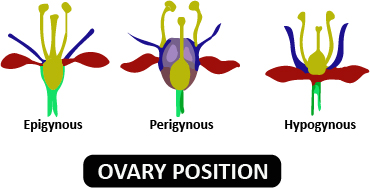
Superior ovary as the name suggests is the type of arrangement in which the ovary receptacle lies above the attachment points of other floral parts. Such types of flowers are also known as hypogynous flowers. It is seen in fleshy fruits such as drupes or berries. It is seen in the legume family.
Half-inferior or half-superior ovaries is the type of arrangement where there is an equal length of ovary below and above the point of attachment of the floral parts. This type of flower is also called a perigynous flower and is seen in the family Lythraceae.
So, the correct answer is, ‘(b) Hypogynous.’
Note: Ovaries can also be classified based on placentation. It is the arrangement of the ovules inside the ovaries. It is mainly classified based on the axes of ovule attachment and the number of compartments and placenta and the arrangement of ovules accordingly. They can be superior, marginal, parietal, axial, free-central, or basal in the arrangement.
Complete step by step answer:
In flowers, the development of the ovary on the thalamus with reference to the opposite floral organs is a characteristic feature. When the ovary develops superior to the other sepals, petals, and stamens, then the ovary is named superior and therefore the flower is said to be hypogynous. In this condition, the thalamus appears swollen.
A. In epigynous flowers, the ovary is inferior.
B. In hypogynous flowers, the ovary is superior.
C. There is no comparison in agynous conditions.
D. In perigynous flowers, the ovary is situated half-inferior and half-superior.
Superior ovary as the name suggests is the type of arrangement in which the ovary receptacle lies above the attachment points of other floral parts. Such types of flowers are also known as hypogynous flowers. It is seen in fleshy fruits such as drupes or berries. It is seen in the legume family.
Half-inferior or half-superior ovaries is the type of arrangement where there is an equal length of ovary below and above the point of attachment of the floral parts. This type of flower is also called a perigynous flower and is seen in the family Lythraceae.
So, the correct answer is, ‘(b) Hypogynous.’
Note: Ovaries can also be classified based on placentation. It is the arrangement of the ovules inside the ovaries. It is mainly classified based on the axes of ovule attachment and the number of compartments and placenta and the arrangement of ovules accordingly. They can be superior, marginal, parietal, axial, free-central, or basal in the arrangement.
Recently Updated Pages
Master Class 12 Business Studies: Engaging Questions & Answers for Success

Master Class 12 Biology: Engaging Questions & Answers for Success
Master Class 12 Chemistry: Engaging Questions & Answers for Success
Class 12 Question and Answer - Your Ultimate Solutions Guide
Master Class 11 Social Science: Engaging Questions & Answers for Success
Master Class 11 English: Engaging Questions & Answers for Success
Trending doubts
Which are the Top 10 Largest Countries of the World?
Draw a labelled sketch of the human eye class 12 physics CBSE
Differentiate between homogeneous and heterogeneous class 12 chemistry CBSE
Sulphuric acid is known as the king of acids State class 12 chemistry CBSE
Why is the cell called the structural and functional class 12 biology CBSE
Which is the correct genotypic ratio of mendel dihybrid class 12 biology CBSE