




On what factors does the induced electromotive force depend?
Answer
 Verified
506.7k+ views
Hint:An electromotive force is induced by a change in magnetic flux, according to Faraday's law of induction. A voltage is formed when the magnetic flux through a coil is altered. The induced emf is the name given to this voltage. The current can only flow if the magnetic field changes.
Complete answer:
The induced electromotive force depends upon the following factors;
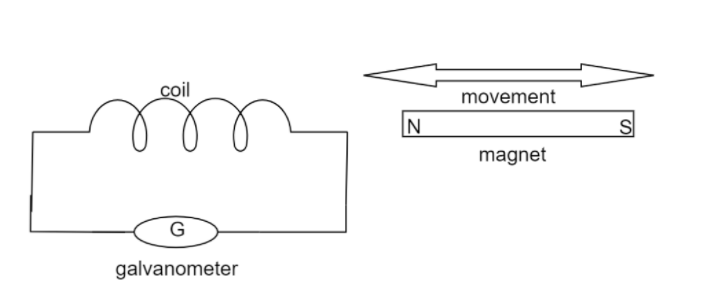
This was the setup to find the induced electromotive force. Here a coil has $N$ number of turns which is connected to a galvanometer. A magnet or the coil is moved which causes a change in the magnetic field in the coil. From this we observed, $N$ , the total number of turns in the coil, is directly proportional to the induced electromotive force.
The induced electromotive force is proportional to $A$ , which is the coil's cross-sectional area.$B$ , the strength of the magnetic field in which the coil is revolving, is directly proportional to the induced electromotive force. The induced electromotive force is proportional to ' $\omega $ ' the coil's angular velocity.
The induced electromotive force changes throughout time and is dependent on the instant '$t$'. When the plane of the coil is parallel to the magnetic field $B$ , the induced electromotive force is greatest, and when the plane of the coil is perpendicular to the magnetic field $B$ , the induced electromotive force is zero.
Note:The coil is unaffected by a steady magnetic field, yet current flows when the field changes. A galvanometer is a device that uses the deflection of a moving coil to measure a small electrical current or a function of the current.
Complete answer:
The induced electromotive force depends upon the following factors;
This was the setup to find the induced electromotive force. Here a coil has $N$ number of turns which is connected to a galvanometer. A magnet or the coil is moved which causes a change in the magnetic field in the coil. From this we observed, $N$ , the total number of turns in the coil, is directly proportional to the induced electromotive force.
The induced electromotive force is proportional to $A$ , which is the coil's cross-sectional area.$B$ , the strength of the magnetic field in which the coil is revolving, is directly proportional to the induced electromotive force. The induced electromotive force is proportional to ' $\omega $ ' the coil's angular velocity.
The induced electromotive force changes throughout time and is dependent on the instant '$t$'. When the plane of the coil is parallel to the magnetic field $B$ , the induced electromotive force is greatest, and when the plane of the coil is perpendicular to the magnetic field $B$ , the induced electromotive force is zero.
Note:The coil is unaffected by a steady magnetic field, yet current flows when the field changes. A galvanometer is a device that uses the deflection of a moving coil to measure a small electrical current or a function of the current.
Recently Updated Pages
Master Class 12 Business Studies: Engaging Questions & Answers for Success

Master Class 12 Chemistry: Engaging Questions & Answers for Success
Master Class 12 Biology: Engaging Questions & Answers for Success
Class 12 Question and Answer - Your Ultimate Solutions Guide
Master Class 11 Social Science: Engaging Questions & Answers for Success
Master Class 11 Chemistry: Engaging Questions & Answers for Success
Trending doubts
Which are the Top 10 Largest Countries of the World?
Draw a labelled sketch of the human eye class 12 physics CBSE
Name the crygenes that control cotton bollworm and class 12 biology CBSE
Differentiate between homogeneous and heterogeneous class 12 chemistry CBSE
Ribosomal RNA is actively synthesised in A Nucleoplasm class 12 biology CBSE
How many molecules of ATP and NADPH are required information class 12 biology CBSE