




Ohmic resistance is
A. Junction diode
B. Photo-emissive diode.
C. Transistor.
D. Copper wire.
Answer
 Verified
568.2k+ views
Hint:We must know that an ohmic resistance always obeys ohm's law. Ohm’s law states the relation between the voltage, resistance and current in any DC circuit. To solve this question, we must know which of these components obeys ohm’s law and which don’t. The resistance of an ohmic resistor will not change with change in voltage and current.
Complete answer:
We can define ohm’s law as, at a constant temperature, the electrical current flowing through a conductor is directly proportional to the potential difference applied across the conductor and inversely proportional to the resistance.
That is, if \[V\]is the potential difference and\[I\]is the current flowing, then
\[\begin{align}
& V\propto I \\
& V=IR \\
\end{align}\]
Here, \[R\] is the probability constant known as resistance.
Now, if we need to prove a resistance is ohmic, it must obey ohm’s law and must be a constant resistance when we vary the voltage across them or if we increase the current.
Where, we know diodes are non-linear, that is they don’t obey ohm’s law. The resistance of a diode varies according to the input voltage and current. We can only calculate the equivalent resistance at a particular current or voltage for a diode which is only valid at that point. So, diodes are non-ohmic resistances. A transistor itself means ‘trans’ ‘resistance’ which means variable resistance.
So, the only material which obeys ohm’s law in the given options is copper wire. So, option d is the right choice.
Note:
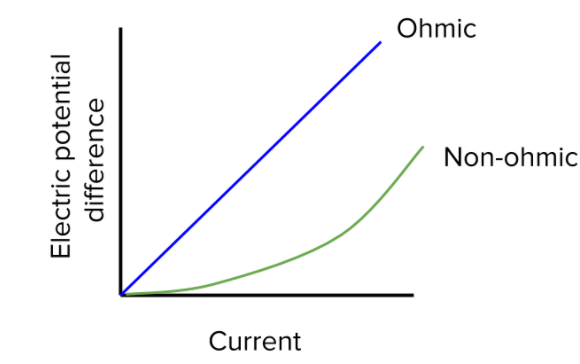
We must remember that in an ohmic resistance, the graph between the voltage and the current flowing will be a straight line because they obey ohm’s law. When we consider a non-ohmic resistor, the graph between voltage and current will not be straight line. So, we can also differentiate between these two resistances on the basis of their voltage-current graph.
Complete answer:
We can define ohm’s law as, at a constant temperature, the electrical current flowing through a conductor is directly proportional to the potential difference applied across the conductor and inversely proportional to the resistance.
That is, if \[V\]is the potential difference and\[I\]is the current flowing, then
\[\begin{align}
& V\propto I \\
& V=IR \\
\end{align}\]
Here, \[R\] is the probability constant known as resistance.
Now, if we need to prove a resistance is ohmic, it must obey ohm’s law and must be a constant resistance when we vary the voltage across them or if we increase the current.
Where, we know diodes are non-linear, that is they don’t obey ohm’s law. The resistance of a diode varies according to the input voltage and current. We can only calculate the equivalent resistance at a particular current or voltage for a diode which is only valid at that point. So, diodes are non-ohmic resistances. A transistor itself means ‘trans’ ‘resistance’ which means variable resistance.
So, the only material which obeys ohm’s law in the given options is copper wire. So, option d is the right choice.
Note:
We must remember that in an ohmic resistance, the graph between the voltage and the current flowing will be a straight line because they obey ohm’s law. When we consider a non-ohmic resistor, the graph between voltage and current will not be straight line. So, we can also differentiate between these two resistances on the basis of their voltage-current graph.
Recently Updated Pages
Master Class 12 Economics: Engaging Questions & Answers for Success

Master Class 12 English: Engaging Questions & Answers for Success
Master Class 12 Social Science: Engaging Questions & Answers for Success
Master Class 12 Maths: Engaging Questions & Answers for Success
Master Class 12 Physics: Engaging Questions & Answers for Success
Master Class 9 General Knowledge: Engaging Questions & Answers for Success
Trending doubts
Which are the Top 10 Largest Countries of the World?
Draw a labelled sketch of the human eye class 12 physics CBSE
Differentiate between homogeneous and heterogeneous class 12 chemistry CBSE
Sulphuric acid is known as the king of acids State class 12 chemistry CBSE
Why is the cell called the structural and functional class 12 biology CBSE
A dentist uses a small mirror that gives a magnification class 12 physics CBSE