




What is the normal site of implantation?
Answer
 Verified
552.9k+ views
Hint:The process of implantation in the uterus begins when the egg travels down the fallopian tubes and becomes a blastocyst. The blastocyst receives a blood supply after being implanted, allowing it to begin growing into a foetus.
Complete answer:
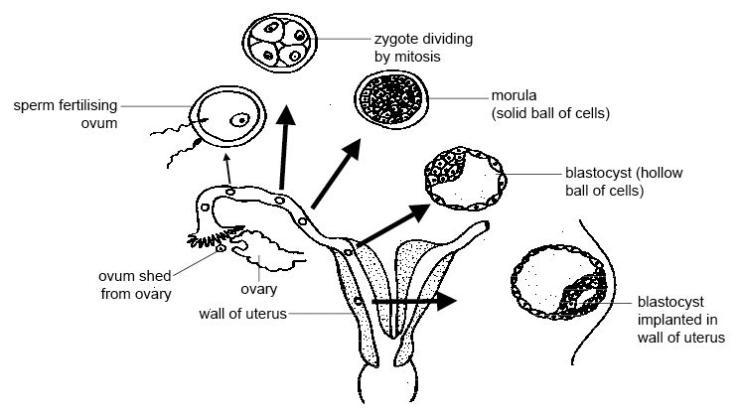
The blastocyst contacts the endometrial implantation site (apposition); the blastocyst's trophoblast cells attach to the receptive endometrial epithelium (adhesion); and the blastocyst's invasive trophoblast cells cross the endometrial epithelial basement membrane and invade the endometrial stroma (invasion).
The blastocyst apposition at the uterine epithelium begins implantation about 2-4 days after the morula enters the uterine cavity. In the human uterus, implantation takes place at the upper and posterior walls in the midsagittal plane.
The blastocyst apposition at the uterine epithelium begins implantation about 2-4 days after the morula enters the uterine cavity. In the human uterus, implantation takes place at the upper and posterior walls in the midsagittal plane. Implantation is thought to be a pro-inflammatory reaction in which Cyclooxygenase (Cox)-derived prostaglandins increase endometrial vascular permeability at the attachment site.Implantation is the process by which a blastocyst, which is travelling through the uterus as a developing embryo, makes contact with the uterine wall and remains attached to it until birth.
The uterine lining (endometrium) undergoes numerous internal alterations in order to prepare for the developing blastocyst to attach to it. After you ovulate, it takes anywhere from 6 to 12 days for your egg to be implanted. It usually happens 8 to 9 days after fertilisation. As a result, when you ovulate and whether conception occurs early or late in the ovulation window can affect the exact timing of implantation.
If you're pregnant, it takes time for your body to produce measurable quantities of HCG. This usually takes seven to twelve days after an egg has been successfully implanted. If you take the test too early in your cycle, you can get an erroneous result.
Note:
The cervix, interstitial portion of the fallopian tube, scar from a previous caesarean birth, uterine myometrium, ovary, and peritoneal cavity are all uncommon implantation sites for ectopic pregnancy. Other uncommon signs include heterotopic and twin ectopic pregnancies.
Complete answer:
The blastocyst contacts the endometrial implantation site (apposition); the blastocyst's trophoblast cells attach to the receptive endometrial epithelium (adhesion); and the blastocyst's invasive trophoblast cells cross the endometrial epithelial basement membrane and invade the endometrial stroma (invasion).
The blastocyst apposition at the uterine epithelium begins implantation about 2-4 days after the morula enters the uterine cavity. In the human uterus, implantation takes place at the upper and posterior walls in the midsagittal plane.
The blastocyst apposition at the uterine epithelium begins implantation about 2-4 days after the morula enters the uterine cavity. In the human uterus, implantation takes place at the upper and posterior walls in the midsagittal plane. Implantation is thought to be a pro-inflammatory reaction in which Cyclooxygenase (Cox)-derived prostaglandins increase endometrial vascular permeability at the attachment site.Implantation is the process by which a blastocyst, which is travelling through the uterus as a developing embryo, makes contact with the uterine wall and remains attached to it until birth.
The uterine lining (endometrium) undergoes numerous internal alterations in order to prepare for the developing blastocyst to attach to it. After you ovulate, it takes anywhere from 6 to 12 days for your egg to be implanted. It usually happens 8 to 9 days after fertilisation. As a result, when you ovulate and whether conception occurs early or late in the ovulation window can affect the exact timing of implantation.
If you're pregnant, it takes time for your body to produce measurable quantities of HCG. This usually takes seven to twelve days after an egg has been successfully implanted. If you take the test too early in your cycle, you can get an erroneous result.
Note:
The cervix, interstitial portion of the fallopian tube, scar from a previous caesarean birth, uterine myometrium, ovary, and peritoneal cavity are all uncommon implantation sites for ectopic pregnancy. Other uncommon signs include heterotopic and twin ectopic pregnancies.
Recently Updated Pages
Master Class 12 Economics: Engaging Questions & Answers for Success

Master Class 12 Social Science: Engaging Questions & Answers for Success
Master Class 12 English: Engaging Questions & Answers for Success
Master Class 12 Maths: Engaging Questions & Answers for Success
Master Class 12 Physics: Engaging Questions & Answers for Success
Master Class 12 Biology: Engaging Questions & Answers for Success
Trending doubts
Draw a labelled sketch of the human eye class 12 physics CBSE
Draw a ray diagram of compound microscope when the class 12 physics CBSE
Derive an expression for the electric field intensity class 12 physics CBSE
Ethylidene chloride and ethylene dichloride are A Chain class 12 chemistry CBSE
What is a transformer Explain the principle construction class 12 physics CBSE
Calculate the equivalent resistance between a and b class 12 physics CBSE