




Newton’s third law of motion gives an idea about the:
A. inertia
B. momentum
C. cause and effect of motion
D. force
Answer
 Verified
646.5k+ views
Hint: This question is based on the topic named, ‘Newton’s third law of motion’. This law deals with the action of an object/body in terms of their motion and the reaction, that is, the response, which results from the change in the physical quantity of object/body, such as, its velocity.
Formula used:
\[\begin{align}
& {{F}_{1}}=-{{F}_{2}} \\
& {{m}_{1}}{{a}_{1}}=-{{m}_{2}}{{a}_{2}} \\
\end{align}\]
Complete answer:
Let us first gain some knowledge about Newton’s third law.
Newton’s third law of motion states that “For every action, there is an equal and opposite reaction.”
The words ‘action’ and ‘reaction’ represents the stimulus and response.
Consider for example: When we try to jump, our foot exerts a force on the ground, for this action, the ground, in turn, exerts the force on our foot (reaction) such that the force propels us in air.
Consider the diagram representing the action and reaction.
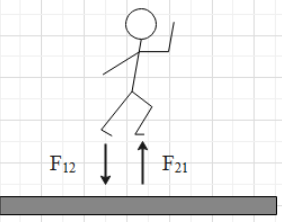
The formula used to represent Newton’s law of motion is as follows.
\[\begin{align}
& {{F}_{1}}=-{{F}_{2}} \\
& {{m}_{1}}{{a}_{1}}=-{{m}_{2}}{{a}_{2}} \\
\end{align}\]
The sign represents the direction, and the forces represent the magnitude.
As the force is the product of mass and acceleration, the same is represented in the above expression.
Along with the cause (the action), the effect (the reaction) of that on the motion of the object/body is explained by Newton’s third law of motion.
As Newton’s third law of motion gives an idea about the cause and effect of motion, thus, option (C) is correct.
Additional information:
Inertia is a tendency to resist any change in the velocity of a body/object.
Momentum is the quantity of the motion which a body has.
Force is an interaction (a push or pull reaction) that tends to change the motion of the body/object.
Note:
In order to confuse the students, one of the given options has “force”. The force defines either of one term, that is, either action or reaction at a time, but not both. Whereas, the law describes the action in terms of motion and effect of this action on the motion of the other, as a reaction. So, there are two forces (action and reaction), which are represented by the law.
Formula used:
\[\begin{align}
& {{F}_{1}}=-{{F}_{2}} \\
& {{m}_{1}}{{a}_{1}}=-{{m}_{2}}{{a}_{2}} \\
\end{align}\]
Complete answer:
Let us first gain some knowledge about Newton’s third law.
Newton’s third law of motion states that “For every action, there is an equal and opposite reaction.”
The words ‘action’ and ‘reaction’ represents the stimulus and response.
Consider for example: When we try to jump, our foot exerts a force on the ground, for this action, the ground, in turn, exerts the force on our foot (reaction) such that the force propels us in air.
Consider the diagram representing the action and reaction.
The formula used to represent Newton’s law of motion is as follows.
\[\begin{align}
& {{F}_{1}}=-{{F}_{2}} \\
& {{m}_{1}}{{a}_{1}}=-{{m}_{2}}{{a}_{2}} \\
\end{align}\]
The sign represents the direction, and the forces represent the magnitude.
As the force is the product of mass and acceleration, the same is represented in the above expression.
Along with the cause (the action), the effect (the reaction) of that on the motion of the object/body is explained by Newton’s third law of motion.
As Newton’s third law of motion gives an idea about the cause and effect of motion, thus, option (C) is correct.
Additional information:
Inertia is a tendency to resist any change in the velocity of a body/object.
Momentum is the quantity of the motion which a body has.
Force is an interaction (a push or pull reaction) that tends to change the motion of the body/object.
Note:
In order to confuse the students, one of the given options has “force”. The force defines either of one term, that is, either action or reaction at a time, but not both. Whereas, the law describes the action in terms of motion and effect of this action on the motion of the other, as a reaction. So, there are two forces (action and reaction), which are represented by the law.
Recently Updated Pages
If x a + bt + ct2 where x is in meters and t is in class 11 physics CBSE

A car covers the first half distance between two places class 11 physics CBSE
The resultant of two vectors overrightarrow P and overrightarrow class 11 physics CBSE
Find the value of cos 135 class 11 maths CBSE
A mass M is held in place by an applied force F and class 11 physics CBSE
A solution of glucose in water is labelled as 10 dfracwv class 11 chemistry CBSE
Trending doubts
Find the value of the expression given below sin 30circ class 11 maths CBSE
One Metric ton is equal to kg A 10000 B 1000 C 100 class 11 physics CBSE
Draw a diagram of nephron and explain its structur class 11 biology CBSE
10 examples of friction in our daily life
Proton was discovered by A Thomson B Rutherford C Chadwick class 11 chemistry CBSE
Bond order ofO2 O2+ O2 and O22 is in order A O2 langle class 11 chemistry CBSE