




Name two unicellular organisms.
Answer
 Verified
665.4k+ views
Hint: Uni= single. The organisms that have a single cell. Two such organisms are to be named here that contain a singular cellular identity.
Complete answer:
The unicellular organisms are the single-celled organisms where all the life processes take place in that particular single cell. From digestion to excretion to nutrition, the organism survives as a single cell. All the unicellular organisms are microscopic and are impossible to see with naked eyes. The single-cell may be naked or covered by a cell wall.
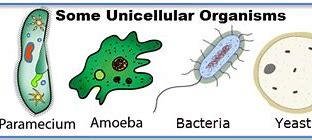
Unicellular organisms are both prokaryotes and eukaryotes. The unicellular prokaryotes are placed under the Kingdom Monera and some of the examples include Bacteria.
The unicellular eukaryotes are placed under the kingdom Protista and examples include Amoeba and Paramecium.
Additional Information:
Some characteristics of unicellular organisms.
-Asexual reproduction is the main mode of reproduction. It involves binary fission (Amoeba and Paramecium) and plasmogamy and budding.
-The genetic material is not enclosed within a nuclear membrane.
-If the flagella are present it is composed of flagellin protein.
-The unicellular prokaryotes have 70S ribosomes, and the unicellular eukaryotes have 80S ribosomes.
-They may or may not include a rigid cell wall. Bacteria have a cell wall made of peptidoglycan.
-Amoeba is characterized by the formation of pseudopodia for the injection of food and locomotion.
Note:
-The unicellular organisms are cosmopolitan. Some of them are found in extreme environments known as extremophiles.
-Yeast is a unicellular fungus.
-Bacteria are the sole member of Kingdom Monera.
Complete answer:
The unicellular organisms are the single-celled organisms where all the life processes take place in that particular single cell. From digestion to excretion to nutrition, the organism survives as a single cell. All the unicellular organisms are microscopic and are impossible to see with naked eyes. The single-cell may be naked or covered by a cell wall.
Unicellular organisms are both prokaryotes and eukaryotes. The unicellular prokaryotes are placed under the Kingdom Monera and some of the examples include Bacteria.
The unicellular eukaryotes are placed under the kingdom Protista and examples include Amoeba and Paramecium.
Additional Information:
Some characteristics of unicellular organisms.
-Asexual reproduction is the main mode of reproduction. It involves binary fission (Amoeba and Paramecium) and plasmogamy and budding.
-The genetic material is not enclosed within a nuclear membrane.
-If the flagella are present it is composed of flagellin protein.
-The unicellular prokaryotes have 70S ribosomes, and the unicellular eukaryotes have 80S ribosomes.
-They may or may not include a rigid cell wall. Bacteria have a cell wall made of peptidoglycan.
-Amoeba is characterized by the formation of pseudopodia for the injection of food and locomotion.
Some unicellular organisms
Note:
-The unicellular organisms are cosmopolitan. Some of them are found in extreme environments known as extremophiles.
-Yeast is a unicellular fungus.
-Bacteria are the sole member of Kingdom Monera.
Recently Updated Pages
Write any three differences between metals and nonmetals class 10 social science CBSE

Amit standing on a horizontal plane finds a bird flying class 10 maths CBSE
Two circles of radii 5 cm and 3 cm intersect at two class 10 maths CBSE
Solve the following i John and Jivanti together have class 10 maths CBSE
What is the relation between orthocenter circumcentre class 10 maths CBSE
Two plane mirrors are inclined at 70circ A ray incident class 10 physics CBSE
Trending doubts
Explain the Treaty of Vienna of 1815 class 10 social science CBSE
Which country is known as "The land of Fire and Ice"?
1 GB equals how many MB?
10 examples of evaporation in daily life with explanations
What is the full form of POSCO class 10 social science CBSE
Make a sketch of the human nerve cell What function class 10 biology CBSE