




How many more grams of \[KI\] will dissolve in $100g$ of water at ${{40}^{\circ }}C$ than at ${{20}^{\circ }}C$ ?
Answer
 Verified
583.8k+ views
Hint: Here the concept of solubility works, solubility is the amount of a particular solute to dissolve in a certain amount of solvent at that temperature. We know that the solubility increases as the temperature increases. The daily life example you can take is the making of sweet syrup for sweets. Here it was asked for the extra amount that we need at these two temperatures.
Complete step by step answer:
The solubility of different solutes can be seen by using the solubility curve. In the curve we have solubility in $\left( \dfrac{g}{100}c{{m}^{3}}\,water \right)\,Vs\,\left( temperature \right)$ this graph shows how the solubility increases with the increase in temperature. So, see the plot for potassium iodide which is given below.
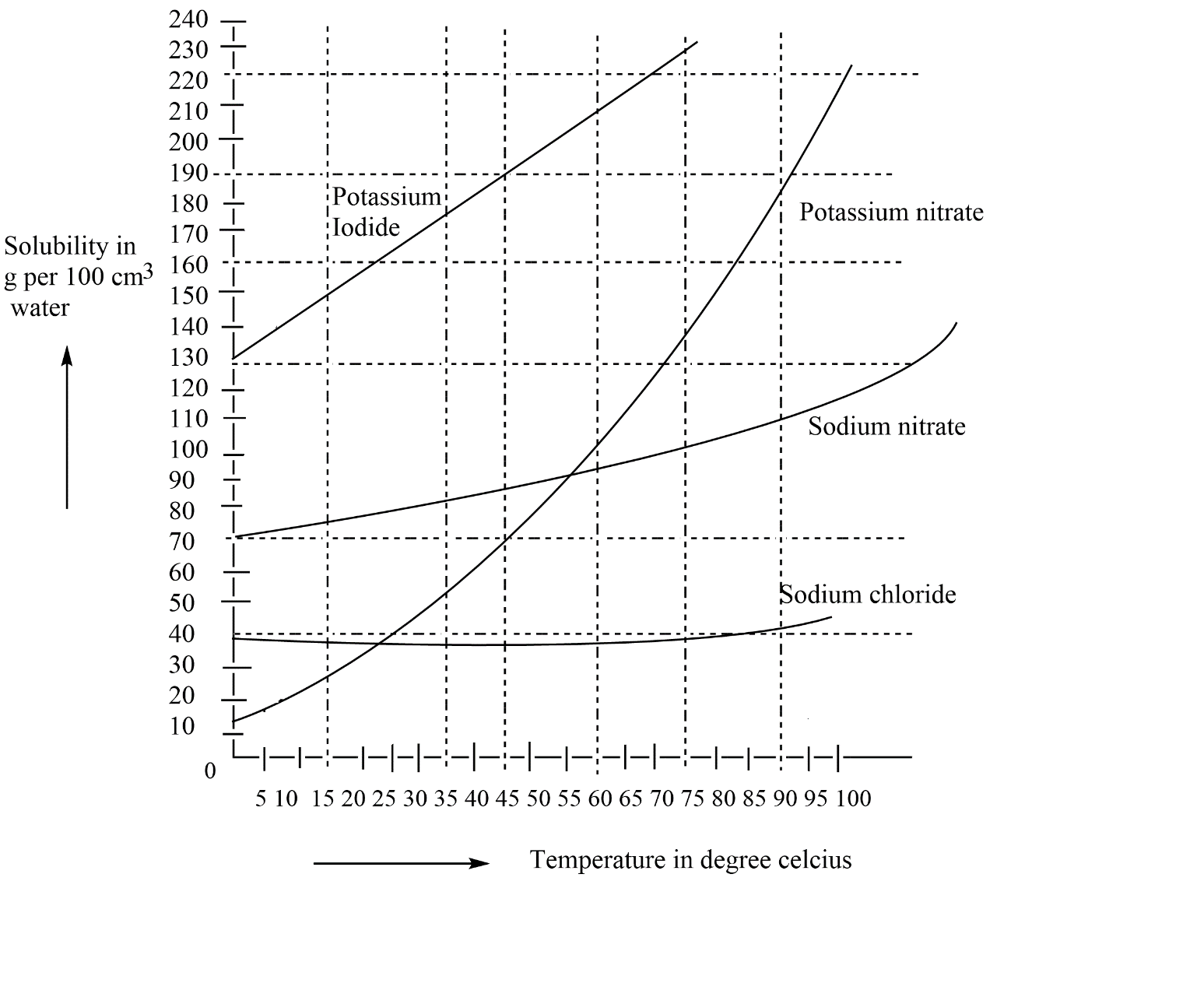
Here, as we are seeing the solubility of different salts in water and their changes with respect to temperature. So, now see for potassium iodide that at ${{40}^{\circ }}C$ the amount of potassium iodide dissolved in water is $195\,g$ you will able to see through the lines drawn so similarly of we see the solubility of same salt that is potassium iodide at ${{20}^{\circ }}C$ there we have the amount of potassium iodide as $155\,g$ . So, as asked in the question, the extra amount that we need for the two temperatures so we have to find out the difference in amount of potassium iodide at two different temperatures.
Amount of potassium iodide needed $=\,195g\,-155g$
$=40\,g$
Thus we need $40g$ grams of \[KI\]for dissolving in $100g$ of water at two temperature differences.
Note: Saturated solution is formed for a particular temperature. So suppose we want a saturated solution of potassium iodide at ${{40}^{\circ }}C$ it means there is a particular amount of this alt which will dissolve in the water. The moment when no more potassium iodide will dissolve in some amount of water at that particular temperature it will be the saturation point.
Complete step by step answer:
The solubility of different solutes can be seen by using the solubility curve. In the curve we have solubility in $\left( \dfrac{g}{100}c{{m}^{3}}\,water \right)\,Vs\,\left( temperature \right)$ this graph shows how the solubility increases with the increase in temperature. So, see the plot for potassium iodide which is given below.
Here, as we are seeing the solubility of different salts in water and their changes with respect to temperature. So, now see for potassium iodide that at ${{40}^{\circ }}C$ the amount of potassium iodide dissolved in water is $195\,g$ you will able to see through the lines drawn so similarly of we see the solubility of same salt that is potassium iodide at ${{20}^{\circ }}C$ there we have the amount of potassium iodide as $155\,g$ . So, as asked in the question, the extra amount that we need for the two temperatures so we have to find out the difference in amount of potassium iodide at two different temperatures.
Amount of potassium iodide needed $=\,195g\,-155g$
$=40\,g$
Thus we need $40g$ grams of \[KI\]for dissolving in $100g$ of water at two temperature differences.
Note: Saturated solution is formed for a particular temperature. So suppose we want a saturated solution of potassium iodide at ${{40}^{\circ }}C$ it means there is a particular amount of this alt which will dissolve in the water. The moment when no more potassium iodide will dissolve in some amount of water at that particular temperature it will be the saturation point.
Recently Updated Pages
Basicity of sulphurous acid and sulphuric acid are

Master Class 12 Economics: Engaging Questions & Answers for Success
Master Class 12 Biology: Engaging Questions & Answers for Success
Master Class 11 English: Engaging Questions & Answers for Success
Master Class 11 Physics: Engaging Questions & Answers for Success
Master Class 11 Computer Science: Engaging Questions & Answers for Success
Trending doubts
Draw a labelled sketch of the human eye class 12 physics CBSE
The chemical formula of tear gas is A CO Cl 2 B C 10 class 12 chemistry CBSE
Draw ray diagrams each showing i myopic eye and ii class 12 physics CBSE
Which are the Top 10 Largest Countries of the World?
Differentiate between homogeneous and heterogeneous class 12 chemistry CBSE
Which is the correct genotypic ratio of mendel dihybrid class 12 biology CBSE