




Minimise and maximise $z = 600x + 400y$
Subject to the following conditions:
$x + 2y \leqslant 12$
$2x + y \leqslant 12$
$4x + 5y \leqslant 20$
$x \geqslant 0,y \geqslant 0$ by the graphical method
Answer
 Verified
616.2k+ views
Hint: First draw the graph and find out the intersection point of every intersecting line for example $x \geqslant 0,y \geqslant 0$
It represents that it will lie in the first quadrant and then draw the graph of $x + 2y = 12$ and $2x + y = 12$, $4x + 5y = 20$ then find out the intersection point, then put that point in $z = 600x + 400y$ and then find out the maxima and minima of the following
Complete step-by-step answer:
Here we need to minimise and maximise $z = 600x + 400y$
Which is subjected to the following conditions:
$x + 2y \leqslant 12$
$2x + y \leqslant 12$
$4x + 5y \leqslant 20$
$x \geqslant 0,y \geqslant 0$ by the graphical method
So their graph represents the first quadrant as every point in the first quadrant satisfies$x \geqslant 0,y \geqslant 0$
(2) Now let us draw the graph of $x + 2y = 12$
So for $x = 0$, $0 + 2y = 12$
$ \Rightarrow $$y = 6 \Rightarrow (0,6)$
For$y = 0$, $x + 0 = 12$
$ \Rightarrow $$x = 12 \Rightarrow (12,0)$
(3) Now if we draw the graph of $2x + y = 12$
So for the graph we need two points
So for$x = 0$, $0 + y = 12$
$ \Rightarrow $$y = 12 \Rightarrow (0,12)$
For$y = 0$, $2x + 0 = 12$
$ \Rightarrow $$x = 6 \Rightarrow (6,0)$
So with the point $(0,12),(6,0)$ we can draw the line
Let $C$ be $(0,12)$ and $D$ be $(6,0)$
(3) Now for$4x + 5y \leqslant 20$, we need to draw the graph of $4x + 5y = 20$
So for $x = 0$, $0 + 5y = 20$
$ \Rightarrow $$y = 4 \Rightarrow (0,4)$
So let this point be $E(0,4)$
For $y = 0$, $4x + 0 = 20$
$ \Rightarrow $$x = 5 \Rightarrow (5,0)$
So let this point be $F(5,0)$
So $(0,4),(5,0)$ are the coordinate axes.
Now if we draw every graph in one graph, we will get
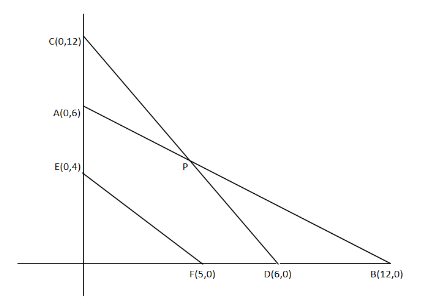
So we need to find the point P which is formed by the intersection of the line $AB,CD$
$ \Rightarrow $$AB = x + 2y = 12$
$ \Rightarrow $$x = 12 - 2y$
$ \Rightarrow $$CD = 2x + y = 12$
Put $x = 12 - 2y$ in $CD$
$ \Rightarrow $$2(12 - 2y) + y = 12$
$ \Rightarrow $$3y = 12$
$ \Rightarrow $$y = 4$
$ \Rightarrow $$x = 12 - 2(4) = 4$
So we get the point P
Now as we know $z = 600x + 400y$
Now the common shaded region of the curve will be
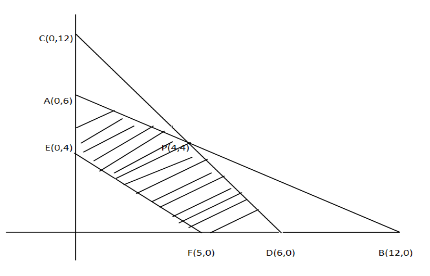
Now for the point A$(0,6)$
$ \Rightarrow $$z = 600x + 400y$
$ \Rightarrow $$z = 600(0) + 400(6)$
$ = 2400$
For the point E $(0,4)$
$ \Rightarrow $$z = 600x + 400y$
$ \Rightarrow $$z = 600(0) + 400(4)$
$ = 1600$
For the point F $(5,0)$
$ \Rightarrow $$z = 600x + 400y$
$ \Rightarrow $$z = 600(5) + 400(0)$
$ = 3000$
For the point D $(6,0)$
$ \Rightarrow $$z = 600x + 400y$
$ \Rightarrow $$z = 600(6) + 400(0)$
$ = 3600$
For the point P $(4,4)$
$ \Rightarrow $$z = 600x + 400y$
$ \Rightarrow $$z = 600(4) + 400(4)$
$ = 4000$
So the maximum value of $z$ is at P$ = 4000$
Minimum value of $z$ is at E$ = 1600$
Note: To draw a graph of this line, we must at least need two points or one point and one slope.
If the two points are $({x_1},{y_1}),({x_2},{y_2})$ then the equation of the line is given by
$y - {y_1} = \dfrac{{{y_2} - {y_1}}}{{{x_2} - {x_1}}}(x - {x_1})$
Or if we are given the slope $m$ of the line $AB$ passing from the point $A({x_1},{y_1})$ then the equation is given by $y - {y_1} = m(x - {x_1})$
General formula for the straight line is
$y = mx + c$
It represents that it will lie in the first quadrant and then draw the graph of $x + 2y = 12$ and $2x + y = 12$, $4x + 5y = 20$ then find out the intersection point, then put that point in $z = 600x + 400y$ and then find out the maxima and minima of the following
Complete step-by-step answer:
Here we need to minimise and maximise $z = 600x + 400y$
Which is subjected to the following conditions:
$x + 2y \leqslant 12$
$2x + y \leqslant 12$
$4x + 5y \leqslant 20$
$x \geqslant 0,y \geqslant 0$ by the graphical method
So their graph represents the first quadrant as every point in the first quadrant satisfies$x \geqslant 0,y \geqslant 0$
(2) Now let us draw the graph of $x + 2y = 12$
So for $x = 0$, $0 + 2y = 12$
$ \Rightarrow $$y = 6 \Rightarrow (0,6)$
For$y = 0$, $x + 0 = 12$
$ \Rightarrow $$x = 12 \Rightarrow (12,0)$
(3) Now if we draw the graph of $2x + y = 12$
So for the graph we need two points
So for$x = 0$, $0 + y = 12$
$ \Rightarrow $$y = 12 \Rightarrow (0,12)$
For$y = 0$, $2x + 0 = 12$
$ \Rightarrow $$x = 6 \Rightarrow (6,0)$
So with the point $(0,12),(6,0)$ we can draw the line
Let $C$ be $(0,12)$ and $D$ be $(6,0)$
(3) Now for$4x + 5y \leqslant 20$, we need to draw the graph of $4x + 5y = 20$
So for $x = 0$, $0 + 5y = 20$
$ \Rightarrow $$y = 4 \Rightarrow (0,4)$
So let this point be $E(0,4)$
For $y = 0$, $4x + 0 = 20$
$ \Rightarrow $$x = 5 \Rightarrow (5,0)$
So let this point be $F(5,0)$
So $(0,4),(5,0)$ are the coordinate axes.
Now if we draw every graph in one graph, we will get
So we need to find the point P which is formed by the intersection of the line $AB,CD$
$ \Rightarrow $$AB = x + 2y = 12$
$ \Rightarrow $$x = 12 - 2y$
$ \Rightarrow $$CD = 2x + y = 12$
Put $x = 12 - 2y$ in $CD$
$ \Rightarrow $$2(12 - 2y) + y = 12$
$ \Rightarrow $$3y = 12$
$ \Rightarrow $$y = 4$
$ \Rightarrow $$x = 12 - 2(4) = 4$
So we get the point P
Now as we know $z = 600x + 400y$
Now the common shaded region of the curve will be
Now for the point A$(0,6)$
$ \Rightarrow $$z = 600x + 400y$
$ \Rightarrow $$z = 600(0) + 400(6)$
$ = 2400$
For the point E $(0,4)$
$ \Rightarrow $$z = 600x + 400y$
$ \Rightarrow $$z = 600(0) + 400(4)$
$ = 1600$
For the point F $(5,0)$
$ \Rightarrow $$z = 600x + 400y$
$ \Rightarrow $$z = 600(5) + 400(0)$
$ = 3000$
For the point D $(6,0)$
$ \Rightarrow $$z = 600x + 400y$
$ \Rightarrow $$z = 600(6) + 400(0)$
$ = 3600$
For the point P $(4,4)$
$ \Rightarrow $$z = 600x + 400y$
$ \Rightarrow $$z = 600(4) + 400(4)$
$ = 4000$
So the maximum value of $z$ is at P$ = 4000$
Minimum value of $z$ is at E$ = 1600$
Note: To draw a graph of this line, we must at least need two points or one point and one slope.
If the two points are $({x_1},{y_1}),({x_2},{y_2})$ then the equation of the line is given by
$y - {y_1} = \dfrac{{{y_2} - {y_1}}}{{{x_2} - {x_1}}}(x - {x_1})$
Or if we are given the slope $m$ of the line $AB$ passing from the point $A({x_1},{y_1})$ then the equation is given by $y - {y_1} = m(x - {x_1})$
General formula for the straight line is
$y = mx + c$
Recently Updated Pages
Master Class 12 Economics: Engaging Questions & Answers for Success

Master Class 12 English: Engaging Questions & Answers for Success
Master Class 12 Social Science: Engaging Questions & Answers for Success
Master Class 12 Maths: Engaging Questions & Answers for Success
Master Class 12 Physics: Engaging Questions & Answers for Success
Master Class 12 Business Studies: Engaging Questions & Answers for Success
Trending doubts
Which are the Top 10 Largest Countries of the World?
Draw a labelled sketch of the human eye class 12 physics CBSE
Differentiate between homogeneous and heterogeneous class 12 chemistry CBSE
Why is the cell called the structural and functional class 12 biology CBSE
Draw ray diagrams each showing i myopic eye and ii class 12 physics CBSE
Which is the correct genotypic ratio of mendel dihybrid class 12 biology CBSE