




What do you mean by incomplete dominance? Give examples
Answer
 Verified
628.2k+ views
Hint: It is a method of Gene interaction in which both alleles of a gene at a locus are partly expressed, often resulting in a transitional or different phenotype. It is also known as partial dominance. Incomplete dominance occurs because neither of the two alleles is completely dominant over the other. This results in a phenotype that is a combination of both.
Complete answer:
Researchers did again Mendel’s pea experiment on other plants. Amazingly, they noted that the F1 Generation showed variation from the normal pattern of inheritance. The monohybrid cross resulted in F1 progeny which didn’t show any likeness to either of the parents, but an in-between progeny.
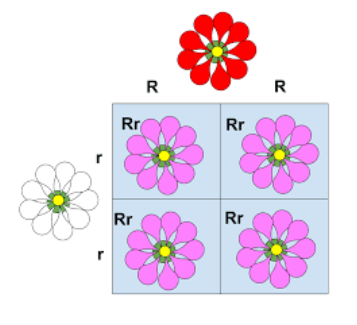
A Monohybrid cross occurred between the red and white-colored flowers of the Snapdragon plant. Initially, true-breeding red (RR) and white (rr) colored flowers of snapdragon were crossed. The F1 generation created a pink-colored flower with Rr pair of alleles.
At that time the F1 progeny was self-pollinated. This is caused in red (RR), pink (Rr), and white (rr) flowers in the ratio of 1:2:1.
Summon up that the genotype ratio of F2 generation in the monohybrid cross by Mendel also gave the same ratio of 1:2:1. But, the phenotype ratio has changed from 3:1 to 1:2:1. The motive for this variation is the incomplete dominance of the allele R over the allele r. This is directed to the blending of color in flowers.
Note: You can also give another example of incomplete dominance is chickens with blue feathers. When a black and a white chicken replicate and neither allele is fully dominant, then the outcome is a blue-feathered bird. The fruit color of eggplants is an added example of incomplete dominance. Blending deep purple eggplants with white eggplants leads to eggplants of a light violet color.
Complete answer:
Researchers did again Mendel’s pea experiment on other plants. Amazingly, they noted that the F1 Generation showed variation from the normal pattern of inheritance. The monohybrid cross resulted in F1 progeny which didn’t show any likeness to either of the parents, but an in-between progeny.
A Monohybrid cross occurred between the red and white-colored flowers of the Snapdragon plant. Initially, true-breeding red (RR) and white (rr) colored flowers of snapdragon were crossed. The F1 generation created a pink-colored flower with Rr pair of alleles.
At that time the F1 progeny was self-pollinated. This is caused in red (RR), pink (Rr), and white (rr) flowers in the ratio of 1:2:1.
Summon up that the genotype ratio of F2 generation in the monohybrid cross by Mendel also gave the same ratio of 1:2:1. But, the phenotype ratio has changed from 3:1 to 1:2:1. The motive for this variation is the incomplete dominance of the allele R over the allele r. This is directed to the blending of color in flowers.
Note: You can also give another example of incomplete dominance is chickens with blue feathers. When a black and a white chicken replicate and neither allele is fully dominant, then the outcome is a blue-feathered bird. The fruit color of eggplants is an added example of incomplete dominance. Blending deep purple eggplants with white eggplants leads to eggplants of a light violet color.
Recently Updated Pages
Master Class 12 Business Studies: Engaging Questions & Answers for Success

Master Class 12 Chemistry: Engaging Questions & Answers for Success
Master Class 12 Biology: Engaging Questions & Answers for Success
Class 12 Question and Answer - Your Ultimate Solutions Guide
Master Class 11 English: Engaging Questions & Answers for Success
Master Class 11 Social Science: Engaging Questions & Answers for Success
Trending doubts
Which are the Top 10 Largest Countries of the World?
Draw a labelled sketch of the human eye class 12 physics CBSE
Differentiate between homogeneous and heterogeneous class 12 chemistry CBSE
Differentiate between Pyramid of energy and pyramid class 12 biology CBSE
Why is the cell called the structural and functional class 12 biology CBSE
Draw the diagram of the pyramid of energy Explain In class 12 biology CBSE